






2021 Technical Paper #6
The Case for HAZOP – Minimizing Effort and Increasing Longevity
Author:
Stephanie Smith, PE, Senior Engineer, Risk Management Professionals
Abstract
Should the hazard and operability (HAZOP) methodology be considered the industry standard for hazard reviews (HRs) and process hazard analyses (PHAs)? The topic is currently the focus of a vigorous debate in the industrial refrigeration industry. While there are advocates for and against employing HAZOP methodology, this paper will argue that the benefits generally outweigh the costs.
Opponents suggest that HAZOP takes more time as compared with other methodologies such as the What-If and/or Checklist methodologies, ultimately resulting in higher project costs. And while this may be true, the additional effort yields a more exhaustive study that can identify specific vulnerabilities throughout a potentially complex system. Instead of evaluating the “big picture” and providing a general, sweeping view of vulnerabilities, HAZOP offers a detailed look at the process and evaluates specific failures throughout the system.
Overall, HAZOP produces a more comprehensive HR or PHA than other, more-common methodologies, and provides more information specific to the location of system vulnerabilities. This may also result in focused recommendations that are specific and straightforward to address. If the industry is aiming to enhance safety culture, shouldn’t it be embracing a deeper and more meaningful methodology to address vulnerabilities before failures occur?
Introduction
It is a question that plagues every facilitator before their PHA study preparation begins: What PHA methodology should I use? Walk into a room of facilitators and pose the question “What methodology is best?” and you’ll receive multiple answers and a myriad of justifications for why. Every facilitator, every end user, every operator has their opinion on which methodology is the best. In all honesty, they are all correct and all incorrect at the same time. The use and comfortability with a particular PHA methodology is facilitator-dependent, and the same facilitator may use different methodologies depending on the application and process type.
All PHA methodologies serve a purpose, all have pros and cons, and all may be the best for a particular study. The What-If and What-If/Checklist methodologies are more flexible due to their more general nature of evaluating hazards. The HAZOP methodology focuses discussion on specific causes and hazards associated with those causes. The FMEA methodology focuses on single failure modes to identify equipment failures that could lead to an incident. The fault tree analysis method focuses on an incident and derives causes based on the incident.
The key is to select the best methodology for the system, team, and overall purpose of the study. The purpose of this paper is to present the opinion that the HAZOP methodology is the best for most (perhaps not all) industrial refrigeration systems, given their complexity and the long-term benefits provided by HAZOP.
HAZOP 101
According to the Center for Chemical Process Safety (CCPS) “Guidelines for Hazard Evaluation Procedures,” the purpose of a HAZOP Study is to “carefully review a process or operation in a systematic fashion to determine whether deviations from the design or operational intent can lead to undesirable consequences.” HAZOP methodology requires a detailed source of design and operational information about the process. This information is typically found in the form of piping and instrumentation diagrams (P&IDs), process safety information, and the team’s input on operations and maintenance procedures implemented at the facility.
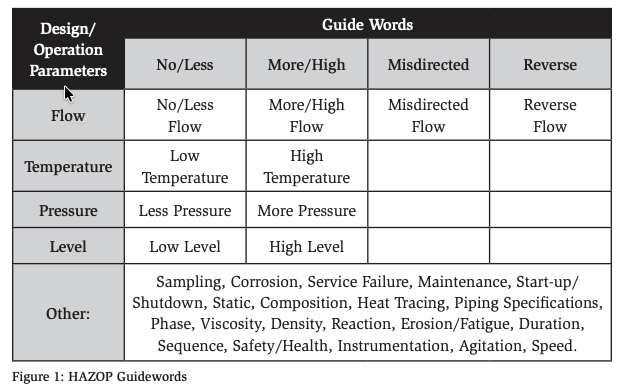
HAZOP is a qualitative, systematic approach to identify problems that are the result of deviations from the process’s design or operational intent and could lead to undesirable consequences. Guide words are used to lead the team through their discussions. Information is broken into nodes, which are compartmentalized portions of the system so the team can focus on smaller, discrete parts of the system. Figure 1 illustrates how guide words and design parameters are integrated.
The HAZOP team identifies and evaluates the causes (i.e., inadvertently closed valves, high/low level in bulk vessels, maintenance failures, etc.), that may have led to an ultimate consequence. Consequence severity is evaluated by a hypothetical withholding of safeguards (i.e., pressure relief valves, administrative controls, etc.) in order to account for worst possible outcomes.
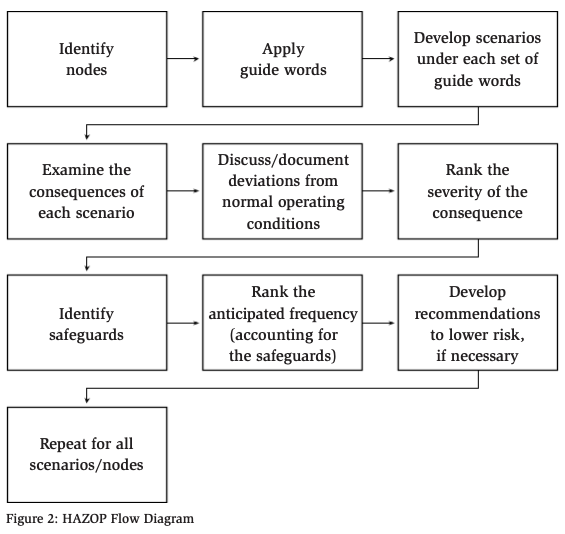
Following the severity evaluation, the team will identify the anticipated likelihood of the outcome WITH the safeguards accounted for. The balancing factor in this “risk ranking” evaluation is that a high severity scenario may have a low likelihood of occurring and will therefore have a lower risk ranking. The HAZOP methodology also allows the team to identify scenarios with unknown consequences that can be evaluated in a future, more focused, study. Figure 2 outlines the HAZOP methodology.
Challenges of HAZOP
The challenges of using the HAZOP methodology are multifold, but they can largely be mitigated by a facilitator who experienced and conversant in the methodology. Remember, the facilitator’s primary role is to guide the team to their own conclusions. Sometimes the ultimate conclusion is obvious, sometimes it can take hours or days of discussion and investigation to unearth.
Probably the most difficult role for a facilitator is to be a mediator for the methodology, ensuring that all team members understand the “rules” and appropriately address the agreed-upon hazard scenarios. Common struggles include trouble assessing severity without safeguards, identifying hazards outside the node/ scenario, disagreements between the design intent and actual function of the system, and recommendations lacking the specificity needed for the study. The facilitator’s role is to mitigate these difficulties and more.
Second, the facilitator must understand the risk ranking methodology. Does the team want to rank only hazardous conditions or are there financial or environmental hazards that should be addressed as well? Does the team only consider equipment losses or loss of production as well? HAZOP can accommodate different angles to the same hazardous scenario and is flexible enough to meet the needs of individual teams, but this benefit also introduces complexity for the team. Maintaining a consistent framework for analyzing hazards can be difficult when additional variables and consequences must be considered.
And finally, HAZOP studies can take more time than other methodologies, but that’s to be expected for a more critical examination that requires additional time for discussing results. It’s a fact; more time equals more resources and more money. A facility may need to remove operators from their normal duties for a longer period of time or arrange with contractors to be present for the study session(s). Involvement of plant management may be distracting to the day-to-day operations of the facility as well. There are ways to keep the session under control, but overwhelmingly this is the biggest complaint about HAZOP… it takes longer.
Benefits of HAZOP
Nevertheless, the benefits of HAZOP far outweigh the challenges, and they can be enhanced by a facilitator who can lead the HAZOP team to a full understanding of the study itself and the resulting conversations. In addition, the more complex, more quantitative methodology lends additional power to the study in that an ultimate consequence can be narrowed down to specific failures in the system without much additional effort. This information is FAR more valuable than that provided by the most-common methodologies used to evaluate ammonia processes.
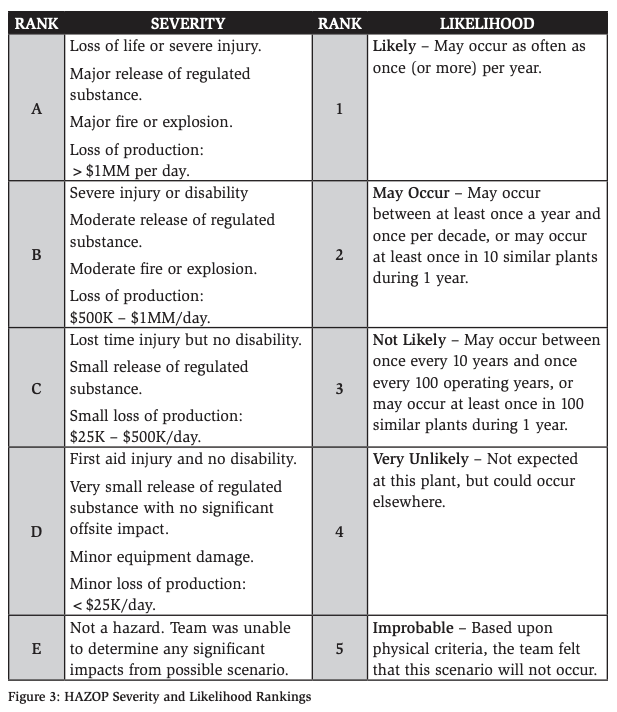
In addition, the risk ranking methodology is more flexible given the fact that financial and environmental impact may be considered by a study. For companies considering whether additional parts should be kept on-site or trying to prioritize what equipment may present a larger production loss, financial impacts can be incredibly important, especially in crucial industries. The same concept applies for environmental impacts, especially for facilities that may be acutely concerned about their impact on the immediate environment. The additional insight can provide information for prioritizing efforts, acquiring funding for capital projects, or confirming that everything in the facility is operating according to design. Figure 3 illustrates an example of risk ranking relationships between severity and likelihood.
In addition, because of the systematic method used for the study, HAZOP minimizes effort, even if time spent may be increased. HAZOP is easily reproducible and easily interpreted at a later date, in contrast to more general methods. When done correctly, HAZOPs can easily be revalidated and reviewed, even well after the study, because the additional detail restricts the generality of the documentation. A well-done initial HAZOP can be revalidated in one-half to three-quarters of the time at a later date, even with a completely different team.
This longevity of the HAZOP methodology is a key decision-making factor. As mentioned, a well-done HAZOP study is much more easily revalidated and reviewed. The systematic nature and documentation of a HAZOP is methodical and uniform across facilities, systems, and applications. Studies utilizing HAZOP methodology only truly change when either 1) the previous team did not interpret the scenario correctly, or 2) there have been changes to the covered process that change the hazards discussed.
The HAZOP methodology is systematic when it comes to discussing hazards, as it requires the team to identify each piece of equipment and each valve in system, which makes the evaluation specific and thorough. Other methodologies generalize the brainstorming of hazards, which can lead the team to misjudge, or even overlook hazards. For example, the facilitator may ask “What happens if Valve X is closed?”, which might lead the team to a discussion of a hazard that may have gone unnoticed by the facilitator or that hadn’t yet been considered by the team. On many occasions, a general question about a specific cause may lead to the discovery that a seemingly small failure (e.g., a drain valve being left open) could potentially lead to significant consequences. It is quite possible to overlook small failures with large consequences in a more general methodology.
In addition, HAZOP allows the team to focus on specific failure modes that can influence whether the team thinks existing safeguards are adequate, even though HAZOP is a qualitative analysis. This is referred to as “common mode” failure. For example, other analyses may examine a high level of refrigerant in a tank with the team noting that there are high level alarms to protect against the consequence. But a HAZOP study may make a more specific identification such as “high level in the tank, possibly due to the level indication malfunctioning/misreading,” leading the team to recognize the high level alarm may then not be credible. This additional detail changes the discussion and addresses a hazard with malfunctioning safeguards.
HAZOP also provides specificity in taking safeguard credits. Specific safeguards may only apply to individual scenarios may not provide safeguard credit in situations where it may not be valid. The benefit ultimately lies in HAZOP’s specificity in identifying the cause (e.g., strainer on the suction of a pump is plugged in a no/low flow scenario vs. loss of flow to pump with unknown/vague cause). The specific safeguard to prevent the scenario from occurring may not be credited correctly with the actual cause of the unknown scenario.
Another benefit is that HAZOP allows the team to verify that the setpoint of a safeguard (i.e., alarm setpoint, PRV setpoint, etc.) is adequate for the scenario and design of the system. At this point, the team can evaluate if that setpoint is appropriate to prevent or mitigate the scenario’s consequences and/or re-evaluate the need to reconfigure the setpoint. The methodology also requires that the team accommodates the necessary time for onsite personnel to respond to the safeguard. In more general methodologies, safeguards are not necessarily evaluated to this level of detail.
Ensuring an Effective and Robust HAZOP
The HAZOP is only as good as the team conducting the study and the documentation following the study. This section is intended to provide some guidance on where to focus resources to best ensure an effective and robust HAZOP study.
A good team is key. The facilitator should be knowledgeable in the methodology and able to guide the team, keeping discussions within scope. Operators and maintenance personnel should have intimate knowledge on the operation of the system and parameters. No one on the team should be fearful of identifying ultimate consequences, which is the main intent of the study. The entire team should participate with open minds and a clear view of addressing any and all safety concerns and vulnerabilities within the system.
The team should have a clear understanding of equipment specifications and operating limits. This ties into having well-documented process safety information (PSI) or safety information (SI), where documentation is consistent, accurate, and comprehensive. P&IDs should be up-to-date or have minimal redlines for recent reviews and/or updates. Inclusion of tag numbers and precise equipment names in the report will add clarity to the study for future use.
Safeguards should be well-defined, and their activation limits known. Safeguards should also be listed in the order of activation in order to provide a clear line of action. For instance, preventative measures such as training or operating procedures should be listed prior to alarm activations. A HAZOP should include only the minimum number of safeguards required to mitigate a given risk. Superfluous safeguards will not lower the risk ranking and could possibly add to poor documentation and/or understanding of system operation.
Finally, teams should phrase recommendations in a way that’s conducive to effective follow-up. “Evaluate the need to…” and “Consider…” are useful initiating phrases for recommendations that confirm not only how the vulnerability can be addressed, but also allow for flexibility in the resolution. In addition, recommendations should include a concern statement identifying why the recommendation was made. For example, “Evaluate the need to install an ammonia sensor near the King Valve. The concern is that potential leaks would not be effectively detected by the nearest ammonia sensor.”
Conclusion
While HAZOP will likely continue to raise arguments, it is important to note the stark differences in the specificity of the methodology compared to more general methodologies. Despite its challenges, HAZOP offers better information, a better study, and more actionable recommendations. The methodology is systematic and easy to get into a rhythm once understood. Documentation is tabulated, straightforward, and can be followed relatively easily during revalidation.
HAZOP has been used by PHA facilitators for decades and rightfully so. The benefits of a more detailed, systematic, team-oriented study far outweigh the generalities of other study methods. Perhaps it is time, as an industry, to embrace HAZOP as the new standard of PHA methodology to address the ongoing needs for a good safety culture and to better the industry’s understanding of vulnerabilities within the systems.
References
CCPS (Center for Chemical Process Safety). 2008. Guidelines for Hazard Evaluation Procedures 3rd ed. Hoboken, New Jersey: CCPS/John Wiley & Sons, Inc.
“Making the Most of Your PHA” Poster; presented at the 2020 GCPS Annual Conference; Authored by Morgan McVey and Steve Maher, Risk Management Professionals.
Acknowledgements
Thank you to the facilities I have worked with. This paper is inspired by what I have encountered in the field with real-world applications. I greatly appreciate the real-world experiences and challenges I have faced working through these studies.
A big shout out to Craig Sticklemaier and Jasmin Dhaliwal with Risk Management Professionals for their help in formulating the benefits to HAZOP methodology. Their experience in other industries provided a new perspective and insight.
Huge thanks to Steve Maher of Risk Management Professionals for lending his multi-decade expertise on HAZOP for this paper. I appreciate his wisdom in the methodology, its challenges, and its triumphs.