





2022 Technical Paper #8
Absorption Applications for Residential-Light Commercial Space Conditioning and Water Heating
Author:
Michael Garrabrant, President & CEO, Stone Mountain Technologies, Inc.
Abstract
Absorption cycles using the ammonia-water refrigerant pair have a long track record of commercial applications ranging from industrial-size cooling using waste heat as the energy source, to gas-fired residential air-conditioners and small refrigerators for recreational vehicles using propane fuel. However, the heating side of the cycle (as a heat pump) has not seen widespread use. With a Coefficient of Performance (COP) ranging from 1.4 to 2.0 for space and water heating, ammonia-water absorption heat pumps have potential to provide significant CO2 emission reductions for residential and light commercial applications, which are historically very difficult to decarbonize. In this paper, methods of applying gas-fired absorption heat pumps to heating applications normally served by furnaces, boilers or commercial water heaters are reviewed, including the potential energy and CO2 emissions reductions compared to both conventional and electric vapor compression appliances.
Introduction
Building space and water heating in North America is predominantly supplied by furnaces, boilers and water heaters using fossil fuels such as natural gas, propane, fuel-oil, which have reached their thermodynamic limit of less than 100% efficiency. Increased pressure to decarbonize the global economy has increased interest in using electric vapor compression heat pumps for space and water heating, which can use low-carbon electric power when the grid is decarbonized in the future. However, the very high and concentrated loads required present technical challenges for electric heat pumps, as well as economic challenges for the end-user.
NH3-H2O absorption heat pump technologies, coverage of which were recently moved from ASHRAE 15 to IIAR-2, offer very high heating efficiencies, with COPs ranging from 130% to 180%. The cycle also offers a high temperature lift capability and very good cold-weather performance (capable of operating down to minus 40°C/°F while retaining close to 70% of rated heating capacity and efficiency), making it a good candidate to significantly reduce energy consumption and carbon emissions for space and water heating applications. In contrast, the space heating efficiency of electric vapor compression heat pumps decreases to about 60% of rated at 25°F (minus 4°C) and to 40% at minus 10°F (minus 23°C) for newer variable speed “cold-climate heat pumps.” In this paper, the NH3-H2O absorption cycle is reviewed, along with several good applications for the technology and its potential impact on efforts to decarbonize space and water heating, especially in cool-cold climate regions.
Building Space and Water Heating Market in North America
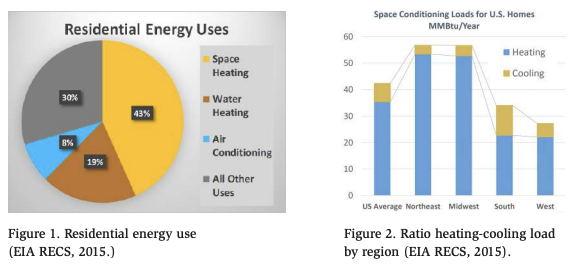
Space and water heating represents a very large expenditure of energy, and as a result is a significant source of carbon dioxide (CO2) emissions. For the U.S. as a whole, space and water heating represents 62% of the total energy consumed in the residential building sector (Figure 1), rising to greater than 80% in cool-cold climates (including all of Canada) due to the higher heating load and lower cooling load (Figure 2). Approximately 4 quadrillion Btu of natural gas and propane are used each year for residential space and water heating (U.S. EIA RECS, 2015), resulting in approximately 273 million metric tons of CO2e emissions.
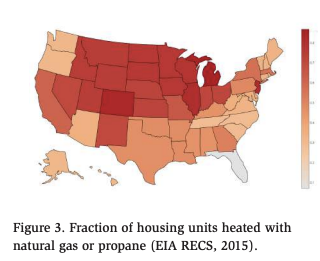
Overall, 58% of residential buildings use natural gas, propane or fuel oil for space heating, rising to 77.6% in cool-cold climates (Figure 3). Water heating is a little more evenly split, with 53.6% of homes using fossil fuels vs electricity (U.S. EIA RECS, 2015). While energy for water heating is spread out over the entire year, energy use for space heating is heavily concentrated into the three month winter period, resulting in a very high power requirement that presents major challenges to electrify.
The efficiency of installed fossil-fuel space heating appliances ranges from 78% to 97% AFUE (Annual Fuel Utilization Efficiency), with less than half being high efficiency condensing (90% or higher) (U.S. DOE SNOPR, 2016). More than 90% of residential water heaters are storage-type, mostly low efficiency (Uniform Energy Factor of 0.62 or less), with only 7% qualifying for EnergyStar (EnergyStar, 2020).
Energy use in commercial buildings such as restaurants, hotels, laundry, dormitory, office, and multi-family varies widely by application and climate region. Within the commercial category, water heating is one of the highest energy uses in the food service, hospitality, dormitory, and laundry sectors. A typical full-service restaurant uses 2,000–6,000 gallons of hot water per day, while a large hotel may use tens of thousands of gallons per day. This represents a very large and often concentrated use of energy that is most often provided by natural gas or propane water heaters and boilers.
As for residential, the efficiency of commercial fossil-fuel water heating appliances varies widely, ranging from low-efficiency non-condensing (82% efficiency) to high-efficiency condensing (90%–98%). Due to the consistent year-round load, condensing water heaters are more often utilized for commercial applications, and comprise the majority of new installations.
The elevated power requirements of cold-weather space heating and commercial water heating present technical challenges for electric heating appliances (including heat pumps), and the current electric power grid was not designed or built to handle multiple quadrillion Btu loads that are concentrated in short periods of time. Additionally, economics favors natural gas appliances, given its very low cost of $12 per MMBtu ($0.041 per kWh) compared to $0.12 per kWh for electricity (U.S. national averages).
Given that conventional fossil-fuel heating appliances are limited to efficiencies less than 100%, decarbonization of building space and water heating loads is very difficult to achieve without a massive investment in low-carbon electric generation and distribution and negative economic impacts on the end-user.
Absorption Heat Pump Technology
Absorption heat pumps (AHP), which use thermal energy as the primary driver instead of electricity used by more common vapor compression heat pumps, have a century long track record of commercial use, primarily for residential and commercial-industrial cooling. AHPs can be driven by any suitable thermal energy source, including the combustion of fossil or renewable fuels (such as renewable gas or hydrogen), thermal solar, and waste heat streams.
AHPs utilize two working fluids, a refrigerant and an absorbent. The two most popular thermodynamic cycles are lithium bromide-water (LiBr-H2O, where water is the refrigerant) and ammonia-water (NH3-H2O, where ammonia is the refrigerant). LiBr-H2O appliances are typically very large (50 RT of cooling or larger), used for commercial comfort cooling applications, and often driven by waste heat streams. NH3-H2O heat pumps are normally smaller, commonly used for residential and light commercial cooling or refrigeration, and most often driven by the heat of combustion. Because water is the refrigerant in LiBr-H2O cycles, they cannot be used for heating at ambient temperatures near or below freezing, or for refrigeration.
Absorption cycles do not use a mechanical compressor, substituting several specialized heat exchangers and a small solution pump that provides the compression process using thermal energy instead of mechanical, often called “thermal compression.” The specialized heat exchangers containing the working fluids are completely sealed, and the working fluids and combustion products always remain outside the building. Owing to the very few moving parts, absorption cycles are known for very long life when properly designed, manufactured, and installed. By actively controlling the energy input into the cycle, AHPs are capable of modulating to load-follow, down to about a 4:1 ratio.
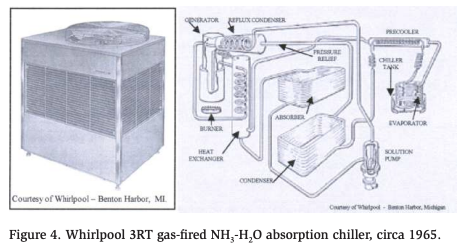
NH3-H2O absorption natural gas-fired chillers were very popular for residential comfort cooling in the mid-20th century, with 200,000–300,000 chillers sold annually. Whirlpool, Bryant, and Servel were among the many manufacturers of these 3–5 RT “gas air-conditioners” (Figure 4). The efficiency (or COP, Coefficient of Performance) of these gas-fired NH3-H2O chillers were quite low, ranging from 40% to 48%. More advanced cycles are capable of achieving a 70% cooling efficiency. Eventually, electric-driven vapor compression air-conditioning appliances overtook them based on first cost and better cooling efficiencies and these gas-fired absorption chillers have been limited to a niche market for the last 40 years.
However, when used for heating, gas-fired NH3-H2O AHPs offer very high efficiencies, with COPs ranging from 130% to 180%. In this case, COP is defined as the useful heating energy output divided by the total gas energy input. The cycle also offers higher temperature lift capability and very good cold-weather performance (capable of operating down to -40°C/°F) compared to the vapor compression cycle, making it a good candidate to significantly reduce energy consumption and carbon emissions for space and water heating applications.
Greater high-heating efficiencies are obtained by pulling energy from outdoor air (or geothermal loop) into the evaporator heat exchanger (where the refrigerant is evaporated at a lower temperature than the outdoor air), which is added to the energy provided by the heat of combustion. These two energy streams are used to heat a hydronic (water + glycol) loop that transfers the heat to the indoor loads (airhanders, indirect storage tanks, baseboard radiators, in-floor heating, etc.). Properly configured and controlled, simultaneous heating and cooling can be obtained for applications such heating domestic water in a restaurant while cooling the kitchen at the same time.
The single-effect NH3-H2O absorption heat pump cycle is shown in Figure 5. Thermal energy from the heat of combustion is used to boil ammonia vapor out of an NH3- H2O solution at the high-side pressure in the desorber heat exchanger. The hot, high pressure ammonia vapor is purified to 99.5% in the rectifier, where the small amount of water vapor existing is stripped away. The ammonia vapor is then cooled and condensed to a liquid in the condenser, with the extracted heat captured by a hydronic loop and used for the space or water heating application. Liquid ammonia exiting the condenser is expanded to the low-pressure and fed into the (normally direct expansion) evaporator, where it is boiled using heat from the low-temperature source (outdoor air or geothermal loop).
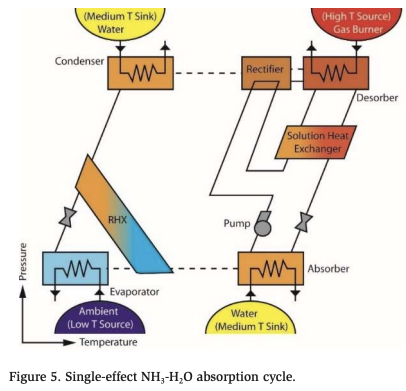
Hot high-pressure weak solution (solution that is low in ammonia concentration, approximately 20%) exits the desorber, expanded to the low-side pressure, and recombined with the ammonia vapor in the absorber where the ammonia vapor is absorbed back into solution. This is an exothermic process, and the heat is captured by the hydronic loop for the heating application. The cooled strong solution (solution that is high in ammonia concentration, approximately 50%) exiting the absorber is pumped back to the high-side pressure and used to preferentially condense the small amount of water vapor out of the ammonia vapor stream in the rectifier. The strong solution is then pre-heated in the solution heat exchanger (SHX) before entering the desorber and starting the process over again. A recuperative heat exchanger in the ammonia loop, called the refrigerant heat exchanger (RHX) sub-cools the liquid ammonia upstream of the expansion valve prior to the evaporator to reduce flashing, increasing the overall cycle efficiency.
The energy balance and (heating) COP equations for the single-effect cycle are:
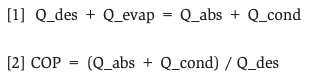
where Q_des and Q_evap represent the energy inputs and Q_abs and Q_cond represent energy outputs. Heating COP is evaluated based on the total energy output divided by the energy input to the desorber. See Keinath et al. for a more in depth review of the single-effect NH3-H2O cycle.
From an energy balance point of view, the useful energy extracted from the condenser (Q_cond) is approximately equal to the energy entering the evaporator (Q_ evap) from the low-temperature energy source. The useful energy extracted from the absorber (Q_abs) is approximately equal to the energy input to the desorber (Q_des), which is approximately two times higher than the energy input from the evaporator. Therefore, even if the energy input into the evaporator goes to zero, the AHP will still provide heating at two-thirds of the rated capacity, with a COP of about 95% (equivalent to a condensing furnace or water heater). Since there is no mechanical compressor, liquid refrigerant leaving the evaporator does not create a reliability problem, and the AHP can continue to operate with the evaporator coil completely frosted or the evaporator fan inoperable.
Similar to a vapor compression cycle, the high-side pressure is determined by the ammonia temperature exiting the condenser. Therefore, the high-side pressure is primarily a function of the hydronic temperature returning to the heat pump. Note that for NH3-H2O cycles, a small amount of water vapor is present (less than 1% at normal design conditions) so ammonia-water properties must be used for evaluation instead of pure ammonia. The water content in the ammonia refrigerant will increase with increasing hydronic return temperature (high-side pressure) and decreasing ambient temperature (low-side pressure). At 100°F (38°C) hydronic return temperature, the high-side pressure is typically 245-275 psia (1689-1896 kPa), increasing to 350-380 psia (2,413-2,620 kPa) at a 130°F (54.4°C) hydronic return temperature depending on the condenser design and design point (heat pump designed for 100°F return will have a tighter pinch at higher return temperatures due to a lower condenser load). The low-side pressure must be low enough so that the ammonia boiling temperature is below the temperature of the low-temperature energy source. At 47°F (8.3°C) ambient air, the low-side pressure is typically 60-70 psia (414-483 kPa), and approaching zero psia as the ambient falls below minus 20°F (-29°C).
The AHP does use a small amount of electrical power for the solution pump, combustion blower, and evaporator fan (if equipped). Typically, the electric power requirement is 2%–4% of the heating capacity and can be provided by a standard 115V single-phase circuit. The solution pump for an NH3-H2O AHP is normally a positive pressure design (diaphragm or piston), as the application requires low-flow and high-head, and the pump must be capable of pumping a solution-vapor mixture.
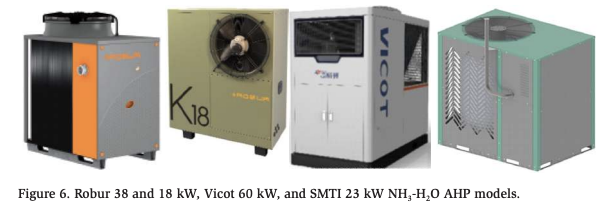
NH3-H2O AHPs configured for heating are available in the market today (Figure 6). Robur (Italy) offers a 38 kW model in North America, and an 18 kW model in Europe. Vicot (China) has recently introduced a 60 kW model in Canada, and SMTI (U.S.) is preparing a 23 kW model for release in late 2022. Ariston (Italy) is planning to introduce a 10 kW model for Europe in 2023.
In order to be sold in North America, these appliances must be design certified to ANSI Z21.40.1, which is currently undergoing revision to reference IIAR-2 instead of ASHRAE 15. ANSI Z21.40.4 can be used to certify capacity, efficiency, and an AFUE equivalent to furnaces and boilers for residential heating applications. For commercial water heating, ASHRAE 118.1 is used to establish a thermal efficiency
Absorption Heat Pump Applications
NH3-H2O absorption heat pumps can be used in almost any application where a furnace, boiler or water heater is currently used. Installed outside the building and connected to the indoor load via a hydronic loop, they can be simply thought of as a “boiler that is installed outdoors.”
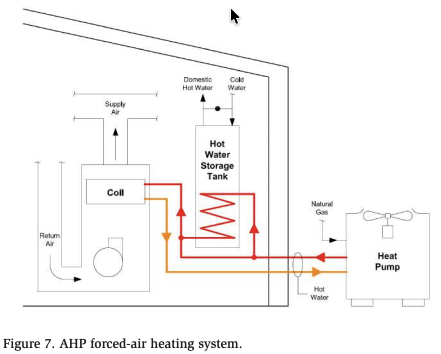
Central forced-air heating is the most common system in North America, used in 70% of residential buildings (U.S. EIA, 2015). For this application, a hydronic airhandler (AHU) is substituted for the conventional furnace and, if desired, a “combi” system is created with the use of an indirect water storage tank (IST) substituting for the conventional water heater (Figure 7). The system delivers warm air through the existing ductwork and domestic hot water through the existing water lines, so the system operates the same from the homeowner’s perspective. Various control schemes can be used to switch the heat pump back and forth between the AHU and IST in order to optimize comfort. Field demonstrations of this arrangement show 30%-50% energy savings compared to conventional furnace-water heating appliances (Glanville, 2019).
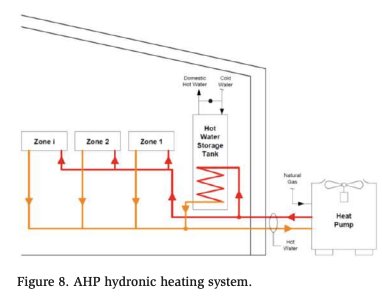
For homes using hydronic heating, the existing heat emitters (baseboard radiators, in-floor heating, small-zoned AHUs) are substituted for the central AHU (Figure 8). One of the “zones” can be an IST for domestic hot water. For systems that utilize more than three zones where the AHP may not be able to modulate its heating capacity low enough, a buffer tank may be required in order to keep the heat pump from short-cycling. AHPs can provide up to 150°F (65.5°C) hydronic supply temperatures, so older homes that require higher hydronic temperatures may need to increase the size of the indoor heat emitters or reduce the heating load of the home with additional insulation, lower air-infiltration, and/or improved windows.
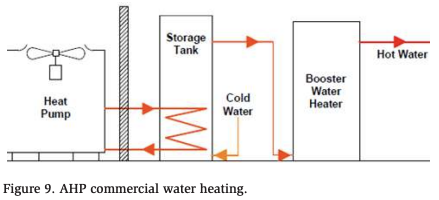
For commercial water heating applications such as food service or hospitality, the preferred arrangement is base load – peak load, where the AHP is sized to provide 40%–80% of the load and a conventional storage tank or tankless water heater is used to handle the peak loads or increase the delivery temperature (Figure 9). This type of system maximizes the capital investment for the AHP by allowing it to operate at close to full capacity for the maximum number of hours, while also providing redundancy in mission-critical applications. Preferably, the cold domestic water is piped to a large (typically 100 gallon, 379 liter) IST that is hydronically connected to the AHP. Warm to hot water exits the IST and flows into the conventional water heater, which only operates if the temperature exiting the IST is not hot enough. With a water-to-water AHP, the evaporator capacity can be connected to the indoor space to provide simultaneous water heating and comfort cooling, with a resulting system COP of 2.0 or higher. Field demonstrations of this arrangement have shown 52% energy savings compared to conventional natural gas water heating appliances, and a 14% reduction in electric power for air-conditioning (Gas Technology Institute, 2021).
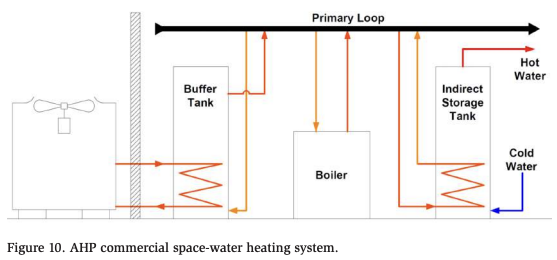
For commercial applications that currently use a boiler(s) to provide both space and water heating, such as multi-family or large office building, a similar base-peak load arrangement is normally preferred. While the piping and control arrangements for these types of buildings vary widely, variations of a primary-secondary hydronic system is normally used. Figure 10 shows a simplified AHP integration, where the AHP becomes the first heating supply for the primary loop and a conventional boiler is used to handle peak loads or increase the primary loop temperature on very cold days. For domestic hot water, heat from the primary loop is pulled into a large IST as needed. Field demonstrations of this arrangement have shown significant energy savings compared to conventional natural gas heating appliances (TAF, 2018).
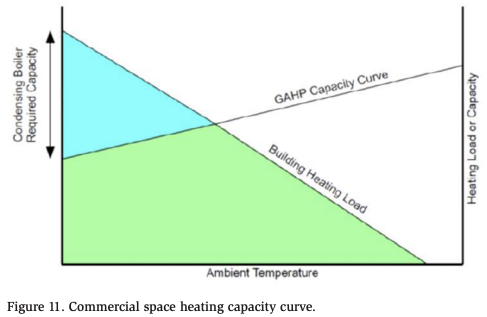
To facilitate sizing the AHP, the heating load of the building and capacity of the heat pump can be plotted as a function of ambient temperature (Figure 11). The ambient temperature at which the load and capacity are equal is known as the cross-over point, or the ambient temperature below which the boiler will need to begin helping. In Figure 11, the AHP will provide the heating load shown in green, while the boiler will need to provide the load shown in blue. Larger or smaller heat pump capacities will result in different heating load splits, as well as different initial capital costs, allowing the building owner and engineer to make the best decision regarding the installed AHP capacity.
Other good applications for AHPs include pool heating (residential and commercial) and pre-heating of industrial process streams. On a smaller scale, dedicated residential water heating appliances have been demonstrated (Gas Technology Institute, 2020), where a small AHP (3 kW heating capacity) is arranged on top of a 60–80 gallon (227–303 liter) IST to provide 23%–67% reduction in energy use.
Role in Decarbonizing World
As the world aims to decarbonize the global economy, electrification of end-uses currently dependent on fossil fuels, using low-carbon energy sources such as wind or solar combined with storage, is a possible solution receiving the most attention from both the private and public sectors. Electrification of transportation using batterypowered vehicles is one example of this transition that is well underway. However, some energy uses are technically difficult or uneconomical to electrify, specifically those which require a lot of energy over a short period of time or high temperatures, such as industrial processes. Space and water heating for buildings is another application that presents challenges for electrification, especially in cool-cold climates where the efficiency and capacity of vapor compression heat pumps are reduced, and solar availability is limited.
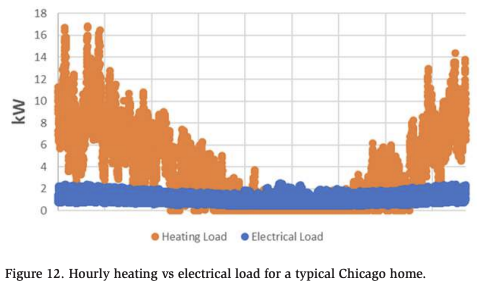
Part of the challenge of electrification of heating is demonstrated in Figure 12, which shows the hourly heating load and total electrical load (all uses) for a typical singlefamily home in the Chicago, Illinois, region using DOE EnergyPlus software. During the coldest part of the winter, the heating load is 5.5 times higher than the peak electrical load during the summer. Assuming an advanced cold-climate electric heat pump has a COP of 2.0 during the coldest nights, the peak electrical load for the home will increase by a factor of 2.75, a load the current electric grid would not be able to handle. Additionally, supplying this extra electric load concentrated during the winter would require long term storage (months) of low-carbon electric generated during the summer. In the near term, 64% of the electricity in the Illinois-area grid region is provided by coal, or natural gas power plants (U.S. EPA eGrid, 2019), meaning the carbon emissions would simply be moved from the furnace in the home to the power plant located a few miles away.
From a nameplate efficiency perspective, AHPs with a COP of 140% reduce the use of fossil fuels for heating by 30%-40% compared to conventional furnaces, boilers and water heaters with efficiencies of 78%–98%. A typical home that requires 120 MMBtu (35,169 kWh) of heating per year will emit approximately 20,000 lb CO2e (9,072 kg) annually using a 90% efficient natural gas furnace (assuming 14.9 lb CO2e per therm (6.76 kg) of natural gas). In comparison, the same home using an AHP will emit approximately 13,750 lb CO2e (6,237 kg) annually, a 31% reduction that occurs without impacting the electric grid.
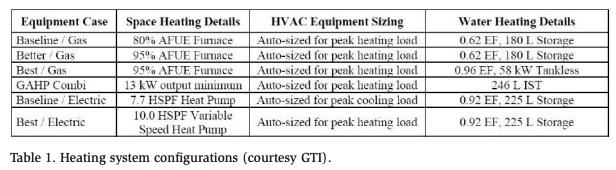
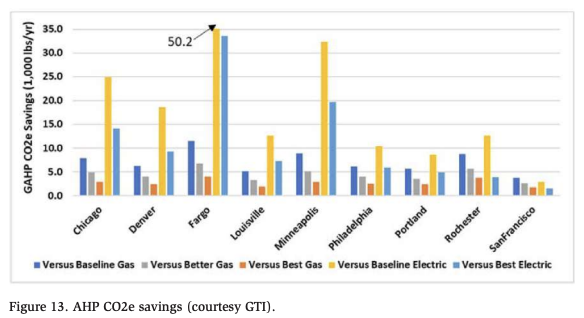
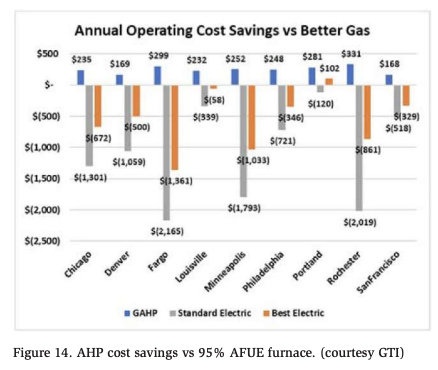
In order to accurately access the economic and emissions benefits of AHPs compared to conventional gas and electric heating systems, annual modeling on an hourly basis is required that calculates the building space-water heating loads and appliance efficiency for each hour based on the ambient temperature. The Gas Technology Institute (GTI) recently completed this type of analysis using EnergyPlusTM software for single family homes located in nine cities representing climate zones 3 through 7 (Fridlyand, 2021). The modeled home was assumed built to IECC 2006 standards and GTI applied various space and water heating systems, including conventional gas, an AHP, and 7.7 and 10.0 HSPF electric heat pumps (Table 1).
The AHP system resulted in the lowest annual CO2e emissions compared to all other heating systems (Figure 13), with the highest savings found in cold-climate regions. Notably, the 7.7 HSPF electric heat pump system resulted in higher CO2e emissions compared to a condensing furnace in all regions, and the 10.0 HSPF electric heat pump was higher for all regions except for San Francisco and Rochester, NY.
GTI’s modeling also showed that AHPs provided the lowest annual operating cost compared to all other heating systems (Figure 14), and that electric heat pumps increased operating costs for all regions except for Portland, OR when using a 10.0 HSPF heat pump.
A similar study was completed (Manjarres, 2020) assuming a 1,000 sq. ft. townhome in Rockford, Illinois, and found similar results. The AHP heating system resulted in the lowest operating cost (26% lower than a 96% AFUE gas furnace and 53% lower than an electric heat pump), and lowest CO2e emissions (27% lower than a 96% gas furnace and 45% lower than an electric heat pump). Notably, the electric heat pump system resulted in the highest CO2e emission of any system, including an 80% noncondensing gas furnace.
In the future, the CO2e emissions from AHP heating systems will reduce towards net-zero as the carbon content of the natural gas grid is reduced over the next several decades. In order to meet 2050 net-zero goals, gas utilities are aggressively developing renewable gas production capability (NW Natural, 2021), as well as preparing to deliver hydrogen blends, produced using excess renewable electricity during the (high solar availability) summer months. Very high efficiency gas-fired appliances like AHPs have a large role to play in this scenario, reducing the natural gas demand so that a lower volume of (more expensive) renewable gases is required to meet net-zero goals.
Conclusion
The migration of coverage for an NH3-H2O absorption heat pump from ASHRAE-15 to IIAR-2 comes at a critical time in the history of this long-used but under-utilized technology. Primarily used for space cooling and refrigeration for decades, the very high heating efficiency of the AHP cycle will be a critical tool for helping to reduce the CO2 emissions for residential and commercial building space and water heating, applications that are very challenging to electrify. Widespread adoption of NH3-H2O heat pumps will result in a new generation of contractors and engineers being trained to install, service and apply. Given that NH3-H2O systems are hydronically connected to the load (indirect), installed outdoors, and have a low cooling efficiency, it opens the door for future AHP-vapor compression hybrid systems that utilize ammonia as the refrigerant for the vapor compression cycle.
References
Albers, A. “Practical Experience of Field Testing Residential and Light Commercial Gas Absorption Heat Pumps,” ASHRAE Winter Conference, Las Vegas, NV, 2017.
EnergyStar Unit Shipment and Market Penetration Report, 2020.https://www. energystar.gov/sites/default/files/asset/document/2020%20USD%20Summary%20 Report_Lighting%20%20EVSE%20Update.
Gas Technology Institute, “Commercial Gas Heat Pumps For Hot Water And A/C Demonstration In Restaurant Applications,” (2021). Technical Summary Of California Energy Commission PIR-16-001. https://www.gti.energy/wp-content/ uploads/2021/03/WhitePaper-Commercial-Gas-Heat-Pumps-for-Hot-Water-AC-DemoRestaurant-Applications_06Jan2021.pdf
Gas Technology Institute, “Demonstration and Assessment of Residential Gas Heat Pump Water Heaters in the Los Angeles Basin,” (2020). Fact Sheet of California Energy Commission PIR-16-003. https://www.gti.energy/wp-content/uploads/2020/07/ PIR-16-003-CEC-Res-GHPWH-Final-Project-Fact-Sheet-2020-06-11-1.pdf
Glanville, P, Fridlyand, A., Keinath, C., and Garrabrant, M. (2019). “Demonstration and Simulation of Gas Heat Pump-Driven Residential Combination Space and Water Heating System Performance,” ASHRAE Transactions; Atlanta Vol. 125, pp. 264-272.
Fridlyand, Alex; Glanville, Paul; and Garrabrant, Michael, “Pathways to Decarbonization of Residential Heating” (2021). International High Performance Buildings Conference. Paper 354. https://docs.lib.purdue.edu/ihpbc/354
Herold, K.E., Radermacher, R., Klein, S.A., (1996). Absorption Chillers and Heat Pumps. CRC Press LLC, Boca Raton, Florida.
Keinath, Christopher, Garimella, Srinivas, and Garrabrant, Michael, “Modeling of an ammonia-water absorption heat pump water heater for residential applications” (2017). International Journal of Refrigeration 83, pp 39-50.
Manjarres, T. and Dusault, A. (2020) “Optimizing Energy Efficiency in Residential Heating Applications – What are the Options? What are the Impacts?” 2020 ACEEE Summer Study on Energy Efficiency in Buildings
NW Natural, (2021). VISION 2050: Destination Zero. https://www.nwnatural.com/ about-us/the-company/destination-zero
Pratt, J. et al., (2020). Robur Heat Pump Field Trial, Report #E20-309 prepared for NEEA.
Toronto Atmospheric Fund (TAF), (2018). “Gas Absorption Heat Pumps: Technology Assessment and Field Test Findings,” Prepared for Enbridge Gas.
U.S. Dept. of Energy (DOE), (2016). Supplemental Notice of Proposed Rulemaking (SNOPR) 2016. Technical Support Document: Residential Furnaces, Prepared for the DOE by Navigant Consulting, Inc. and Lawrence Berkeley National Laboratory.
U.S. Energy Information Administration (EIA), (2009-2015). Residential Energy Consumption Survey (RECS).www.eia.gov/consumption/residential/
U.S. EPA, Emissions & Generation Resource Integrated Database (eGRID), 2019.
Acknowledgements
Special recognition for Alex Fridlyand and Paul Glanville of the Gas Technology Institute for their contribution with regard to annual modeling materials for absorption heat pump residential space-water heating.