



2021 Tech Paper: RAGAGEP: Historical Variants and the Importance of IIAR Standards
Author:
Uriah Donaldson, Process Safety Consultant, Resource Compliance
Introduction
Recognized and generally accepted good engineering practices (RAGAGEP) are written documents intended for use in the design, installation, operation, and maintenance of process equipment. There has been a movement in the ammonia refrigeration industry towards standardization, yet there are historical variants that have led to confusion as to exactly what constitutes RAGAGEP.
This paper will discuss the importance of adhering to the International Institute of Ammonia Refrigeration (IIAR) suite of standards by exploring variants in historical RAGAGEPs related to ammonia refrigeration. The goal is to provide individuals who are responsible for PSM/RMP programs with an understanding of the ammonia industry’s historic RAGAGEP requirements in order to aid them in documenting that their systems have been designed in accordance with recognized and generally accepted good engineering practices at the time of construction.
A historical analysis of RAGAGEP variants related to emergency shutdown controls, diffusion systems, ammonia detection, machinery room ventilation, and labeling will be performed. The study will utilize citations from the Uniform Mechanical Code (UMC), International Mechanical Code (IMC), Uniform Fire Code/National Fire Protection Association (UFC/NFPA 1), International Fire Code (IFC), American Society of Heating, Refrigerating and Air-Conditioning Engineers Standard 15 (ASHRAE 15) and relevant bulletins and standards published by the International Institute of Ammonia Refrigeration (IIAR). In general, the study will highlight variants beginning with the initial publication of IIAR 2 in 1974 through the present. Concluding thoughts will emphasize the importance of ANSI/IIAR 9-2020.
Defining RAGAGEP and Historical Perspectives
The origin of the acronym RAGAGEP can be traced to the Process Safety Management (PSM) regulation, published and enforced by the Occupational Safety and Health Administration (OSHA). Several of the PSM program elements require facilities to document that their refrigeration systems have been designed in accordance with recognized and generally accepted good engineering practices. 1
Understanding that RAGAGEP is a regulatory requirement is important. As far as the law is concerned, there are engineering standards that are accepted, normal, and good, and by law these standards are legally enforceable. A facility is not allowed to build a new system, or part thereof, if the design is not in accordance with these accepted standards. But the question reasonably presents itself, “What qualifies as RAGAGEP?”
In the industrial refrigeration industry, like any other industry, there are organizations that work to write documents that seek to standardize best practices and minimum criteria for design; installation; startup; and inspection, testing, and maintenance for ammonia refrigeration systems. These organizations fall into two general categories: code writing organizations and standard writing organizations.
Code Writing Organizations
In the United States, codes are documents that are adopted by local jurisdictions, generally at the state level, and are therefore enforceable by compliance officers and local regulators. Organizations such as the International Code Council (ICC), which publishes the International Mechanical Code, and the International Association of Plumbing and Mechanical Officials (IAPMO), which publishes the Uniform Mechanical Code, are code writing organizations.
Standard Writing Organizations
Organizations that write documents regarding specific subjects and/or for specific industries, but which do not inherently hold the same authority as code documents, are called Standard Writing Organizations or Standard Developing Organizations. In general, documents published by these organizations are not formally adopted by local jurisdictions but become enforceable by being referenced in code documents. The two most prominent standard writing organizations in the Ammonia industry are the International Institute of Ammonia Refrigeration (IIAR), which has published numerous standards and bulletins over the years, and the American Society of Heating, Refrigerating and Air-Conditioning Engineers (ASHRAE), which is most widely known for its Safety Standard for Refrigeration Systems, ASHRAE 15.
In answering the question “What qualifies as RAGAGEP?” it is also important to mention the American National Standards Institute (ANSI). While ANSI is not a code or standard writing organization, it sets the parameters and procedures for developing consensus documents. For a document to be ANSI approved it must meet certain criteria, such as public review periods, to ensure the document does not show bias towards a particular group within that industry, but rather represents genuine consensus among the industry as a whole. If a standard document is ANSI certified, it will most certainly be considered RAGAGEP by the regulatory community.
IIAR’s Vision for the Future
Over the last several decades, there have been a myriad of published documents that could legitimately be considered RAGAGEP. This has understandably led to confusion in deciding which requirements, from which documents and from which publication year, apply to a given facility. More frustrating still is the lack of clarity in the applicability of these documents at the end user level, but this confusion has been exacerbated by the inconsistent enforcement of the regulatory community.
Possibly the most common example of this is the issuing of citations and violations based on guidelines published by the International Institute of Ammonia Refrigeration (IIAR) in the 1990s, known as the IIAR Bulletins. These bulletins were written with the clear and unmistakable intent of being general guidelines, and not documents that would carry the same weight as ANSI-approved standards or codes. In fact, each bulletin declares on its first page under a large title “NOTICE” that “this publication is intended to be voluntary and not binding.”
Recognizing that their bulletins were being used in ways unfaithful to the original authorial intent, along with the general need for simplification in answering the question, “what qualifies as RAGAGEP?” IIAR set out to develop a suite of ANSIapproved standards that would cover every aspect of ammonia refrigeration systems. Building upon its historically published ANSI/IIAR 2 Equipment, Design, Installation of Ammonia Mechanical Refrigerating Systems, IIAR has worked since the mid-2000s to develop nine standards. At the time of this paper’s publication, all nine standards have been published and are in circulation. A basic summary and major revision years for each standard are as follows:
IIAR 1 – Definitions and Terminology (2012, 2017)
IIAR 2 – Design (1974, 1984, 1999, 2008, 2014, 2014 Addendum A-2019)
IIAR 3 – Valves (2005, 2012, 2017)
IIAR 4 – Installation (2015, 2020)
IIAR 5 – Startup (2013, 2019)
IIAR 6 – Inspection, Testing, and Maintenance (2019)
IIAR 7 – Operating Procedures (2013, 2019)
IIAR 8 – Decommissioning (2015, 2020)
IIAR 9 – Minimum System Safety Requirements for Existing Systems (2020)
Beyond publishing RAGAGEP-setting standards, IIAR has also lobbied the major code writing organizations to have its standards referenced in the various model codes in such a way that additional requirements would not go beyond what is included in IIAR standards. At the time of this paper’s publication, IIAR has been largely successful in achieving this goal, such that each of the most recent publications of the major mechanical and fire codes now references IIAR standards as requirements for ammonia refrigeration systems. The Uniform Mechanical Code has gone the furthest by stating ammonia refrigeration systems shall comply with IIAR standards and “shall not be required to comply with this chapter.”2
At the time of this writing, IIAR was actively lobbying the code bodies to reference IIAR standards for ammonia refrigeration, so it is likely that these references will be included in upcoming versions of the various codes.
1 29 CRF§1910.119 (d)(3)(ii)
2 2018 UMC §1102.2 Ammonia Refrigeration Systems; Similarly, ASHRAE 15-2019 §2.3 also explicitly excludes ammonia in its applicable statement: “This standard shall not apply to refrigeration systems using ammonia (R-717) as the refrigerant.”
Historical RAGAGEP Variants
While it is advantageous that the question of RAGAGEP applicability can now be answered by turning to IIAR’s suite of ANSI-approved standards, this has not always been the case. Therefore, it is important that refrigeration professionals be familiar with historical variants not only to better appreciate the scope of IIAR’s suite of standards and the gravity of their achievement, but also to properly document historical RAGAGEP conformity as part of a PSM/RMP-compliant process.
Emergency Shutdown Controls
Like we will see throughout this section with multiple subjects, an initial requirement is often picked up by other code and standard documents, and over many years that same requirement will evolve as safer technologies are developed. Regarding emergency shutdown controls, the language for an emergency control switch first appeared in the 1967 Uniform Mechanical Code. These requirements were straightforward and left little room for misinterpretation:
A readily accessible single emergency refrigeration control switch shall be provided to shut off all electrically operated machinery in any machinery room, except the exhaust ventilation system complying with Section 1508. Such switch shall be controlled from a point outside of, and within ten feet (10’) of the required opening to the machinery room it serves.3
In 1982, the evolution of the emergency shutdown requirement began when the Uniform Fire Code specified that the switch should be located “within the Emergency Control Box.”4 This meant that in order to also comply with the UMC, the emergency control box would need to be located within 10 feet of the machinery room entrance.
3 1967 UMC §1509 Equipment in a Machinery Room 4
4 1982 UFC §63.108(a)(5)(iv) Control Valves
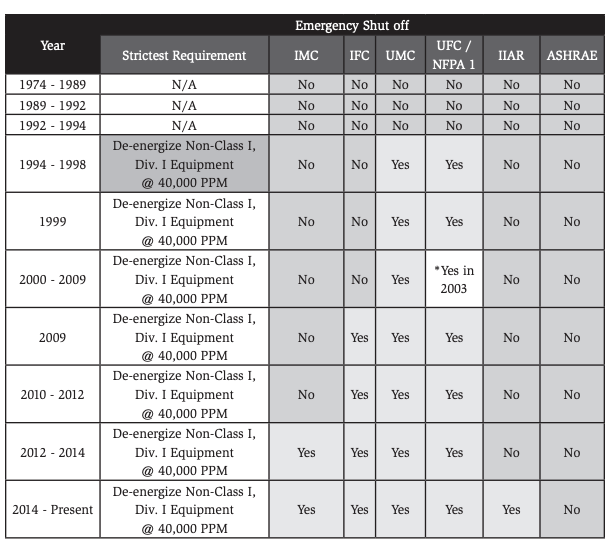
In 1994, the Uniform Mechanical and Fire Codes further required the switch to be “of the break-glass type” and recommended the emergency shutoff be interlocked with the detection system to automatically activate at 25% of the LFL (i.e., 40,000 ppm for ammonia). Additionally, the location of the emergency switch was to be located “immediately adjacent to and outside of each refrigeration machinery room exit” [author emphasis]. 5
For facilities under the jurisdiction of states that adopted codes published by the International Code Council starting in 2000, namely the International Fire Code and Mechanical Code, only a single emergency switch was required to be located at an “approved location immediately outside the machinery room and adjacent to its principal entrance.”6 Furthermore, the requirement for interlocking the emergency switch with the detection and automatic shutdown at 25% of the LFL was not adopted until 2009 by the IFC, and 2012 by the IMC respectively.7 Regarding the location of the emergency switch, the Uniform Fire and Mechanical Codes would continue to require an emergency switch “outside of each refrigeration machinery room exit” until 2009 and 2012, respectively.8
In 2014, ANSI/IIAR 2 was updated to better align with the mechanical and fire codes. One of the additions made was that automatic emergency shutdown controls be activated at 25% of the LFL (or the ammonia detector’s upper limit).9
5 1994 UMC §1108.4 Emergency Control; 1994 UFC §6314.4 Emergency Control
6 2000 IFC §606.9 Remote Controls 7
7 2009 IFC §606.9.1 Refrigeration System Emergency Shutoff; 2012 IMC §1106.5.1 Refrigeration System Emergency Shutoff
8 2009 NFPA 1 §53.2.3.4.5; 2012 UMC §1109.4 Emergency Control
9 ANSI/IIAR 2-2014 §6.13.2.4
Emergency Pressure Control System vs Emergency Control Box
The idea behind the emergency control box (also called a fire dump box) was in code documents for many years before the general time period we are studying in this paper (i.e., the first major publication of IIAR 2 in the early 1970s). In 1973, the Uniform Mechanical Code maintained the same language from earlier versions requiring “Every refrigerating system located in a building and containing… a Group 2 refrigerant shall be equipped with means for manual discharge of the refrigerant to the atmosphere.”10
In 1982, the first requirement for removing ammonia refrigerant “in the event of an emergency” appeared in the Uniform Fire Code. At this time, the UFC did not specify that an emergency control box configuration had to be installed, choosing instead to require that it must be “an approved system.”11
In 2006, both Fire Codes (NFPA 1 and IFC), along with the International Mechanical Code, acknowledged there were new and better ideas than discharging ammonia systems during an emergency and therefore replaced the requirement of the antiquated emergency control box with an automated “emergency pressure control system.”12 This new system would activate during over-pressurization to relieve pressure from the high side of the system to the low side of the system, thus reducing the likelihood of a lifted relief valve.
Ammonia Discharge Termination
In the 1970s, the first language to set the foundation for later diffusion tank requirements appeared in the Uniform Fire Code. The 1971 version of the UFC, in the section detailing “ammonia diffusion” requirements (i.e., emergency control boxes), allowed for atmospheric diffusion or the discharge of ammonia into a “tank of fresh water.”13 In 1982 the Uniform Fire Code went further and became the first publication to no longer allow an option of simple atmospheric diffusion, but instead required the emergency discharge be into an “approved water storage tank, water basin or diffuser having a capacity of 2 gallons of water for each pound of ammonia.”14
In the 1994 Uniform Mechanical and Fire Codes the language for emergency control boxes evolved to specifically require a diffusion (or adsorption) tank. Following earlier editions of the Uniform Fire Code, the requirement for both the UMC and UFC was for the water tank to hold at least one gallon of fresh water for every pound of ammonia.15
For states adopting the codes developed and published by the International Code Council (ICC), the International Fire Code reduced the capacity requirement in its 2000 publication to “At least one (1) gallon (3.785 L) of fresh water… for each pound (454 g) of ammonia that will be released in one (1) hour from the largest relief device connected to the discharge pipe.”16
In 2003, the National Fire Protection Association updated its fire prevention code, NFPA 1 (aka the Uniform Fire Code), to match the IFC requirement of “1 gal of water for each pound of ammonia that will be released in 1 hour from the largest relief device connected to the discharge pipe.” The UMC followed suit three editions later in 2009.17
10 1973 UMC §1518(a) Manual Discharge or Refrigerant
11 1982 UFC §63.108(a) Emergency Ammonia Diffusion Systems
12 2006 NFPA 1 §53.7; 2006 IMC §1105.9; 2006 IFC §606.10
13 1971 UFC §28.106(a)
14 1982 UFC §63.108(a) Emergency Ammonia Diffusion Systems
15 1994 UMC §1119; 1994 UFC §6308.1.1, §6309 Ammonia Discharge
16 2000 IFC §606.11.6 Ammonia Diffusion Systems
17 2003 NFPA 1 §53.9.1 Ammonia Diffusion Systems; 2009 UMC §1120.0 Ammonia Discharge
In the present day, the two major mechanical codes adopted across the United States default to the standard writing organizations that specialize in refrigeration. With regard to application of ammonia discharge and relief valve termination, the most recent published version of the International Mechanical Code (2018) refers to ASHRAE 15 for ammonia discharge while the Uniform Mechanical Code states that ammonia systems need to comply with IIAR 2 for design.18 Since the 2019 version of ASHRAE 15 explicitly excludes ammonia,19 IIAR 2 has become the default. IIAR 2 allows for water diffusion systems but prioritizes atmospheric diffusion.20
The International Fire Code states that ammonia refrigeration systems “shall discharge vapor to the atmosphere in accordance with” one of five (5) options. The first option listed is to discharge “Directly to atmosphere where the fire code official determines, on review of an engineering analysis prepared in accordance with Section 104.7.2, that a fire, health or environmental hazard would not result from atmospheric discharge of ammonia.”21
The Uniform Fire Code is the sole major code which has not been as quick to relinquish control over ammonia diffusion systems. The 2018 version of NFPA 1 still defaults to requiring ammonia diffusion systems unless the owner can prove that atmospheric diffusion will not result in significant fire, health, or environmental hazards.
“Unless the AHJ [authority having jurisdiction] determines, upon review of an engineering analysis prepared at the expense of the owner, that a significant fire, health, or environmental hazard would not result from an atmospheric release, refrigeration systems that are designed to discharge refrigerant vapor to the atmosphere shall be provided with an approved treatment, flaring, or diffusion system where required by 53.2.2.1.1 through 53.2.2.1.3.”22
18 2018 IMC §1105.8 Ammonia Discharge, 2018 UMC §1102.2 Ammonia Refrigeration Systems
19 ASHRAE 15-2019 §2.3
20 ANSI/IIAR 2-2014 Addendum A §15.5.1 Atmospheric Discharge; ANSI/ASHRAE 15-2016 §9.7.8.4.2 Ammonia
21 2018 IFC §605.12.4 Ammonia Refrigerant
22 2018 NFPA 1 §53.2.2.1
Ammonia Detection
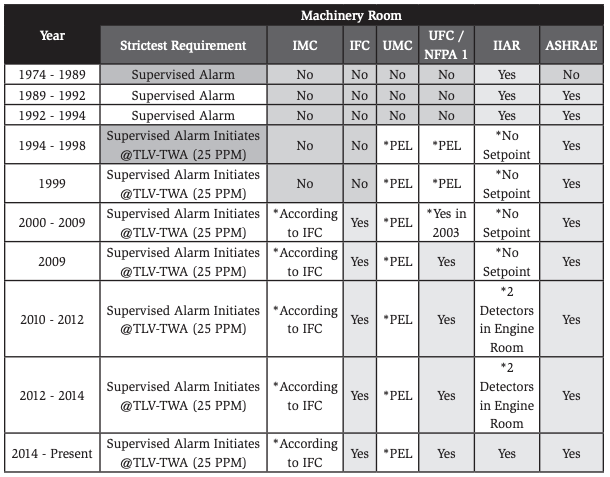
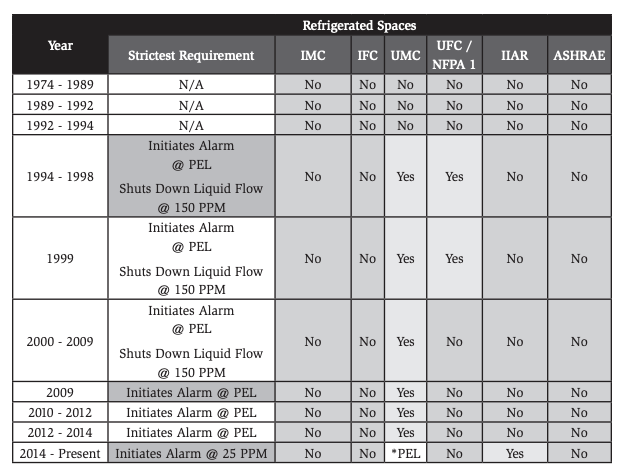
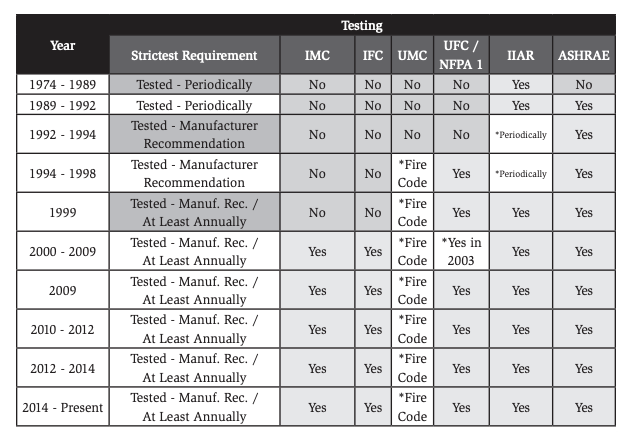
Requirements related to ammonia detection systems can be grouped into six (6) major categories: machinery rooms, audible/visual alarms, refrigerated spaces, ventilation control, emergency shut off, and testing.
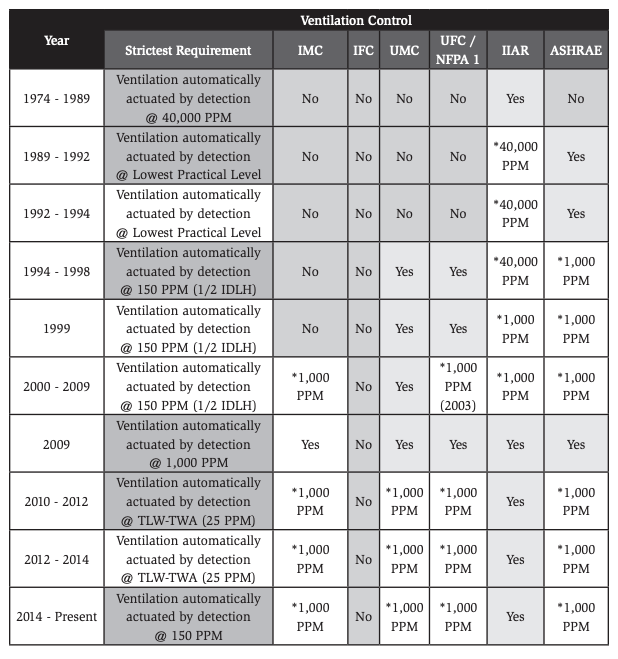
Ammonia detection is a confusing and contradictory subject among the various RAGAGEP code and standard documents. Because of the vastness of this subject, this discussion will be limited to the historical RAGAGEP variants in a single category: ventilation control. For further study, a detailed chart showing the varying requirements of the major code and standard documents across the six categories is provided in Appendix A.
Ventilation Control
Surprising to some in the industry, the RAGAGEP precedent for both machinery room ammonia detection and automatic ventilation control has been around since the ANSI certified publication of IIAR 2 in the 1970s. Initially, IIAR 2 required that machinery rooms “shall be provided with an independent mechanical ventilation system actuated automatically by a vapor detector(s) when the concentration of ammonia in the room exceeds 40,000 parts per million.”23 IIAR maintained its 40,000 PPM requirement until its third major revision in 1999, lowering its automatic ventilation activation level to 1,000 PPM. This was ostensibly to conform with ASHRAE 15, which initially required that machinery rooms “shall have continuous ventilation or be equipped with a vapor detector that will automatically start the ventilation system and actuate an alarm at the lowest practical detection levels…”24 but later revised its standard in 1994 to 1,000 PPM.25
23 ANSI / IIAR 1974-78 §4.3.2.2
24 ASHRAE 15 1989 §10.14(h)
25 ANSI/ASHRAE 15-1994 §8.14(h)
The year 2000 provided new RAGAGEP interpretations for machinery room ventilation control. In its two previous publications (1994 & 1997) the Uniform Fire Code maintained a requirement for machinery room ventilation to be automatically activated at “50 percent of the IDLH”26 (e.g., 150 PPM for ammonia) which conformed with the Uniform Mechanical Code.27 In its 2000 revision, this requirement was dropped entirely by the UFC and later brought back in 2003 with a higher level of 1,000 PPM.28
Why NFPA 1 dropped its ventilation control requirement in 2000 is a mystery but setting the level at 1,000 PPM in its 2003 version is not. At that time, most of the other code and standard documents all required ventilation systems to be interlocked with ammonia detection and automatically activated at 1,000 PPM.29 The lone exception to this was the Uniform Mechanical Code which maintained its requirement for ventilation to be activated at “50 percent of the IDLH”30 until 2009 when it was updated to conform with all other code and standard documents by requiring that “purge fans shall also respond automatically to the refrigerant concentration detection system set to activate the ventilation system at no more than 1,000 parts per million.31
26 1997 UFC §6311.4 Emergency Control of Ventilation Systems
27 1997 UMC §1107.5 Emergency Control of the Ventilation Systems
28 2003 NFPA 1 §53.10.4.2, §53.11.2.1(2)
29 ANSI/ASHRAE 15-2001 §8.12(h); 2000 IMC §1106.3 Ammonia Room Ventilation; ANSI/IIAR 2-1999 §6.2.3 Equipment
30 2000 UMC §1108.5 Emergency Control of the Ventilation Systems
31 2009 UMC §1108.5 Emergency Control of the Ventilation Systems
In 2010, IIAR 2-2008 Addendum A maintained the 1,000 PPM requirement for activating emergency ventilation, but it added a secondary requirement for activating normal ventilation at the Threshold Limit Value – Time Weighted Average (TLVTWA e.g., 25 PPM for ammonia).32 IIAR maintained this position until its revised publication in 2014 when it changed once again. This time, IIAR made a full RAGAGEP circle and required that ventilation be activated at 150 PPM (½ the IDLH).33 This is the same as the initial requirement of the Uniform Mechanical Code in 1994.
At the time of this paper’s publication, all major mechanical and fire codes reference IIAR 2 and therefore, new detection and ventilation systems will need to conform with the 150 PPM requirement.
Machinery Room Ventilation
As was highlighted in the previous section, mechanical ventilation for ammonia machinery rooms has been part of IIAR 2 since its publication as an ANSI standard in the early 1970s. Unlike detection systems, however, ventilation has also been part of the major code documents since the 1970s. For the purposes of this study, two RAGAGEP variants will be reviewed: the sizing of ventilation fans and the types of fans.
Sizing of Fans for Emergency Ventilation
In 1970, the Uniform Mechanical Code required machinery rooms to be equipped with “an exhaust system of ventilation arranged to provide a complete change of air in such a room at least once every five minutes and discharge to the outside air at a location not less than 20 feet from any exterior door, window or ventilation inlet in any building.”34 The major idea here is that fans sized according to the Uniform Mechanical Code from this time must have had the capacity to perform “a complete change of air… once every five minutes” (i.e., 12 air changes per hour).
32 ANSI/IIAR 2008 Addendum A §13.2.3.1
33 ANSI/IIAR 2014 §6.13.2.3
34 1970 UMC §1508 Machinery Room Ventilation
In 1989 ASHRAE updated its Safety Code for Mechanical Refrigeration and published a new equation for sizing fans for emergency ventilation:35
Q = 100 x √G
Where:
Q = the air flow in cubic feet per minute
G = the mass of refrigerant in pounds in the largest system, any part of which is located in the machinery room
This equation became the standard for sizing ventilation fans for nearly two decades and was subsequently adopted by the Uniform Mechanical Code in 1994, by IIAR in 1999, and by the International Mechanical Code in 2000.36
In 2010, IIAR changed the landscape by requiring 30 air changes per hour (ACH) as the new standard for sizing emergency ventilation fans.37 This requirement would be adopted by both the International and Uniform Mechanical Codes in 2012, and as such remains the accepted standard for sizing emergency ventilation fans today in the ammonia industry.38
35 ANSI/ASHRAE 15-1989 §10.13.6.2
36 1994 UMC §1107.2(4); ANSI/IIAR 2-1999 §6.2.3.3; 2000 IMC §1105.6.4
37 ANSI/IIAR 2-2008 Addendum A §13.3.9.1
38 2012 UMC §1108.2(2); 2012 IMC §1105.6.3
Type of Fan
Another pertinent question regarding machinery room ventilation is the type of discharge. In 2002, IIAR published a bulletin addressing ammonia machinery room ventilation which recommended that consideration be given to “up-blast, high velocity” fans.39 This recommendation would become incorporated into IIAR’s standard for design in 2010 as part of IIAR 2-2008, Addendum A. Therefore, emergency ventilation fans installed post-2010 must be of the up-blast type with a minimum discharge velocity of 2500 ft./min. (FPM).40
Pipe Labeling
The concept of pipe labeling is based on the need for system equipment to be identifiable. The unfortunate reality is that for many end users. it seems like the job is never done: “What needs to be labeled? Where should labels be located? How often? What color?”
Like many of the subjects we’ve studied thus far, pipe labeling requirements can be found in code documents dating back to the 1970s. The historical requirements were straightforward, and simply specified that “exposed refrigerant piping shall be labeled at intervals of not more than thirty feet.”41 It wasn’t until the 1994 version of the UMC that certain requirements for the label itself were specified—namely, the “type of refrigerant, function and pressure”42—and were required to be included on the label.
39 IIAR Bulletin 111 §3.3.1 Fan Type
40 ANSI/IIAR 2-2008 Addendum A §13.3.7.1
41 1970 UMC §1519
42 1994 UMC §1110.8 Identification
The next major precedent for pipe labeling in the ammonia industry was the publication of IIAR’s Bulletin No. 114 “Identification of Ammonia Refrigeration Piping and System Components.” This guideline recommended that pipe labels should be “Safety Yellow” and have five sections: marker body, physical state, pressure level, abbreviation, and directional arrow.43 Bulletin No. 114 was updated in 2014 to conform with ANSI/ASME A13.1-2007 “Scheme for the Identification of Piping Systems,” which indicates that labels for “toxic and corrosive fluids” have aIn the initial months and after IIAR Bulletin No. 114 was updated in 2014, there was confusion on whether a facility’s labeling system needed to be updated from yellow to orange. The answer to that question is to remember that the IIAR’s bulletins are guidelines that are intended to be voluntary and not binding. On the other hand, IIAR 2, which is an ANSI-approved standard, requires that pipe labels have the same five sections as recommended in the bulletin, but it does not specify background color.
Summary and Conclusion
Recognized and generally accepted good engineering practices (RAGAGEP) are written documents intended for use in the design; installation; startup; operation; and inspection, testing, and maintenance of process equipment. Over the last several decades there have been a myriad of documents published that can rightly be considered RAGAGEP, but they differ in requirements at different times in history.
In recent years, IIAR has endeavored to become the primary standard writing organization for ammonia refrigeration by developing and publishing ANSI-certified RAGAGEP documents. The importance of the IIAR suite of standards cannot be overemphasized, as they are now referenced in the major model codes adopted by local jurisdictions throughout the United States.
43 1991 IIAR Bulletin 114 §4.1 Piping Markers
While the primary content of this paper has been to study a small sampling of historical RAGAGEP variants, our goal has been to emphasize the importance of properly documenting the codes and standards used and adhered to at a facility. It is obvious from this short study that RAGAGEP requirements have changed throughout history. Because there is legal precedent in the PSM regulation to document that an ammonia system has been designed, operated, and maintained in accordance with RAGAGEP, the implication is that if codes and standards used at a facility are not clearly documented, that facility may be required by regulatory enforcement to upgrade their system (or parts thereof) to the newest codes and standards.
As an example, if an expansion project designed and completed in 1999 included a new machinery room, the emergency ventilation fan could acceptably have been a down-blast type. If, however, this facility did not document that the fan was designed and installed in accordance with the governing codes and standards of the time (e.g., IIAR 2-1984 and 1997 UMC, neither of which required emergency ventilation fans to be of the up-blast type), an OSHA compliance officer performing an inspection in the present day could theoretically require the facility to upgrade its fan to meet revised codes and standards.
This example highlights two important realities: (1) Most facilities should have multiple RAGAGEP documents from different years that apply to their process, depending on the years of initial design and installation and subsequent modifications; and (2) Most facilities have not kept meticulous records of these historically applicable RAGAGEP documents and therefore may be liable to regulatory enforcement. These realities underscore the importance of ANSI/IIAR 9-2020 “Standard for Minimum System Safety Requirements for Existing Closed-Circuit Ammonia Refrigeration Systems.”
The industrial ammonia refrigeration industry has for years been seeking such a unifying standard that applies to existing facilities, as this paper’s historical analysis of RAGAGEP variants has clearly shown. Now, with the publication of ANSI/IIAR 9-2020, if a facility is unsure which codes and standards were used and adhered to in its original design and installation, or subsequent modifications, it can use the Minimum System Safety Evaluation contained in Chapter 8 of ANSI/IIAR 9-2020 to document that its refrigeration system has been designed in accordance with recognized and generally accepted good engineering practices.44
It should be noted that while a facility can rely on IIAR 9 for minimum safety requirements, facilities are still obligated to follow the RAGAGEP in place at the time of construction, unless such RAGAGEP is superseded by IIAR 9. In other words, complying with the minimum requirements stated in IIAR 9 does not necessarily relieve a facility from following other provisions that might have been required at the time of construction. For example, a facility constructed using the latest version of IIAR 2 cannot simply revert to IIAR 9, where many of the provisions of IIAR 2 are not addressed. IIAR 9 serves to set minimum safety requirements and provide a means to evaluate existing systems against these minimum requirements.
When the history of a facility is unknown, using IIAR 9 will substantially help to mitigate regulatory liability. This could prove particularly useful when facilities were constructed prior to the initial promulgation of the PSM/RMP regulations, when documentation of RAGAGEP was not required.
While complexity often results in confusion, the simplicity of the IIAR’s suite of standards will hopefully lead to unified communication between engineers, end users, and regulatory enforcement.
44 ANSI/IIAR 9-2020 §8.3.1 requires a Minimum System Safety Evaluation to be performed for all existing facilities within 5 years of its initial publication in May 2020.
Appendix A – Ammonia Detection Through the Years
This table categorizes ammonia detection requirements through in the years into six (6) primary areas: Machinery Rooms, Refrigerated Spaces, Ventilation Control, Emergency Shut off, and Testing.