





2026 White Paper: CO2 as a Refrigerant: A Reemerging Opportunity for U.S. HVAC Applications
Author:
Evan Aschow, Lead Engineer, Effecterra
Abstract
The CO2 (R744) Simultaneous Chiller Heat Pump integrates cooling, heating, and domestic hot water production into a single, modular system using CO2, a natural refrigerant with an ozone depletion potential of 0 and a global warming potential of 1. By employing parallel VFD-driven compressors (20–70 Hz), centralized oil management, brazed-plate heat exchangers, three-way valves for loadspecific routing to water- or air-source evaporators, dry or adiabatic gas coolers, electronic highpressure control, multi-ejector blocks for efficiency and floodback protection, a flash tank with bypass valve, and advanced PLC controls, this system can achieve a coefficient of performance ≥ 7.0 under simultaneous heating and cooling operation, as demonstrated through Modelica- and Dymola-based modeling. The system is designed for the U.S. commercial HVAC market as a replacement for legacy boiler–chiller combinations. It is capable of maintaining near-full capacity across ambient temperature conditions ranging from 0°F to 120°F (−17.8°C to 48.9°C), and supports scalable manufacturing and application-specific configuration, while ensuring full compliance with evolving refrigerant regulations.
Introduction
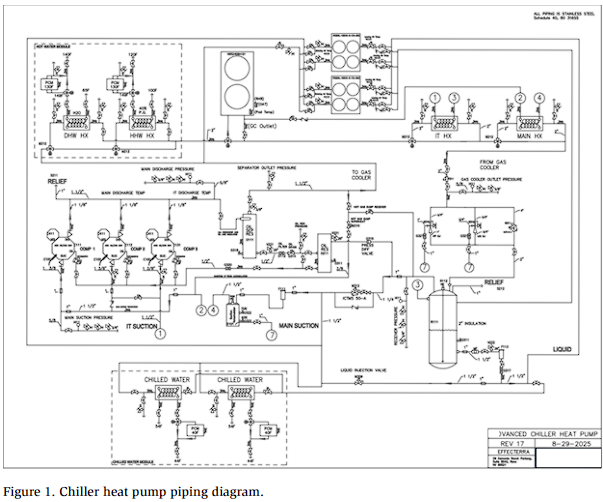
The commercial HVAC industry is facing increasing pressure to reduce energy consumption while meeting diverse user demands and maintaining operational reliability across the wide range of climate zones across the United States. Due to the broad range of climatic conditions in the United States, standardized systems must be capable of being deployed modularly to address the specific needs of each site. The CO2 (R744) Simultaneous Chiller Heat Pump addresses these challenges by integrating cooling, heating, and domestic hot water (DHW) into a single, highefficiency system that can be optimized for deployment into any location in the United States as a replacement for traditional boiler–chiller pairs. Using natural CO2 refrigerant, this modular platform achieves a COP ≥ 7.0 in simultaneous mode, which is designed to operate reliably in ambient temperatures ranging from 0°F to 120°F (−17.8°C to 48.9°C), and supports real-time load matching through advanced controls, ejector-assisted expansion, and dynamic suction control. The COP (calculated by the sum of the useful cooling and heating output divided by the compressor and fan power) of this system should be comparable or better than other cold and hot water production heat pumps as described by Wang et al. (2023). Figure 1 presents the piping and instrumentation diagram (P&ID) of the core system architecture, illustrating the parallel compressor arrangement, modular heat exchanger loops, and key components, including the gas cooler, ejector block, flash tank, and three-way valves.
CO2 as a Refrigerant
Properties
The CO2 (R744) Simultaneous Chiller Heat Pump utilizes carbon dioxide as its refrigerant, which is a natural, non-toxic, non-flammable fluid (ASHRAE A1 safety classification) with zero ozone depletion potential (ODP = 0), a global warming potential of 1 (GWP = 1), and no PFAS or synthetic byproducts, making it fully compliant with current EPA, the AIM Act, and state-level refrigerant regulations. These inherent characteristics, in conjunction with its high volumetric cooling capacity, excellent heat transfer coefficients, and ability to operate efficiently in transcritical cycles, allow the CO2 heat pump to achieve high energy efficiencies (COP ≥ 7.0) and provide a high-temperature heat supply (over 140°F [60°C] for DHW) while maintaining a compact system design and robust performance across a wide range of U.S. climates without compromising safety, performance, or operational reliability.
Policy
The adoption of CO2 (R-744) simultaneous chiller–heat pumps has been accelerated by the convergence of federal, state, and utility policies focused on decarbonization, refrigerant transition, and energy efficiency. At the federal level, the AIM Act (2020) directs the EPA to phase out HFCs and establish sector-based technology transitions, while the SNAP program lists CO2 as an acceptable low-GWP refrigerant for numerous commercial and industrial applications. Federal procurement standards require agencies to purchase high-efficiency equipment, and the U.S. federal tax incentive §179D deduction provides a financial incentive for qualifying highperformance commercial systems.
At the state level, regulatory frameworks are increasingly aligned around carbon disclosure, building performance standards, and refrigerant transition. For example, California couples its F-Gas Reduction Incentive Program (FRIP) with funding from the CEC EPIC and CalNEXT programs to advance low-GWP refrigeration and heatpump R&D, while its new climate disclosure laws (SB 253 and SB 261) require large companies to report full-scope emissions and climate-related risks beginning in 2026. Similarly, commercialization efforts in Massachusetts are supported through MassCEC innovation grants and Mass Save incentives for high-efficiency HVAC/R systems. New York has implemented an all-electric new-construction law that will phase in between 2026 and 2029, while Local Law 97 emission caps will be reinforced by the state’s forthcoming Cap-and-Invest program, which will generate funding for building-sector decarbonization. Likewise, Washington’s Clean Buildings Performance Standard, supported by revenue from its Climate Commitment Act, establishes mandatory energy-use and emissions targets for large commercial facilities starting in 2026.
Other jurisdictions, including Oregon (HB 3409), Maryland (BEPS), and the District of Columbia (BPS), are implementing statewide or municipal Building Performance Standards that require large commercial buildings to track, report, and reduce energy use and GHG emissions over time, often targeting net-zero outcomes by 2040. Collectively, these state and municipal policies have created a consistent demand for low GWP and high-efficiency mechanical systems.
These policies are complemented by utility and market-transformation programs, including NYSERDA and Con Edison in New York, IOUs in California, and Mass Save in Massachusetts. These initiatives provide significant incentives for the commercialscale electrification of major building systems and industrial loads. These regulatory drivers, market forces, and state financial incentive programs combine to reduce firstcost barriers, ensure compliance with emerging emissions standards, and position CO2 simultaneous chiller–heat pumps as a critical technology of large-building decarbonization and refrigerant-transition goals.
System Architecture
The CO2 (R744) Simultaneous Chiller Heat Pump employs a transcritical vapor compression cycle rather than the subcritical cycle that has been used since the early 1900s. In contrast to earlier system designs from the 1930s that required lowtemperature condensing water to sustain operability, the transcritical cycle allows operation at high ambient temperatures that exceed the critical point (88°F; 31.1°C) while maintaining full evaporator capacity. The heat pump includes rack-style parallel architecture with multiple VFD-driven compressors (20–70 Hz), centralized oil management, brazed-plate heat exchangers for gas cooling and evaporation, threeway valves for modular distribution, dry or adiabatic gas coolers, electronic highpressure valves, multi-ejector blocks for work recovery and floodback protection, a flash tank for phase separation, and a flash gas bypass valve. These components are integrated by a single PLC, allowing for simultaneous cooling, heating, and DHW generation with real-time load matching, reliable off-the-shelf components, and full modularity. This design allows heat transfer from one or multiple sources to one or multiple sinks with minimal energy loss. In particular, this system leverages unique thermophysical properties of CO2 to adjust between subcritical and transcritical operating regimes, thereby increasing the heating capacity and efficiency in response to load demands.
Performance Validation
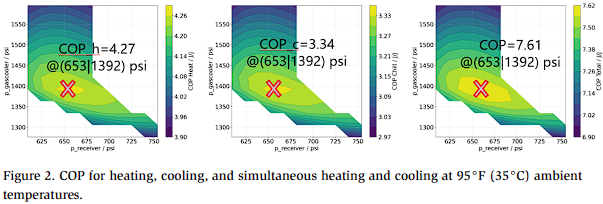
The performance of the CO2 (R744) Simultaneous Chiller Heat Pump was validated using Dymola 2025x with Modelica, incorporating TILSuite 2024.1, TILMedia, and Refprop v10.0 for high-fidelity fluid property and component modeling. The system was evaluated across nine major simulation iterations as well as many minor iterations in order to assess the suitability of the selected components, the operability of the system across ambient temperature conditions ranging from 10°F to 100°F (−12.2°C to 37.8°C), and the reliability of the design. The dynamic transcritical cycle model includes primary and intermediate compressors, ejector-assisted expansion, flash tank dynamics, modular evaporators, and real-time load distribution. The simulations were performed using simultaneous chilled water (44°F/54°F; 6.7°C/12.2°C), domestic hot water (140°F/65°F [60°C/18.3°C] supply/return temperatures, respectively), and ambient temperatures from 0°F to 100°F (−17.8°C to 37.8°C). The simulations demonstrated that the system was capable of delivering COP values that exceeded 7.0 under balanced DHW and cooling loads, with a peak efficiency of 7.61 at 100% total load, and was relatively robust to unbalanced scenarios (e.g., a COP of 3.34 and 4.27 in cooling-dominant and DHW-dominant modes, respectively).
These results validate the system’s ability to maintain near-full capacity at ambient temperatures as low as 0°F (−17.8°C) and full capacity at 120°F (48.9°C). These findings provide a foundation for energy savings projections and system sizing, while demonstrating compliance with ASHRAE 90.1 performance paths. unbalanced scenarios (e.g., a COP of 3.34 and 4.27 in cooling-dominant and DHW-dominant modes, respectively).
These results validate the system’s ability to maintain near-full capacity at ambient temperatures as low as 0°F (−17.8°C) and full capacity at 120°F (48.9°C). These findings provide a foundation for energy savings projections and system sizing, while demonstrating compliance with ASHRAE 90.1 performance paths.
Modular Design and Scalability
The CO2 (R744) Simultaneous Chiller Heat Pump features a fully modular architecture built around a standardized rack-style platform, allowing manufacturers to scale production efficiently using common components while allowing end users to configure only the required functions, including chilled water cooling, space heating, or DHW production, via selectable modules, such as dedicated evaporators, three-way routing valves, and optional compressor staging. This design eliminates oversizing, reduces initial capital cost, and supports field upgradability; additional capacity or functionality can be accommodated by integrating extra compressor units or heat exchanger loops without redesigning the system. The scalability of the system extends from small commercial loads (e.g., 20 tons) to large facilities (100+ tons) through parallel rack expansion. This design ensures consistent performance, simplified inventory, and lower lifecycle costs across a wide range of building types.
The system has also been designed to accommodate a dedicated thermal storage skid; this component allows for peak shaving to optimize electrical utility costs or utilize heat that would otherwise be rejected while in the cooling mode. When producing chilled water or space cooling, the system can store the rejected heat in thermal storage for subsequent heating demands. For example, a residential building with space cooling needs during the day and hot water needs during the evening would benefit greatly from this module. Peak shaving can be used to produce and store heat when electricity costs are lower, so the stored energy is discharged during periods with higher grid pricing. Naturally, the thermal storage skid can be designed to meet site-specific storage needs. The quantifiable impact on overall efficiency and cost effectiveness is dependent on the scale and load behavior of the application, as well as its specific electric rates.
Advanced PLC Controls
The CO2 (R-744) Simultaneous Chiller Heat Pump incorporates advanced PLC hardware with custom algorithms that provide real-time efficiency optimization, automated fault detection and diagnostics, remote programming and troubleshooting, and precise load-based setpoint management. The system is fully BACnet and Modbus compatible, allowing it to integrate seamlessly with building management systems and enabling centralized monitoring, dynamic capacity modulation via VFD staging, and valve positioning. The features are contained within a user-friendly interface that supports safe, reliable, and energy-efficient operation across varying thermal demands.
Conclusion
The CO2 (R744) Simultaneous Chiller Heat Pump represents a proven, scalable, and policy-aligned solution that consolidates cooling, heating, and DHW production into a single high-efficiency platform capable of achieving COP ≥ 7.0, highly climate-resilient operation, and long-term regulatory compliance while eliminating combustion-based heating and synthetic refrigerants. Modelica-based performance validation, modular design, and advanced PLC controls allow building owners to achieve immediate energy savings and regulatory approval without operational compromise.
Further development involves the scaled manufacturing of modular rack systems, pilot installations in a range of commercial facilities in the United States to verify its real-world performance, and in-situ testing to collect operational data, refine controls, and support third-party certification. These efforts will pave the way for broad market deployment and integration into sustainable building standards.
Acknowledgements
The dynamic performance simulations described in the Performance Validation section were conducted by A3S / Danfoss using Dymola 2025x, TILSuite 2024.1, TILMedia, and Refprop v10.0.
References
Wang, Z., Luther, M. B., Siamas, A., Matthews, J., & Liu, C. (2024). Development and performance testing of a polyvalent heat pump for hot and cold water production. Architectural Science Review, 67(4), 309-320, DOI: 10.1080/00038628.2023.2273836