



2026 White Paper: Enhancing CO2 Refrigeration Reliability: The Role of 90-bar Evaporators in a Low-GWP Future
Author:
Hiram De La Torre Salinas
Abstract
Carbon dioxide (CO2) has emerged as a leading natural refrigerant in commercial refrigeration applications due to its ultra-low global warming potential (GWP of 1), energy efficiency, and alignment with global regulatory phase-down mandates. However, system reliability, charge preservation due to power outages or scheduled maintenance, and overall operational resilience remain key concerns for end users and system designers.
This whitepaper explores the critical role of 90-bar rated evaporators in improving the performance, resilience, and sustainability of CO2 refrigeration systems. By enabling longer system shutdown periods without refrigerant venting, supporting familiar copper–iron welding practices, and reducing dependence on emergency power or backup condensing units, 90-bar evaporators—especially when combined with 90-bar high side systems—represent a strategic investment in reliability and lifecycle cost efficiency.
Introduction
The refrigeration industry is rapidly transitioning toward low-global warming potential (GWP) alternatives driven by environmental regulations, consumer expectations, and corporate sustainability goals. CO2 (R744) has emerged as a leading refrigerant solution, particularly for supermarkets, cold storage, and food processing applications.
CO2 is also gaining traction as a refrigerant in industrial applications, in which users and contractors are increasingly seeking alternatives to ammonia (NH3) as well as synthetic refrigerants that are being phased out due to environmental regulations.
Despite these advantages, CO2 systems present unique engineering challenges,
including:
- Higher operating pressures
- Flash tank pressure management during outages
- Charge scarcity due to the large CO2 charge required
- Increased sensitivity to power-loss events
These challenges increase the risk of refrigerant loss, product spoilage, and emergency infrastructure requirements. However, all of these issues can be mitigated through the implementation of higher-pressure-rated components, including evaporators.
90-bar Evaporators
Enabling Extended Shutdown
A critical advantage of 90-bar evaporators is their increased tolerance to pressure increases during power outages or service events, which reduces the likelihood of pressure relief valve venting. When a system shuts down, the temperature of CO2 increases, resulting in a corresponding increase in pressure. Although venting is possible in any system, traditional 45–60 bar refrigeration systems are much more likely to require pressure relief valve discharge or auxiliary cooling because their pressure ratings fall below the typical resting pressure of CO2 at higher ambient temperatures.
Key benefits of 90-bar rating
- Extended system downtime without refrigerant venting
- Preservation of full CO2 charge, thereby avoiding release and recharge costs
- Improved operational reliability during outages or scheduled maintenance
The higher-pressure capabilities of these components can improve the reliability of the system while directly supporting sustainability objectives. Table 1 presents the duration that a CO2 system can be offline before charge venting occurs. These times are derived from experimental data obtained from flash tank testing. Specifically, a flash tank assembly was constructed, filled with liquid CO2, and heated to a sustained temperature of 115°F (46.1°C) to simulate realistic outdoor ambient conditions in summer.

Technical Reliability: Familiar Materials and Proven Durability
Familiar brazing practices
90-bar evaporators are commonly designed using iron-copper XHP materials. These provide conditions with:
- Brazing methods that are similar to traditional copper piping systems
- Simplified installation and service procedures
- A reduced need for specialized stainless-steel welding expertise
These characteristics lead to lower labor and technician training costs.
Structural strength and resilience
Iron-copper XHP materials are engineered to provide:
- Improved wear resistance: XHP copper–iron tubing is a CuFe2P alloy that has been designated as UNS C19400. Its chemical composition includes copper (Cu), iron (Fe), and phosphorus (P), with the latter two elements contributing to its improved wear resistance (TriangleAlloy, 2025).
- Long-term corrosion resistance: The incorporation of copper into steel or alloy systems has been shown to improve resistance to microbiologically influenced corrosion (Liu et al., 2024).
- Structural resilience against earthquakes and mechanical impacts: Engineered iron–copper alloys exhibit greater mechanical strength and hardness compared with pure copper, improving their resistance to deformation and mechanical impacts, such as those experienced during seismic events (Dragomir et al., 2024).
- Longevity that exceeds typical supermarket lifecycle expectations (based on engineering estimate): Based on the documented improvements in wear resistance, corrosion resistance, and the mechanical strength of CuFe2P (UNS C19400) alloys, systems built with XHP materials are designed to support service lives comparable to or potentially exceeding the typical 15–25-year lifecycle of supermarket refrigeration systems.
The durability of these materials thus allows for reliable operation even in demanding environments.
Eliminating Backup Cooling and Emergency Power
Conventional CO2 systems require a backup condensing unit to cool the flash tank during power outages or scheduled maintenance, as well as an emergency generator or battery backup to operate auxiliary equipment.
Advantages of high-pressure 90-bar design compared to standard pressure of 45-60-bar
- No backup condensing unit required for operations at ambient temperatures of 115°F (46.1°C) or lower.
- No emergency power generators are required to protect the refrigerant charge.
- Reduced CO2 costs through the preservation of charge and a reduced need to source CO2 locally, especially in non-urban areas.
- Potential leak reduction due to the higher overall strength of the system compared to traditional 45- or 60-bar systems.
- Simplified facility design.
Economic Impact: Savings Over a 10-Year Lifecycle
When evaluating the initial cost of a 90-bar CO2 system that incorporates 90-bar evaporators, it is important to consider the long-term savings that this high-pressure rating system will deliver compared to 45-60-bar systems:
- Avoids investment in backup condensing unit and emergency power generators: The cost of a backup condensing unit depends on its specifications, but is estimated to cost between $1,400 to $9,000 (Restaurant Equipment World, n.d.). Similarly, a 15kW emergency generator ranges between $3,800 to $7,000 in price (Rosen, n.d.).
- Avoids charge loss and refrigerant replacement costs: Based on a market price of around $3.00 per pound of CO2 (~$6.61 per kg of CO2) and a system load of 2,000 pounds of refrigerant, each refrigerant release event represents savings of up to $6,000 plus freight charges (California Air Resources Board, 2020, p. 73).
- Avoids additional costs related to the unavailability of large quantities of CO2 during emergencies: Market analyses indicate that the CO2 (R744) refrigerant supply chain is less mature and more constrained than that of conventional refrigerants. Its distribution depends on specialized high-pressure cylinders and limited inventories at regional distributors, making rapid bulk delivery difficult during emergencies (PW Consulting Chemical & Energy Research Center, 2025)
- Increased uptime and product preservation, thus preventing food loss: Around 30% of food in U.S. grocery stores is discarded, and refrigeration problems are a key contributing factor behind the spoilage of perishables. In addition, hidden costs, such as the disruption to employee productivity when a refrigeration system goes offline (since they need to be diverted from their standard customers service and logistical roles to address emergencies) and the loss of sales, can be significant: a 4-hour outage in just one display case can result in hundreds of dollars in lost sales, while a full-store refrigeration outage can cause over $10,000 of lost sales (Robbins, 2025). In terms of actual food loss, a retail inventory analysis from 2012 (for all inventory, not just refrigerated) found that the average total inventory value per store was about $289,648, with larger, high-perishable stores carrying significantly more inventory (up to ~$850,734 retail value). Although these totals include dry goods, perishable items typically represent a substantial proportion of total store value (Chiarello-Ebner, 2012).
- Reduced installation and service costs: Maintenance fees for the backup condensing unit often involve at least two visits per year for preventive maintenance. At an estimated four hours per visit and an hourly wage from $75 to $150 (Patel, 2025), this would represent savings of up to $12,000 over a period of 10 years. Additional avoided expenses include generator maintenance and fuel consumption.
The rapid growth in demand for R744 systems, driven by the adoption of natural refrigerants in supermarket and cold storage applications, may outpace the expansion of production and distribution infrastructure (ATMOsphere America & NASRC, 2023). This could potentially affect refrigerant availability and cost, further strengthening the ROI associated with these systems.
Industry Standardization and Future Security
Making 90-bar systems the industry standard ensures:
- Compatibility with future system upgrades: Emphasizing a 90-bar pressure rating encourages alignment among component and equipment manufacturers in the development of high-pressure-capable technologies, including compressors and accumulators.
- Interchangeability of components: As 90-bar pressure ratings become the new standard, sourcing components from different suppliers that meet system requirements will become more feasible. The adoption of this pressure rating would also drive global alignment in CO2 equipment specifications. Indeed, many manufacturers in Europe have historically designed CO2 refrigeration components, such as liquid vessels, for ~60-bar working pressures, reflecting common industry practice and compliance with PED requirements (Isentra Ltd., n.d.). The emergence of 90-bar pressure ratings represents the next step toward global standardization. This harmonization would improve supplier availability, simplify equipment qualification processes, and provide greater flexibility in system procurement and design.
- Compliance with evolving safety and environmental regulations: In the U.S., the Environmental Protection Agency (EPA) is expected to continue driving the transition toward low-GWP refrigerants. With a GWP of 1, CO2 is widely considered a long-term, regulation-proof solution. Designing refrigeration systems around a 90-bar pressure rating would provide long-term safeguards against evolving high pressure system requirements and developments in high-pressure system components.
By deploying CO2 refrigeration systems designed for 90-bar operation, organizations can future-proof their operations, improve equipment flexibility, and be protected from evolving sustainability and regulatory compliance objectives.
Importance of Certified, Established Manufacturers
Investing in a high-pressure CO2 system represents a significant long-term commitment. To maximize the reliability, safety, and regulatory compliance of the system, it is crucial to source equipment from a reputable, established manufacturer that can guarantee:
- Regulatory compliance: A structured organization is required to monitor and adapt to the latest changes to EPA, UL, ASHRAE, ASME, and other relevant standards.
- UL and market-specific certifications: Ensure all equipment meets safety and performance requirements in target markets.
- Proven field reliability and safety standards: This should be validated through operational experience and rigorous testing.
- Robust warranty and technical support: Provide confidence in service and longterm operational reliability.
- Traceable materials and validated brazing integrity: Demonstrate manufacturing quality and long-term durability.
Partnering with trusted OEMs mitigates operational and compliance risks while ensuring optimal long-term performance, reliability, and maintainability of highpressure CO2 refrigeration assets.
Conclusion
90-bar evaporators represent a strategic advancement in CO2 refrigeration technology, combining operational resilience, environmental responsibility, and optimizations in lifecycle cost. When integrated into 90 bar systems, 90-bar evaporators allow for longer shutdown periods (between 2.6 to 13 hours), eliminate the need for costly backup systems (which can cost up to $9,000 plus an additional ~$7,000 for a power generator, excluding fuel and maintenance), and avoid around $2,560 in maintenance fees for a backup condensing unit over a 10-year period.
In addition, 90-bar evaporators and high-pressure rated CO2 systems help preserve refrigerant charge (which can cost around $6,000 per loss event), prevent lost sales (which can reach up to $10,000 per hour of refrigeration system downtime), and avoid food losses of up to $850,734 at retail value while providing superior mechanical durability.
As the demand for CO2 increases, 90-bar evaporators are expected to play a central role in ensuring system reliability and long-term investment value amidst tightening availability and rising sustainability targets. Forward-thinking operators should treat the 90-bar design as the new baseline standard for future-ready CO2 refrigeration systems, as it allows them to retain their copper-based systems and avoid the complexities associated with stainless steel.
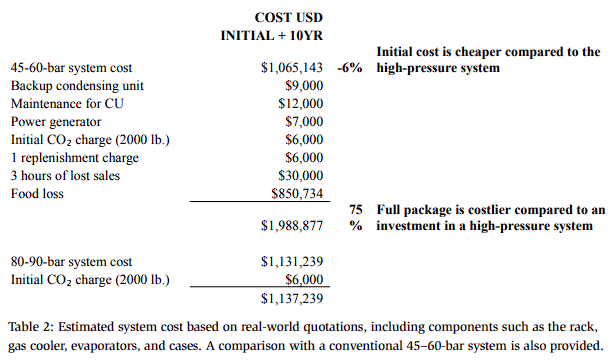
Based on the evidence presented in Table 2, the recommendation is to choose 90-bar systems over lower-pressure alternatives regardless of system size, as the potential costs associated with system downtime are far more significant than the difference in initial cost between a 45–60-bar and a 90-bar system.
Acknowledgements
I would like to acknowledge Jony Zangari, Ron Grabowski, Michael Lehtinen, Venkata Vayuvegula, Kevin Hoskins, Bruce Schneider, and the entire Krack team for their outstanding leadership, vision, and technical guidance over the past two years. Their commitment to advancing reliable, future‑ready CO2 refrigeration solutions has been instrumental in shaping the innovations and perspectives presented in this paper.
References
ATMOsphere America & NASRC. (2023). U.S. demand for CO2 refrigerant projected to quadruple by 2027. NaturalRefrigerants.com. https://naturalrefrigerants.com/news/ atmo-america-nasrc-projects-u-s-demand-for-co2-refrigerant-to-quadruple-by-2027
California Air Resources Board. (2020). Staff report: Initial statement of reasons for the proposed amendments to the prohibitions on use of certain hydrofluorocarbons in stationary refrigeration, chillers, aerosols propellants, and foam end-uses regulation (p. 73). California Environmental Protection Agency. https://ww2.arb.ca.gov/sites/ default/files/barcu/regact/2020/hfc2020/isor.pdf
Chiarello-Ebner, K. (2012, November 21). 2012 WholeFoods retailer survey. WholeFoods Magazine. https://www.wholefoodsmagazine.com/articles/12888-2012- wholefoods-retailer-survey
Dragomir, F., Manescu, T., & Tufisi, C. (2024). Influence of copper-iron (CuFe) and copper-tin (CuSn) alloys over mechanical strength properties in crimping process. Vibroengineering Procedia, 56, 163–168. https://www.extrica.com/article/24508
Environmental Protection Agency. (2023). Technology transitions: HFC restrictions by sector. U.S. Environmental Protection Agency. https://www.epa.gov/climate-hfcsreduction/technology-transitions-hfc-restrictions-sector
Environmental Protection Agency. (2023). Transitioning to low-GWP alternatives in commercial refrigeration. U.S. Environmental Protection Agency. https://www. epa.gov/ozone-layer-protection/transitioning-low-gwp-alternatives-commercialrefrigeration
Isentra Ltd. (n.d.). CO2 refrigeration products. Retrieved January 28, 2026, from https://www.isentra.net/products/
Liu, Q., Li, P., Wu, B., Wei, Y., Jiang, H., Shen, J., & Liang, Q. (2024). Copper alloying improves the microbiologically influenced corrosion resistance of pipeline steel. Coatings, 14(7), 834. https://www.mdpi.com/2079-6412/14/7/834
Patel, J. (2025, June 18). How much to charge per hour for field services in 2026. FieldCamp. https://fieldcamp.ai/blog/how-much-to-charge-per-hour/
PW Consulting Chemical & Energy Research Center. (2025, June 23). CO2-based refrigerant market. https://pmarketresearch.com/chemi/co2-based-refrigerantmarket/
Restaurant Equipment World. (n.d.). Remote condensing units. REW Online. Retrieved January 20, 2026, from https://www.rewonline.com/category/5190/ Remote-Condensing-Units
Robbins, A. (2025, March 11). How refrigeration outages make grocery stores lose more than just food. Food Logistics. https://www.foodlogistics.com/warehousing/ grocery-retail/article/22934766/axiom-cloud how-refrigeration-outages-make-grocerystores-lose-more-than-just-food
Rosen, S. (n.d.). Home generators introduction. BuyerZone. Retrieved January 19, 2026, from https://www.buyerzone.com/residential/home-generators/bg-homegenerators-introduction/
TriangleAlloy. (2025, January 8). UNS C19400 (CuFe2P) copper iron alloy.
TriangleAlloy. https://trianglealloy.com/uns-c19400-cufe2p-copper-iron-alloy/