





IIAR Greenpaper: Natural Refrigerants for a Sustainable Future

TABLE OF CONTENTS
Executive Summary
I. Energy and the Environment
II. Technology and Industry Resources
III. Future Uses of Ammonia
Natural Refrigerants
I. Ammonia
II. Carbon Dioxide
III. Hydrocarbons
IV. Air
V. Water
R Numbers – What Do They Mean?
Education
I. IIAR – The Academy of Natural Refrigerants
II. University Programs and Trade Schools
III. Industry Groups and Resources
Practical Applications / Business Argument
New Uses for Natural Refrigerants
I. Shipping
II. Maritime
III. Automotive
Authors
Stephanie Smith
Andrea Fischer
EXECUTIVE SUMMARY
Industrial food production around the globe depends on natural refrigerants. Ammonia (NH₃), carbon dioxide (CO₂), and hydrocarbons such as propane (R290) make up the foundation of the technologies that support the global cold chain.
Often called one of the world’s “century-proof” technologies, natural refrigerants have been used for over 100 years and continue to outperform synthetic alternatives in terms of energy efficiency and environmental impact.
And in a rapidly warming world, the low Global Warming Potential (GWP) and zero Ozone Depletion Potential (ODP) of natural refrigerants pose the only truly climate-neutral solution for the technical systems and infrastructure required to feed the world’s population.
For the countries that have adopted HFC phase-down mandates, natural refrigerants promise certain climate gains without the drawbacks and PFAS pollution risk that synthetic replacements present.
This technical versatility has pushed natural refrigerants past traditional uses like refrigeration – and they now support complex climate control systems in data centers, contribute to waste heat recovery in district energy networks, and improve thermal management across industrial manufacturing processes.
Natural refrigerants play a vital role in keeping global food supply accessible. By converting energy savings into lower operating costs, natural refrigerants keep food available to consumers and make food relief feasible in the world’s poorest places.
Energy and the Environment
In the 1980’s and 1990’s, as regulators began to recognize the science behind climate change, ozone degradation and warming, governments around the world joined coalitions and partnerships to identify the causes.
Chief among them were chlorofluorocarbons (CFCs) and hydrochlorofluorocarbons (HCFCs). Introduced in the 1930’s, CFC’s were fully halogenated hydrocarbons, mostly replaced in the late 1980’s by HCFCs, their partially halogenated successors.
While HCFCs were meant to be used as transitional replacements for CFCs – because they break down more readily in the lower atmosphere and therefore have lower ozone-depleting potential – they are currently being phased out in favor of a class of unsaturated fluorinated organic compounds called hydrofluoroolefins, or HFOs.
The advent of HFO’s, far from safely solving refrigerant-based ozone depletion, has introduced perhaps the most dangerous risk posed by synthetic refrigerants so far, widespread PFAS pollution. Chemically, HFO’s are olefins meaning they contain a carbon–carbon double bond (C=C). This structural feature makes them far more reactive in the lower atmosphere than CFCs, HCFCs, or HFCs.
And while that reactivity means they break apart before they reach the upper atmosphere, the PFAS chemical they degrade into, called trifluoroacetic acid, or TFA, is now one of the most pervasive PFAS in the environment, worldwide. TFA is an ultrashort-chain PFAS that forms as a breakdown product of fluorinated refrigerants and other substances. It disperses back into the environment, posing widespread unknown risk to human and environmental health.
Unlike their synthetic refrigerant counterparts, ammonia, CO₂ and other natural refrigerants do not impact atmospheric ozone or contribute to climate change, and they pose no risk of PFAS pollution. Industry momentum has so far built powerful policy frameworks to meet climate goals by phasing out synthetic refrigerants. The Kigali Amendment to the Montreal Protocol is the primary HFC phase-down initiative.
Under each protocol, each signatory nation establishes its own rules and procedures to meet the phase-out goals. This led to the United States Environmental Protection Agency (EPA)-established Significant New Alternatives Policy (SNAP) Program, which establishes timelines to phase-out listed substances contributing to climate change.
Through the SNAP Program, the EPA has identified ammonia, (R-717) and CO₂(R-744) as an acceptable substitute Informational Paper and Videos Archive – IIAR Resources.
Now, natural refrigerants are poised for expanded deployment across industrial and commercial sectors, fueled by both technological progress and regulatory alignment. However, the coming potential widespread adoption of HFO’s to replace HCFC’s represents the next major environmental
threat. The natural refrigeration industry, together with regulatory bodies and global governments must meet this challenge with the same focus and purpose that created the original phase-outs of earlier generations of synthetic refrigerants.
Technology and Industry Resources
Because natural refrigerants pose no long-term environmental risk, or the risk of an eventual regulatory phaseout, the technology and equipment supporting their use has boomed in recent years.
End users and industry sectors are switching from synthetic to natural refrigerants, and the technologies that support natural refrigerants are growing. Carbon dioxide (CO₂) has re-emerged as a popular option. It is non-toxic, non-flammable, and efficient because of new system design innovations.
Modern CO₂ systems now overcome the high operating pressures and temperature constraints that limited early adoption, enabling technologies that rival or exceed the performance of synthetic alternatives from an environmental perspective.
Significant advances have been made in the manufacture of compressors, heat exchangers, and control systems, and natural refrigerants are increasingly integrated into high-efficiency applications, from supermarket refrigeration and cold chain logistics to heat pumps and energy recovery systems.
The International Institute of All-Natural Refrigeration has compiled industry resources, including comprehensive training and safety standards, to support these rapid advances. In addition to IIAR’s standards, the American Society of Heating, Refrigerating and Air-Conditioning Engineers (ASHRAE)
has, for the first time in recent years, formally recognized natural refrigerants alongside synthetic options.
In 2021 ASHRAE reaffirmed its Position Document on Refrigerants and Their Responsible Use, and formally expanded its scope to recognize natural refrigerants. The Position Document was further updated in February of 2026. Earlier versions of the document emphasized fluorinated compounds such as CFCs, HCFCs, HFCs, and HFOs.
ASHRAE’s position now emphasizes that several factors should influence refrigerant choice, including safety, efficiency, performance and system design.
In 2024, IIAR recognized the need for end users contemplating a transition from synthetics to naturals to have an easy way to compare natural and synthetic refrigerants over a broader range of criteria like performance and safety metrics.
To meet that need, IIAR introduced the Refrigerant Evaluator Tool, a digital comparison platform for owners and manufacturers. The evaluator tool allows a user to analyze and compare up to three refrigerants at a glance. Among other factors, users can see data like installation cost, energy use, flammability and toxicity. The tool also ranks comparisons based on Global Warming Potential (GWP) and Ozone Depletion Potential (ODP).
For data, the tool draws on ASHRAE standards, EPA guidelines, and National Institute of Standards and Technology, NIST, databases as well as IIAR resources.
IIAR developed the evaluator to highlight the technical and regulatory advantages of natural refrigerants and help members navigating the phase out of high-GWP synthetics. But new uses have been uncovered as users started to use the tool to evaluate the compatibility of refrigerants with their existing systems as they plan for future compliance requirements. This has become especially important as synthetic blends increasingly share safety classifications with naturals.
Future Uses of Ammonia
Thanks to the rapidly growing global energy transition, ammonia is receiving renewed attention from industries, where its properties as a carbon-free energy carrier and potential fuel offer opportunities in sectors beyond refrigeration.
Electrification still poses big challenges in fossil-fuel-dominated sectors. Ammonia could become a compelling way around those challenges because its chemical structure (NH₃) allows it to store and transport hydrogen efficiently, making it an unexpected potential fuel source.
Regulatory goals in Japan already exist to transition to zero-emission electricity by leveraging existing thermal assets. Ammonia is already being tested there and large-scale Japanese trials have demonstrated that ammonia-coal co-firing can achieve a 20% reduction in CO₂ emissions without major infrastructure overhauls.
Meanwhile, recent fuel innovations could one day extend to maritime energy where battery-electric systems face logistical constraints. Most consequentially, ammonia is also being explored as a fuel for internal combustion engines in heavy-duty applications such as freight transport, mining and construction.
The technology that ultimately paves the way for ammonia to be used as a fuel lies in the field of fuel cell technology where direct ammonia fuel cells are starting to bypass the need for hydrogen storage by accommodating direct ammonia input.
These new high efficiency ammonia fuel cell systems could mean scalability for transportation and energy applications in many industries, particularly in sectors where decarbonization has run up against major hurdles.
NATURAL REFRIGERANTS
There are several natural refrigerants used in cooling (industrial, commercial, and residential use). Ammonia, arguably, is the most common in industrial applications in the United States. Other natural refrigerants, such as CO₂, propane, and isobutane, are gaining popularity. CO₂ is popular for commercial systems needing a smaller footprint or having a smaller refrigeration need and hydrocarbons are beginning to emerge in residential applications and have been used in industries that already manage hydrocarbons at their facilities.
Ammonia
Ammonia was first synthesized in 1823 by reacting air and hydrogen, and the first commercial production of synthetic ammonia began in 1913. Currently, there are an estimated two billion metric tons of ammonia present in the world. Of this amount, approximately five percent is man-made. Roughly 18 million metric tons of ammonia are produced annually in North America alone, and of this amount, less than two percent is used for refrigeration. Ammonia is a common, naturally occurring compound in the environment and can be naturally broken down into environmentally compatible hydrogen and nitrogen molecules (the atmosphere consists of nearly 80% nitrogen).
Ammonia was first used as a refrigerant in the 1850s in France and was applied in the United States in the 1860s for artificial ice production. The first patents for ammonia refrigeration machines were filed in the 1870s. By the 1900s, ammonia refrigeration machines were being commercially installed in block ice, food processing, and chemical production facilities. From 1875 onwards, ammonia refrigeration was being applied to ice rinks, first as a brine chiller and later as a direct refrigerant.
Today, ammonia refrigeration is used significantly in the food processing and preservation (cold storage) industries and widely in the chemical industries. As these sectors grow and their technologies advance, ammonia use will expand in far more places than just refrigeration.
Two unique properties – high nitrogen content and reactivity – place ammonia at the center of at least seven different industries that manufacture fertilizer, nitric acid, plastics, fibers and resins, and cleaning agents. Other industries such as water treatment, mining and metal processing use ammonia while pharmaceutical and laboratory industries and a growing green energy sector also make use of NH3.
Meanwhile, clean hydrogen-carrying ammonia is attracting attention as a potential carbon-free fuel because it can be cracked back into hydrogen and burns without emitting CO₂ The natural advantages of ammonia are also beginning to align with future needs for advances in energy storage, power generation and even marine fuel.
Ammonia refrigeration is the backbone of the food industry for freezing and storage of both frozen and chilled foods. It is the workhorse for the post-harvest cooling of fruits and vegetables, the cooling of meat, poultry, and fish, refrigeration in the beverage industry, particularly for beer and wine, refrigeration of milk and cheese, and the freezing of ice cream.
Practically all fruits, vegetables, produce and meats, as well as many beverages and juices, pass through at least one facility that uses an ammonia refrigeration system before reaching our homes.
Air conditioning provided by ammonia refrigeration systems have found limited applications on college campuses and office parks, small scale buildings such as convenience stores, and larger office buildings. These applications have been enhanced by using water chillers, ice thermal storage units, and district cooling systems. In Europe, where regulatory regimes have encouraged new applications, ammonia refrigeration systems have been used safely for air conditioning in hospitals, public buildings, airports, and hotels. Ammonia refrigeration has also been used to provide air conditioning for the International Space Station and Biosphere II. Installation at power generation facilities represents an emerging application of ammonia refrigeration.
Ammonia functions as a refrigerant in various types of systems that consume electricity or other types of energy during operation. Due to its highly favorable thermodynamic properties, ammonia used as a refrigerant requires less primary energy to produce a certain refrigeration effect compared to other commonly used refrigerants.
Ammonia is a naturally occurring compound, made up of one atom of nitrogen and three atoms of hydrogen, with the chemical formula NH3 and a molecular weight of 17.03 g/mol. Refrigerant-grade ammonia is 99.98% pure – free of water and other impurities. It is readily available, inexpensive compared to other refrigerants, and capable of absorbing large amounts of heat through evaporation. The operating pressures of ammonia are comparable with other refrigerants. Ammonia’s ability to absorb larger amounts of heat per volume makes it possible to use smaller pipes and smaller components compared to other refrigeration systems while delivering the same amount of refrigeration.
As a refrigerant, ammonia offers three distinct advantages over other commonly used refrigerants. First, ammonia is an environmentally compatible refrigerant because it has an ozone depletion potential (ODP) of zero and a global warming potential (GWP) of zero. Second, because of its superior thermodynamic properties, ammonia as a refrigerant typically requires less energy than other refrigerants. Third, ammonia refrigeration has a proven safety record, in part because of the physical properties of ammonia, compliance with voluntary industry standards, and an industry of well-trained operators.
The inherent safety of ammonia refrigeration is explained in part by ammonia’s characteristic odor. Ammonia’s self alarming quality is due to its well recognizable and easily detectable odor and OSHA’s odor threshold is between 5 parts per million (ppm) to 50 ppm. This allows for the safe and immediate repair of system leaks or sources of leaks. Ammonia’s strong safety record as a refrigerant is also explained by other physical characteristics such as its density and limited range of flammability, engineering advances for refrigeration systems, and the solid record of well-trained ammonia refrigeration systems operators. However, ammonia is classified under ASHRAE Standard 34 as a B2L refrigerant, meaning it has a higher toxicity rating and a lower flammability.
While releases of liquid ammonia are rare, ammonia is 1.7 times lighter than air and will vaporize quickly even at ambient temperatures.
Ammonia exhibits a narrow flammability range under extremely limited conditions and requires an ignition source. Ammonia’s burning velocity is substantially lower than that of other flammable refrigerants and is not high enough to create an explosion. For these reasons, ammonia explosions are rare.
Hydrofluoroolefins (HFOs), such as R-1234yf and R-1234ze, are classified under ASHRAE Standard 34 as A2L refrigerants, meaning they have a lower toxicity and lower flammability.
Their chemical structure includes fluorine atoms and unsaturated carbon bonds, which reduce flammability compared to hydrocarbons but still allow ignition under specific conditions. HFOs typically have low burning velocities and high minimum ignition energies. Under elevated temperatures or in confined-leak scenarios, HFOs can ignite and produce toxic byproducts, such as hydrogen fluoride.
Meanwhile, ammonia (NH₃) is classified as a B2L refrigerant—indicating low flammability but higher toxicity. Despite its classification, ammonia’s flammability is limited by its narrow flammable range and high ignition energy. It does not sustain combustion easily in open air, and its pungent odor provides a natural leak warning long before concentrations reach hazardous levels. Unlike HFOs, ammonia does not produce harmful combustion byproducts.
Properly designed ammonia refrigeration systems that are well ventilated and free of open flames or ignition sources mitigate against potential explosion. Also significant to ammonia’s safety record is the fact that individuals who work with ammonia refrigeration systems have specific training available to them through organizations such as the Refrigerating Engineers and Technicians Association (RETA) and The International Institute of All-Natural Refrigeration (IIAR). A wide range of education and hands-on instruction is currently provided by industry associates, contractors, and community colleges. RETA maintains a robust credential program for operations technicians including five certificates requiring ongoing education.
Additionally, industry codes and standards established by federal, state, and local authorities provide further operational and system design safeguards. IIAR has gone further to address concerns by establishing specific codes designed to mitigate safety issues with ammonia refrigeration systems. OSHA, ASHRAE, NFPA, and International Mechanical Code have recognized the standards established by IIAR and consider a standard to measure recognized and generally accepted good engineering practices (RAGAGEP).
Carbon Dioxide
The history of CO₂ use as a refrigerant closely parallels the use of ammonia although certainly not to the same extent. Alexander Twining first proposed the use of CO₂ in a steam compression cycle in 1850; however, it was Thaddeus Lowe who first built an ice production refrigeration system using CO₂ in 1866. Significant progress was made in the adoption of CO₂ as a refrigerant in the late 1800s and into the early 1900s in developing machines utilizing CO₂ as a refrigerant primarily for ice making machines and marine applications. In the early 1900s only about 25% of ships used CO₂ as a refrigerant but this number is estimated to have grown to 80% by the 1930s. CO₂ was also introduced for use in comfort cooling in the early 1900s.
Additionally, CFCs were discovered in the early 1900s and were perceived to be a better alternative. Equipment challenges (sealing issues, capacity loss, and difficulties in warm climates) and improved alternatives for CO₂ likely contributed to the decline of use of CO₂ as a refrigerant. The last large-scale CO₂ system was built in 1935 for Commonwealth Edison and was replaced 15 years later by machines using CFC refrigeration. By the early 1950s, nearly all CO₂ refrigeration systems had been eliminated.
In the late 1980s there was a revival of interest in CO₂ as a refrigerant primarily in response to the discovery of the adverse effects of CFCs on the ozone layer. This revival was spearheaded by Professor Gustav Lorentzen who believed that the most significant opportunities for CO₂ refrigeration were in automotive applications and heat pumps. While CO₂ offers substantial benefits in terms of ODP, GWP, no toxicity, and no flammability, it has its limitations. CO₂ based refrigeration systems operate at significantly higher pressures than ammonia and have a much lower critical point temperature which creates challenges for heat rejection. Advances in compressor technology, gas cooler/condenser designs, innovative valves, system configuration and software advances have allowed CO₂ to become almost as mainstream as ammonia. Today, potential applications around the globe in commercial and industrial refrigeration are seeing the early stages of a resurgence.
CO₂, on the other hand, typically consumes more power than ammonia in meeting the load requirements of any given facility. However, the combination of new technological developments and the opportunity to make use of high-grade heat from a CO₂ system can make overall energy consumption the lowest of all refrigerants. Therefore, the indirect climate change effect due to CO₂ emissions from electric power plants can be considered one of the lowest of all refrigerants for both ammonia and carbon dioxide refrigeration systems.
CO₂ is a naturally occurring compound in nature consisting of one atom of carbon and two atoms of oxygen with the chemical formula CO₂ and a molecular weight of 44. As with ammonia, carbon dioxide is part of our natural ecosystem and readily available. It represents about 0.04% of air by volume. It is the baseline for GWP with a value of 1.0 and has an ODP rating of 0. From a global warming perspective, all refrigerants are judged against CO₂.
Historically, the industry has viewed the higher operating pressures of CO₂ as a disadvantage; however, the fact that CO₂ refrigeration systems never operate in a vacuum means that impurities such as air and moisture do not have an easy path into the closed system other than through poor installation or maintenance practices. Moisture content in CO₂ can be a severe detriment, and it is important to have a very high purity in refrigerant applications.
Typical purity of CO₂ is greater than 99.99% with less than 10 ppm water by weight. While it is an excellent heat transfer fluid, it is less effective in its ability to absorb heat than ammonia; however, it redeems itself in its high density. This allows for lower displacement compressors, much smaller pipes on the suction side of the system and significantly lower pumping power than ammonia. Also of significance is the fact that it is far less affected by parasitic losses manifested in temperature drops.
This can contribute to higher overall system efficiency. Additionally, CO₂ is not flammable and has no toxicity below 400 ppm. Further developments of transcritical systems have shown that these systems are more efficient in colder climates. In contrast, subcritical and cascade CO₂ systems are equally efficient in all climates. This information has allowed designers and end users to contemplate better choices in the type of system for their application and where the system will be located geographically.
CO₂ is odorless and, at certain concentrations, can cause illness and death. Due to its odorless nature, it is difficult to detect without detection systems. CO₂ is heavier than air and a major leak into a confined space can displace the oxygen leading to asphyxiation of individuals working in that space.
Of course, this condition is true for synthetic refrigerants as well. Detection systems for CO₂ are composed of either a direct CO₂ sensor and / or an oxygen sensor to detect low oxygen levels. Detection, as well as design and building standards are specified in IIAR’s CO₂ guidance document, which was released in 2021 to establish safe practices and standards for these refrigeration systems. IIAR’s CO₂ standard, CO₂-2021 Safety Standard for Closed-Circuit Carbon Dioxide Refrigeration Systems, is the industry’s safety reference for CO₂. The standard covers maintenance of closed-circuit CO₂ refrigeration systems as well as design, installation, startup, inspection and testing.
Unique to CO₂, the standard gives a comprehensive look at the different configurations of CO₂ systems like transcritical and cascade systems as well as those that use CO₂ as a secondary fluid. Design and safety requirements are listed in the standard alongside the main categories of design considerations, including: equipment location and system pressures, leak concentration limits and refrigerant specifications, overpressure protection and suitable materials, and monitoring equipment and alarm thresholds.
One factor that simplifies installation and reduces the safety restrictions CO₂ is subject to – as compared to ammonia – is CO₂’s classification as a non-toxic and non-flammable A1 refrigerant.
However, CO₂’s high operating pressures make its system design and equipment more complex than ammonia because CO₂ systems require specialized components. IIAR saw the need to create a comprehensive CO₂ safety standard to consolidate the CO₂ guidance that was previously contained in several different ammonia standards. The new standard addresses the entire system lifecycle, and like all IIAR standards, it is subject to extensive public review. Today, the standard incorporates feedback from both industrial and commercial refrigeration professionals.
One of CO₂’s biggest benefits as a natural refrigerant is its ozone depletion potential of zero and its global warming potential of one. These two values make CO₂ one of the natural refrigerants that pose a convincing alternative to synthetics, especially when it comes to CO₂’s heat transfer properties and compact system design.
Ultimately, IIAR’s standard is important because it supports safe deployment of CO₂ and makes the refrigerant a viable alternative to higher-GWP synthetics.
Hydrocarbons
Hydrocarbons are another class of natural refrigerants that offer zero ODP and ultra-low GWP. One advantage of this class of naturals is that compressor efficiency across hydrocarbons is close to that of many synthetic refrigerants making them good substitutes for phased-out substances like R-22 and R-134a.
While the required equipment for hydrocarbons is compatible with existing systems, building safeguards to meet demands posed by their high flammability is important, and users should adhere closely to updated safety codes.
Previously, hydrocarbons were most popular in gas separation processes and other sectors that are accustomed to managing flammability risk.
Ten years ago in Europe and Asia and more recently in North America, hydrocarbons have seen much broader deployment in personal and residential appliances, and in light commercial coolers, thanks to new sealed system designs and lower charges. And as the market for these refrigerants grows and safety standards evolve, hydrocarbons may become one of the most practical and scalable options to replace synthetics.
The International Institute of Refrigeration (IIR) includes information on hydrocarbons as refrigerants and their properties on the IIR website, while IIAR is preparing to publish a new hydrocarbon standard.
IIAR’s Hydrocarbon Safety Standard (IIAR HC-202x) will serve as a guideline for closed-circuit refrigeration systems using natural hydrocarbons, such as propane, butane, and isobutane. Following multiple rounds of public review – including a third round that concluded in May 2025 – the standard is now on track for ANSI approval in 2026.
As with other IIAR standards, the document outlines best practices for design, installation, startup, inspection, testing, maintenance, and decommissioning of hydrocarbon systems. It replicates the structure of IIAR’s CO₂ and ammonia standards, supplying a framework harmonized with ASHRAE 15 and other building code requirements. The standard also addresses machinery room configurations, charge limits, and secondary loop designs, with provisions for both listed systems and larger industrial applications.
IIAR’s hydrocarbon standard is also a response to regulatory pressure from the AIM Act and EPA SNAP approvals. In the coming years, that list may also include PFAS restrictions where hydrocarbons have an important role to play in replacing synthetics where other naturals can’t.
In America and other parts of the world, this replacement process is already gearing up as early regulations take shape. In Canada and the USA, hydrocarbon refrigerants like propane (R290) and isobutane (R600a) are being used in residential refrigerators and freezers designed for energy efficiency.
The Association of Home Appliance Manufacturers (AHAM) has committed to phasing down HFCs in household appliances after 2024 in the U.S. to stay current with federal climate goals and EPA SNAP approvals.
The EU F-Gas Regulation, which bans high-GWP refrigerants in certain sectors, has accelerated this transition and Europe is now the biggest user of hydrocarbons in residential appliances. Part of the reason for this is that European manufacturers benefit from higher allowable charge limits and harmonized safety standards such as EN 378 and IEC 60335, which support safe integration of flammable refrigerants.
Governments across the EU are actively incentivizing hydrocarbon technologies through energy efficiency programs, eco design regulations, and PFAS-free product initiatives.
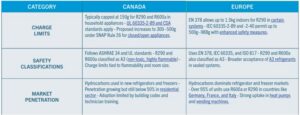
Europe, in particular, is leading the charge. The EU’s revised F-Gas Regulation will ban fluorinated refrigerants in small (less than 12 kW) heat pumps by 2035, unless safety concerns demand otherwise. Meanwhile, hydrocarbon-based heat pumps are no longer experimental. In Europe alone, hundreds of air-to-water and liquid-to-water systems using R290 are commercially available, with performance metrics that rival or exceed those of traditional HFC models. These systems are especially well-suited for outdoor units, where flammability risks are easier to manage. Manufacturers are also pushing into split systems and reversible air-to-air models, expanding the versatility of hydrocarbons across climate zones and building types.
The relevance of hydrocarbons is further increased by their compatibility with high-efficiency compressors, low-pressure operation, and competitive heat exchanger designs. As governments ramp up incentives for clean heating — and as fossil fuel bans take hold in places like Australia and parts of Europe — hydrocarbon heat pumps are poised to become a default choice for climate-conscious consumers and builders alike.
Air
Air can be utilized as a refrigerant with obvious environmental advantages. Due to the thermodynamic properties of air, efficiency is only achieved at considerably lower temperatures than commonly seen in cold storage and food processing. However, traditional mechanical refrigeration with air is not an option. For air refrigeration, the Brayton cycle (thermodynamics) would have to be utilized, which requires a large input of power due to the thermodynamic properties of air. Power consumption in air cycles is a direct function of temperature. Air as a refrigerant has some clear advantages under certain conditions (e.g., cooling air on jet planes, cooling processes below -60°F, etc.).
Water
Water may also be used as a refrigerant with the similar environmental advantages to air, but evaporating temperatures need to be kept above freezing unless temperature suppression additives are included. Analysis from many different sources show the potential for water to be capable of providing one of the highest efficiencies for all refrigerants.
Compressors could, in theory, be optimized for water as a refrigerant, but research, development, and manufacturing costs would have to be justified before this becomes a reality.
On February 8, 2024, Colmac Coil announced the completion of a project for the National Aeronautics and Space Administration (NASA) Jet Propulsion Laboratory (JPL) in building a replacement fluid cooler system for Deep Space Station 14. The cooler system will utilize natural refrigerants (water and air) for an application not previously attempted. For more information on the project, see Colmac Coil’s news page.
R NUMBERS – WHAT DO THEY MEAN?
R numbers are a system administrated by the American Society of Heating, Refrigerating and Air Conditioning Engineers, or ASHRAE, to designate different refrigerants. ASHRAE assigns the R-number of a chemical refrigerant, between two and four digits, according to its molecular structure.
Refrigerant blends also follow the naming convention according to the rules established in the ASHRAE’s Standard 34.
ASHRAE 34’s numbering scheme adjusts for whether or not there are carbon-carbon bonds or single carbon atoms but does not consider multiple bonds. The number of hydrogen, fluorine, and chlorine atoms determines the system of R numbers.
EDUCATION
The natural refrigeration industry has long developed training, education and standards to hasten the widespread adoption of its technologies. And now, as industrial refrigeration markets trend towards low GWP refrigerants, educational resources that demonstrate how to use them safely are becoming as critical as the systems themselves.
IIAR – The Academy of Natural Refrigerants
IIAR’s educational platform – the Academy of Natural Refrigerants – grew out of a need to gather the organization’s robust body of member-contributed knowledge and training into one place. IIAR’s suite of online certificate courses are designed to build technical proficiency in ammonia and other natural refrigerants.
These self-paced programs cover topics such as ANSI/IIAR standards, Process Safety Management (PSM), Risk Management Programs (RMP), and Ammonia Refrigeration Management (ARM). Each course includes lectures, quizzes, and a final exam. Attendees earn a certificate of completion and professional development hours (PDHs). These courses are accessible via the IIAR Learning Center.
IIAR’s monthly webinars—are both live and recorded—and cover different topics like regulatory updates, and best practices in natural refrigeration. Members can attend live sessions for free and access recordings on demand. And the sessions are also available for a fee to non-members. These webinars often qualify for RCEP-accredited professional development hours.
One of IIAR’s most important training areas is its suite of standards. Training on IIAR’s ANSI standards, including IIAR-2 (Safe Design), IIAR-4 (Installation), IIAR-6 (Maintenance), and IIAR-7 (Operating Procedures) is available as a standalone course or integrated into certificate programs. IIAR also publishes technical papers and guidelines that are accessible through the IIAR publications information portal – Publications Home.
Meanwhile, the IIAR Natural Refrigeration Conference & Heavy Equipment Expo, held each spring, is the natural refrigeration industry’s convention. Details and registration are available on the Events List.

University Programs and Trade Schools
The growth of natural refrigerants depends on a skilled workforce trained to handle the complexities of ammonia, CO₂, and hydrocarbon systems. Technical schools across the U.S. offer hands-on education and serve as gateways for new talent and continuing education.
IIAR has developed a searchable list of these industry-wide training programs. The Natural Refrigerant Training site lists companies across the industry that offer training on natural refrigerants.
Industry Groups and Resources
While IIAR is the premier organization for codes, standards and technical resources for the industrial refrigeration industry, several other groups provide specialized training and educational resources and work closely with IIAR.
Globally, IIAR is expanding the reach and use of ammonia via its own standards and close ties with several allied associations. These associations can be found on the IIAR Global Alliances web page as well as the Natural Refrigeration Directory.
PRACTICAL APPLICATIONS / BUSINESS ARGUMENT
Once viewed primarily through the lens of ozone protection and climate compliance, natural refrigerants have now emerged as strategic enablers of global decarbonization. From industrial food systems and energy districts to power generation and fuel innovation, their proven technical efficiency, low environmental impact, and expanding applications position them as catalysts for sustainable growth. With the backing of industry standards, modern decision tools, and robust policy alignment, natural refrigerants are redefining what is possible—not only in cooling, but across the broader climate economy.
Economic Advantages of Ammonia and Carbon Dioxide
For industrial refrigeration applications, ammonia and CO₂ refrigeration systems may cost less to design and install than systems using alternative synthetic refrigerants when compared on an in-kind system basis. Thermodynamically, ammonia and carbon dioxide are more efficient than other refrigerants; as a result, both systems use less power than systems with synthetic refrigerants.
The costs of CO₂, Ammonia and hydrocarbons per pound is significantly less (up to 10 times or more less) than the cost per pound of the process manufacturing-generated and patent synthetics.
In addition, less ammonia or carbon dioxide is generally required to meet the load requirements as compared to synthetic refrigerants. Regulatory programs (i.e., the EPA Refrigerant Management Requirements and the California Air Resources Board Refrigerant Management Program) also imply that leak rates are higher for synthetic refrigerants, thus consuming more synthetic refrigerant and resulting in higher cost.
Utilization of ammonia or CO₂ as refrigerants may lead to lower operating costs for food processors and cold storage facility operators. Energy costs are historically one of the most significant operating costs for cold storage operators.
Lower energy costs ultimately translate to lower grocery bills for the average household. GWP is a measure of how much energy the emissions of one ton of a given gas will absorb over a period of 100 years relative to one ton of CO₂ emissions over the same period. The amount of energy absorbed is a function of both the ability to absorb energy and how long the gas stays in the atmosphere.
This energy absorption prevents the energy from escaping to space and warms the earth’s surface. CO₂, while itself a greenhouse gas, is naturally occurring in the environment and, when used as a refrigerant, does not contribute to warming. It is the base by which other greenhouse gases are judged with a GWP rating of 1.0.
The table below summarizes the ODP, GWP, flammability, and toxicity values for selected refrigerants. The flammability and toxicity values are from the National Fire Protection Agency (NFPA 704).
Summary of Most Commonly Used Refrigerants and Their Environmental Impact
The following two charts demonstrate that newer refrigerant blends are still made of prohibited or banned substances:

NEW USES FOR NATURAL REFRIGERANTS
The widespread use of natural refrigerants is no longer confined to industrial refrigeration. As their technology expands, naturals are also finding new uses in the transportation, automotive, and marine sectors.
Shipping
In shipping, CO₂-based reefer containers are setting new standards for sustainability. These systems replace high-GWP synthetic refrigerants with R-744 (CO₂) and offer a global warming potential of just one.
Maritime
In maritime operations, natural refrigerants are used both as cooling agents and potential fuels. Ammonia (R-717) is gaining traction aboard fishing vessels and cargo ships for its zero-GWP and high thermodynamic efficiency, particularly in high-capacity systems.
In maritime applications, research groups like the Norwegian Foundation for Industrial and Technical Research, or SINTEF, are exploring CO₂-based heat pumps for onboard HVAC and provisioning systems, aiming to reduce fuel consumption and greenhouse gas emissions.
Automotive
In the automotive industry, automakers have unveiled a 2.0L ammonia-powered internal combustion engine, claiming a 90% reduction in carbon emissions compared to gasoline. Ammonia’s potential as a renewable, high-density fuel source is drawing attention –especially for long-haul and heavy duty applications.
Meanwhile, CO₂ heat pumps are being integrated into electric vehicle lineups. These systems offer thermal efficiency in cold climates and eliminate PFAS concerns tied to synthetic refrigerants.