






2026 Tech Paper: R-744 Heat Pumps with Ejectors: Key Performance Indicators and Control Strategies
Author:
Alessandro Silva, Oliver Javerschek, Andres Hegglin, Lukas Patryarcha, Shahriar Amini, Mustafa Erguvan
Abstract
This study experimentally investigates the use of ejectors in transcritical R-744 water-to-water heat pump systems, focusing on adjustable-nozzle control strategies to enhance energy efficiency and operational stability. Although R-744 systems offer several environmental and thermodynamic benefits, they often struggle to maintain optimal performance in real-world conditions due to the influence of fluctuating ambient temperatures and varying load profiles. This investigation was performed on a water-to-water R-744 heat pump installed at the SCHAUFLER Academy in Germany, which was equipped with a semi-hermetic reciprocating compressor and adjustable ejector technology. Performance was evaluated under several operating conditions. Key performance indicators included the coefficient of performance of heating (COPh), pressure lift, heating capacity, high-side pressure, gas cooler outlet temperature, and ejector opening ratio. The results demonstrated improved adaptability and control when variable nozzle geometries were applied, achieving pressure lifts of 2.2–5.0 bar (31.9–72.5 psi) and heating capacities of 28.6–39.1 kW (97.6–133.4 kBTU/h). Under low-pressure lift conditions, COPh values ranged from 3.91 to 5.44. In addition, this study assessed several advanced control strategies, such as pinch-point regulation and adaptive algorithms, which proved effective at improving pressure stability and heat exchanger effectiveness.
Introduction
The decarbonization of heating and cooling across sectors, such as manufacturing, commercial buildings, grocery stores, food processing plants, cold storage facilities, and district heating networks, is essential to achieve global climate targets and is at the center of climate mitigation efforts. Vapor compression heat pump systems play a crucial role in this transition due to their high energy efficiency, particularly when powered by renewable electricity. By converting low-grade thermal energy into useful heat with minimal emissions, these systems represent one of the most effective means of reducing fossil fuel dependence (de Boer et al., 2020; National Academies of Sciences, Engineering, and Medicine [NASEM], 2021). As decarbonization efforts intensify and efficiency standards become more stringent, the transition toward ecofriendly technologies has accelerated the adoption of natural refrigerants such as R-744 in refrigeration, air conditioning, and heat pump applications (ATMOsphere, 2024). R-744 is distinguished by its negligible global warming potential (GWP = 1) and zero ozone depletion potential (ODP), positioning it as a greener alternative to synthetic refrigerants. In addition, its favorable thermophysical properties allow for high outlet temperatures, which are ideal for heat pump applications.
Despite these advantages, transcritical R-744 systems are constrained by significant throttling losses (Elbel, 2011). The pronounced pressure difference between the gas cooler and the evaporator results in considerable to considerable exergy destruction, reducing the overall cycle efficiency. Several enhancement strategies have been proposed to address these limitations, including two-phase ejectors, vortex tubes, expanders, mechanical subcooling, flash gas bypass (FGB), parallel compression, two-stage compression, and evaporative pre-cooling. Of these alternatives, ejector integration has received a significant amount of attention: Elbel and Hrnjak (2008) pioneered the application of two-phase ejectors in transcritical R-744 cycles, reporting coefficient of performance (COP) improvements of approximately 7%. They also introduced a variable-geometry ejector equipped with a needle mechanism that dynamically adjusts the throat diameter to accommodate a wide range of operating conditions. Since their seminal work, several subsequent studies have refined the ejector design and control across a range of applications, including industrial refrigeration systems, heat pumps, supermarket refrigeration systems, dairy processing, marine chillers, and both residential and automotive air conditioning systems. Collectively, these studies have consistently demonstrated that ejectors exhibit higher efficiency and greater operational flexibility compared to conventional throttling devices.
Effective control strategies are crucial for optimizing ejector performance under off-design conditions. For example, Xu et al. (2012) used a stepper-motor nozzle to adjust the throat area based on gas cooler outlet conditions, allowing for increased COP despite low ejector efficiency. Liu et al. (2023) found that discharge–pressure optimization in two-stage systems improved efficiency by 5.7%. Lawrence and Elbel (2019) showed that poor control could lead to significant performance losses, highlighting the importance of dynamic regulation. Gullo et al. (2021) applied pulse-width modulation control in small-scale R-744 systems, improving COP by over 5% compared to passive ejectors and by 10% compared to baselines. Ding et al. (2024) developed a non-equilibrium flow model that leveraged precise inlet pressure and temperature control to achieve 31% ejector efficiency and reduce exergy destruction from 48.3% to 10.2%. Zhu and Elbel (2020) proposed a vortex-based control method that regulated high-side pressure through inlet swirl, yielding an 11% increase in capacity and an 8.1% increase in COP without geometric modification.
Complementary modeling and review studies have further expanded our understanding of ejector design and control. Sisti et al. (2023) developed a dynamic model of a transcritical R-744 chiller validated using hybrid proportional-integral-derivative (PID) and rule-based control under 15-100% part-load ranges. Gullo et al. (2020) reviewed capacity control methods for two-phase ejectors, concluding that medium- and large-scale applications are relatively mature, but small-scale systems remain challenging. Barta et al. (2021) introduced and validated a design tool that generates internal geometries from performance targets, accurately predicting efficiency trends and guiding design optimization.
This study experimentally investigates variable-nozzle ejector control strategies under dynamic operating conditions in a transcritical R-744 water-to-water heat pump. By integrating laboratory data with analytical modeling, this study demonstrates how variable-geometry ejectors can overcome limitations associated with conventional methods, thus facilitating large-scale implementation. Despite some promising progress, systematic evaluations of advanced control methods in transcritical R-744 water-to-water systems remain scarce. These systems present distinct challenges, including dynamic load profiles and off-design operation, which are seldom addressed in prior studies. This work seeks to fill this knowledge gap through detailed experiments at the SCHAUFLER Academy. The system is designed for lowpressure lift applications and can operate in either ejector-assisted or FGB modes. Although direct experimental comparison with FGB applications is beyond the scope of this study, it represents an important avenue for future research.
Methods
System Set Up
The evaluations were conducted using the experimental R-744 heat pump system at the SCHAUFLER Academy, which was configured and instrumented for the detailed measurement of ejector KPIs and control strategies with the aim of extending previous research through comprehensive experimental validation. The waterto-water heat pump is equipped with a 4MTEU-10LK semi-hermetic compressor with a displacement of 6.5 m³/h (3.83 CFM) at 50 Hz (1500 rpm). The compressor is driven by a line-start permanent magnet (LSPM) motor and controlled via a variable-frequency drive operating between 25 and 70 Hz. Active oil management is accomplished using an oil separator, a low-pressure oil reservoir, and an oil level controller. The lubricant used in this system is polyalkylene glycol (PAG) oil with a kinematic viscosity of 68 mm²/s (316 SUS) at 40°C (104°F). Additional components include plate heat exchangers that serve as an evaporator and gas cooler, water pumps, an internal heat exchanger, a horizontal flash gas tank, and an adjustable ejector operating in low-pressure-lift mode. Control and monitoring are managed by a controller with oscilloscope logging. A three-way valve (1) regulates the gas-cooler inlet temperature using a 1,000 liter hot-water tank (264.2 gallons). Figure 1 presents an overview of the R-744 heat pump system with its key components. Further details on the specifications of the system and its operation can be found in Silva et al. (2024).
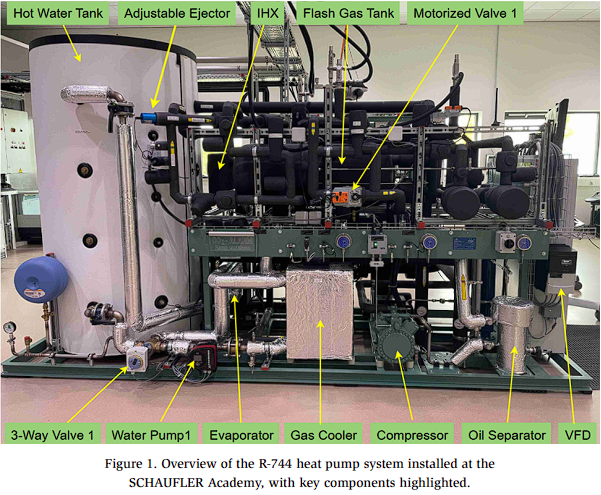
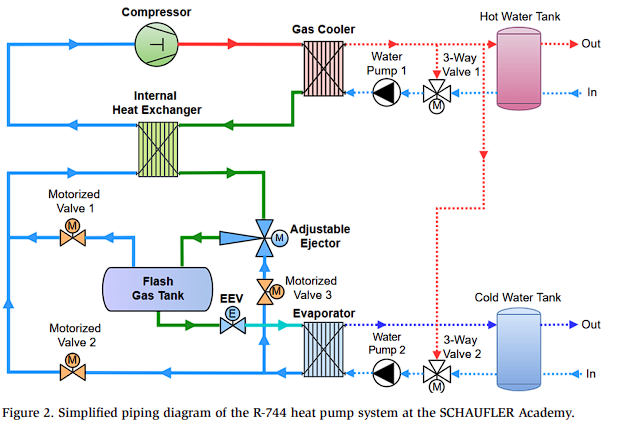
Figure 2 presents the simplified piping diagram of the R-744 heat pump system. In a previous system on industrial-scale R-744 systems, Simon et al. (2022) developed and validated calculation models for variable geometry ejectors using experimental data from the SCHAUFLER Academy’s refrigeration and heat pump systems as well as field measurements at OEM sites. During the initial measurements, the system operated without a Coriolis mass flow meter in the liquid line; this instrument has since been added to improve accuracy. To verify the reliability of the previously collected data, a comparative analysis was performed using time-averaged liquid mass flow rates; these values were cross-checked against two independent mass flow estimates:
1) a water-side energy balance around the gas cooler and compressor maps, and
2) estimates derived from ejector performance and vapor quality data. The results revealed a relative deviation of only 1.6% (483.3 kg/h [1065.7 lb/h] vs. 475.5 kg/h [1048.4 lb/h]). Planned upgrades to the system include the installation of a second flow meter on the compressor suction line.
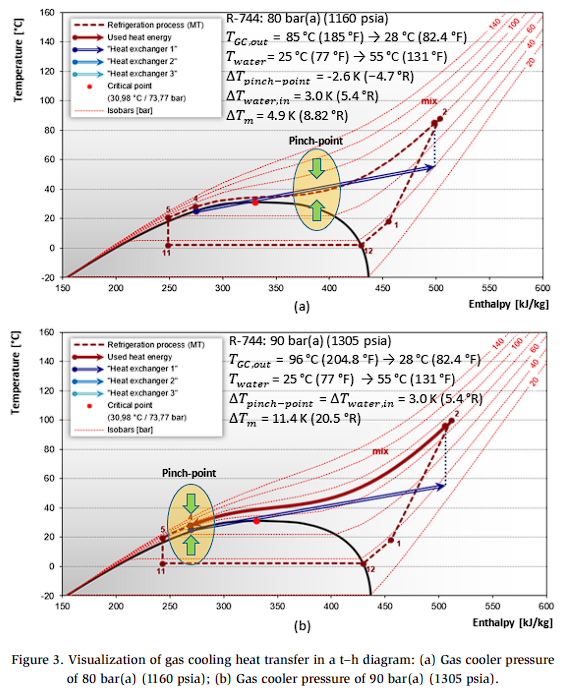
The R-744 heat pump system incorporates continuous high-pressure monitoring to support the control strategy and maintain stable and efficient operation. The primary control objective is to keep the high-side pressure steady while regulating the water outlet temperature and the overall system power through precise water flow rate adjustments. As illustrated in the t–h diagram presented in Figure 3, heating water from 25°C (77°F) to 55°C (131°F) cannot be achieved at a gas cooler pressure of 80 bar(a) (1160 psia), as this pressure does not provide the necessary thermal conditions (Figure 3a). In contrast, increasing the pressure to approximately 90 bar(a) (1305 psia) allows the system to reach the desired outlet temperature (Figure 3b).
Javerschek (2020) demonstrated that increasing the system pressure has a strong influence on the , particularly when minimum pinch-point temperature requirements are satisfied. This highlights the interdependence between pressure regulation and thermal efficiency in transcritical R-744 heat pumps, where maintaining a small pinch-point (≈ 3 K [5.4°R]) between the gas cooler and water circuit is essential for effective heat transfer. Simulation results have shown that gas cooler pressures between 85–100 bar(a) (1233–1450 psia) provide optimal thermal gradients, particularly when operating with a 40°C (104°F) water inlet and a 55°C (131°F) outlet temperature. Although higher discharge pressures reduce the pinch-point and improve heat transfer, efficiency increases are diminished beyond this optimal range. At 70 Hz and 90 bar(a) (1305 psia), both standard TE and high-efficiency TE+ compressors with LSPM motors achieved an identical 3 K (5.4°R) pinch-point, with the TE+ compressors exhibiting slightly lower efficiencies. LSPM motors delivered superior performance at lower frequencies (≈ 25 Hz) due to reduced slip, higher mass flow, and lower discharge temperatures. Overall, adaptive high-pressure regulation optimizes the COPh, improves gas–cooler heat exchange, and minimizes compressor energy consumption under a range of thermal loads.
This study examines the effect of variable-nozzle area control in the ejector of the R-744 heat pump system at the SCHAUFLER Academy under varying operating conditions. Experiments were conducted with the compressor running at a constant frequency of 48 Hz and a gas cooler pressure of 91 bar(a) (1320 psia) ± 0.4 bar (± 5.8 psi). Variations in driving mass flow were achieved by adjusting the evaporation temperature to −2.6°C (27.3°F), 2.0°C (35.6°F), 7.0°C (44.6°F), and 10.3°C (50.5°F), with time-averaged deviations of ± 0.1 K (0.18°R) to ± 0.4 K (0.72°R). The warm-water outlet temperature was maintained at 43°C (109.4°F) ± 0.3 K (0.54°R) using the three-way valve (1), resulting in average gas cooler outlet temperatures between 30.3°C (86.5°F) and 34.0°C (93.2°F).
System Performance Calculations
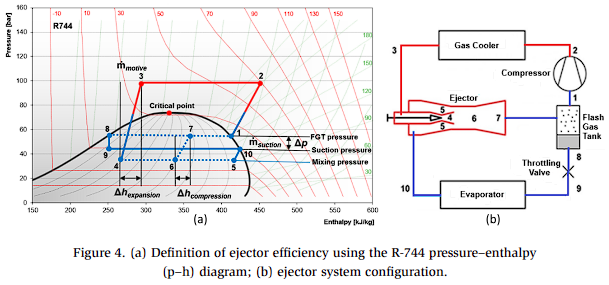
Elbel (2011) identified several key parameters that can be used to evaluate the performance of two-phase expansion ejectors: pressure ratio, pressure lift, mass entrainment ratio, and ejector efficiency. High performance is achieved when a large pressure lift occurs with a high suction mass flow rate. The pressure ratio (Equation 1) refers to the ratio between the diffuser outlet and the suction inlet pressure, and serves as an indicator of pressure augmentation. The pressure lift (Equation 2) refers to the difference between the diffuser outlet and suction inlet pressures. The mass entrainment ratio (Equation 3) is the suction-to-motive mass flow ratio, which reflecting entrainment capacity of the ejector. Ejector efficiency (Equation 4) is an expression of the amount of energy recovered during expansion relative to the work required to compress both flows. Figure 4(a) presents the R-744 pressure–enthalpy (p–h) diagram used to define the ejector efficiency, while Figure 4(b) presents the ejector system configuration.
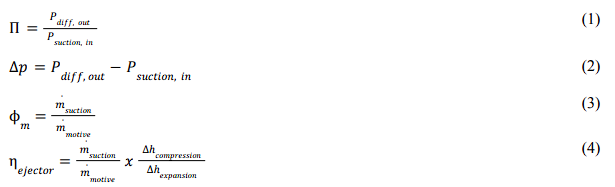
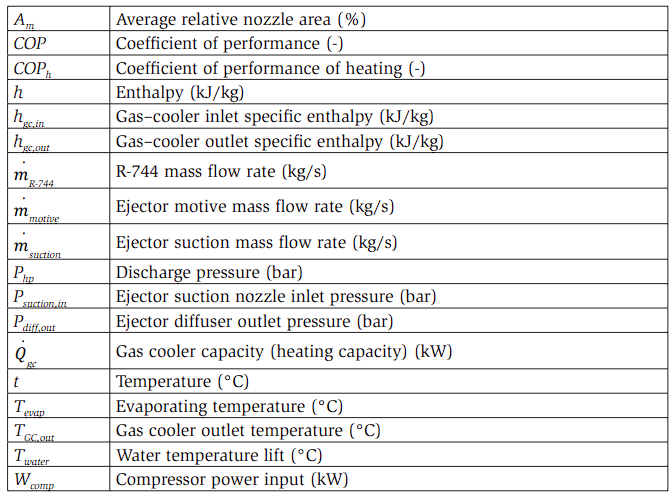
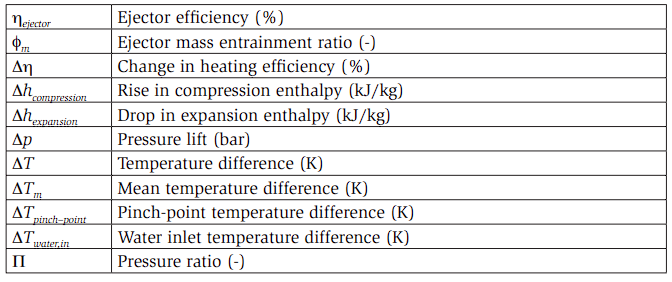
In Equations 1–4, Π represents the pressure ratio; Pdiff,out and Psunction, in are the ejector diffuser outlet pressure and suction nozzle inlet pressure in bar, respectively; Δp is the pressure lift in bar; φm is the mass entrainment ratio; and msunction and mmotive are the suction mass flow rate and the motive nozzle mass flow rate in kg/s, respectively; ηejector is the ejector efficiency; and Δhcompression represent the compression enthalpy rise and expansion enthalpy drop in kJ/kg, respectively. Ejector performance calculations were carried out in accordance with the first and second laws of thermodynamics and subject to the following simplifying constraints:
- All processes were assumed to operate under steady-state conditions.
- Pressure losses in the gas cooler, evaporator, IHX, and interconnecting piping were neglected.
- The amount of compressor oil mixed with the refrigerant during heat transfer is assumed to be negligible.
- Variations in the kinetic and potential energy of the working fluid were considered to be negligible.
- The system was treated as adiabatically isolated, with no heat exchange with the surroundings.
- The expansion and compression processes within the ejector were assumed to be isentropic.
- The working fluid at the ejector inlet was assumed to be either superheated or dry saturated vapor, consistent with standard thermodynamic modeling practice.
COPh is a fundamental performance indicator used to assess the performance of the R-744 heat pump system. This parameter refers to the ratio between the useful heating capacity delivered by the system and the corresponding energy input as defined in Equation 5. The contribution of the ejector to overall system performance can be assessed by examining the relative improvement in COPh when the ejector is integrated into the cycle. Accordingly, Equation 6 defines the gas cooler capacity, i.e., the heating capacity of the system.

where COPh is the coefficient of performance (heating); Qgc is the gas cooler capacity (or heating capacity) in kW; Wcomp is the compressor power input in kW; mR-744 is the R-744 mass flow rate in kg/s; and hgc,in and hgc,out are the specific enthalpies at the gas cooler inlet and outlet in kJ/kg, respectively.
KPI Calculations
Several tests were conducted to examine the relationship between evaporating temperature and ejector performance parameters, including average relative nozzle area, heating capacity, pressure lift, and efficiency. Figure 5 presents the results of these analyses, showing that the average nozzle area (Am) varied between 73.1–85.9% while the heating capacities ranged from 28.6–39.1 kW (97.6–133.4 kBTU/h) as the evaporating temperature rose from −4°C (24.8°F) to 12°C (53.6°F) at 90 bar (1305 psi). The COPh during low-pressure lift operation ranged from 3.91 to 5.44. These results show that the heating capacity increases with both larger nozzle openings and at higher evaporation temperatures, confirming the influence of ejector modulation on system performance. However, these data cannot be directly used to determine the seasonal coefficient of performance (SCOP) or seasonal energy efficiency ratio (SEER) evaluation under EN 14825:2022.
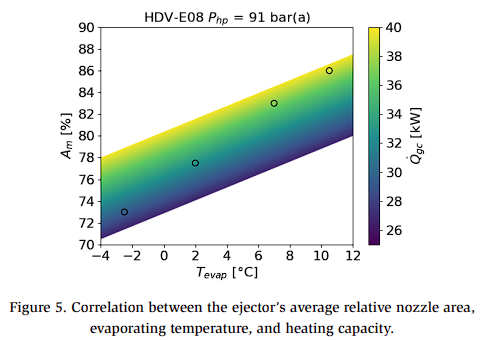
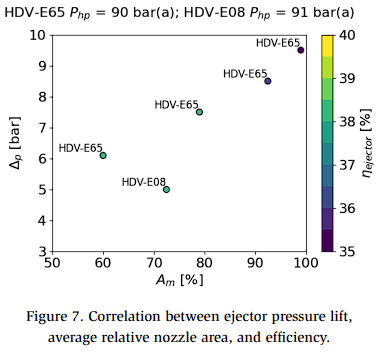
Figure 6 illustrates the effect of evaporating temperature on pressure lift, which ranged from 2.2 bar (31.9 psi) to 5.0 bar (72.5 psi) as the temperature increased from −4°C (24.8°F) to 12°C (53.6°F). A quadratic regression was applied to extrapolate the data and assess its predictive accuracy. For the HDV-E08 ejector, efficiencies ranged from 23.0% to 38.5%, while Javerschek et al. (2024) reported similar trends for the HDV-E65 ejector. The estimated uncertainties were ±3% for COPh and efficiency and ±0.1 bar (1.45 psi) for pressure lift. These findings highlight the strong influence of ejector geometry on pressure lift and demonstrate that regressionbased extrapolation can effectively predict performance beyond the experimentally tested range.
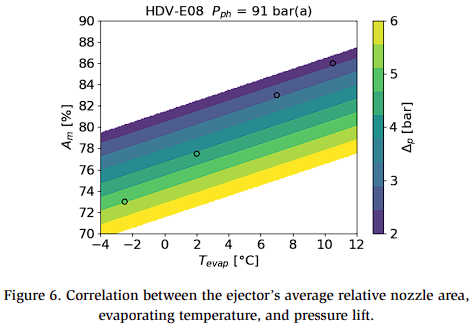
Figure 7 shows that the HDV-E65 ejector delivers a significantly higher pressure lift than the HDV-E08; this is consistent with ejector theory, which predicts that larger ejectors provide greater pressure lift at the same relative nozzle area due to higher motive mass flow. At a relative nozzle area of 73.1%, the HDV-E65 achieved a pressure lift that was 1.7 bar (24.7 psi) higher while maintaining efficiency levels that were comparable to those reported by Elbel (2011). These results confirm that increasing the ejector size can increase pressure lift without compromising efficiency and emphasize the importance of precise nozzle area modulation for balancing lift and efficiency in high-capacity R-744 heat pump systems.
Control Strategies
Integrating Ejector Opening Control with Compressor Frequency and Power
Compressors regulated by suction pressure inherently respond to variations in cooling load, which directly influence compressor power consumption as well as the thermal load on the gas cooler. Consequently, excess heat must be effectively dissipated to maintain a high system efficiency. By integrating ejector opening control with the compressor load, this configuration aims to improve system stability and efficiency by linking the cooling load with the heat rejected in the gas cooler. However, suctioncontrolled compressor control and gas cooler pressure regulation have traditionally been managed as independent control loops: in this system, the gas cooler controller maintains an optimal pressure that varies with the thermal load to be dissipated.
External factors, such as ambient temperature, fan speed, solar radiation, fouling, and dirt accumulation, often introduce disturbances that affect heat rejection. Directly linking the ejector opening to the compressor load would suppress these influences, effectively creating an open-loop configuration for the gas cooler. Consequently, closed-loop control strategies based on the leaving water or air temperature and the corresponding optimal pressure are preferred. Field experience indicates that the coordination of fan operations (in terms of both number and speed) with compressor performance can improve overall efficiency. Consequently, several studies have focused on advanced control strategies that integrate ejector operation into the broader system framework for improved performance and reliability (Nawaz et al., 2018; Rony et al., 2019).
Pinch-Point Control
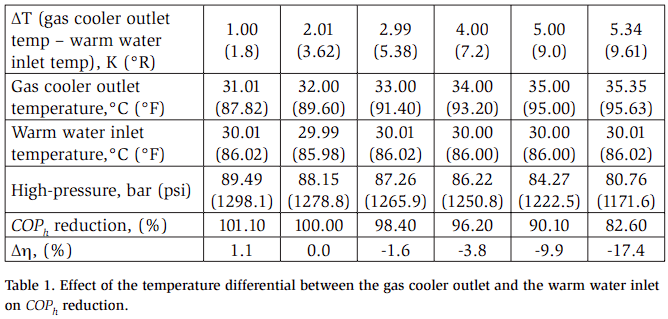
In heat pumps and refrigeration systems that use R-744 as a refrigerant, the gas cooler curve is typically selected to maximize COPh by balancing the power input for a given high-pressure and gas cooler outlet temperature (Okasha & Müller, 2018). Figure 8a illustrates that the evaporating temperature is another important parameter for optimizing COPh. However, experimental measurements using plate heat exchangers have revealed an offset between the designed gas cooler outlet and warm-water inlet temperatures. Table 1 summarizes the effect of varying temperature differentials on COPh reduction, relative to a design reference value of 1.9 K (3.4°R).
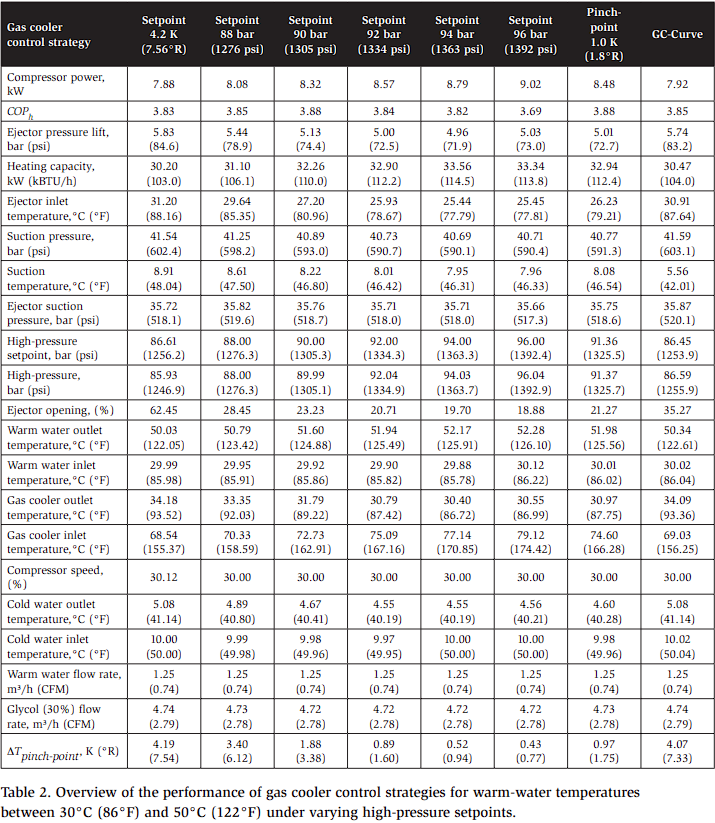
In the experimental setup examined in this study, a temperature differential of 4.2 K (7.6°R) was maintained using the gas cooler control. Experimental measurements were carried out with warm-water temperatures ranging between 30°C (86°F) and 50°C (122°F). The system featured a constant water flow rate, temperature difference control between the gas cooler outlet and the warm-water inlet, and compressor speed control to meet the required heating load.
An alternative approach is to directly regulate the desired temperature differential between the gas cooler outlet and the warm-water inlet with the aim of maintaining the minimum allowable temperature difference at the gas cooler outlet. In this study, this strategy is referred to as pinch-point control. Figure 8b illustrates the implementation of the pinch-point control in the gas cooler. This technique uses the desired temperature differential—ideally determined from the design specifications of the gas cooler—as the control setpoint. The system pressure is then dynamically adjusted to achieve maximum operating efficiency. When the measured temperature differential exceeds the setpoint, the pressure increases until the differential returns to the target value. Conversely, when the measured differential falls below the setpoint, the pressure is reduced until it matches the desired value.
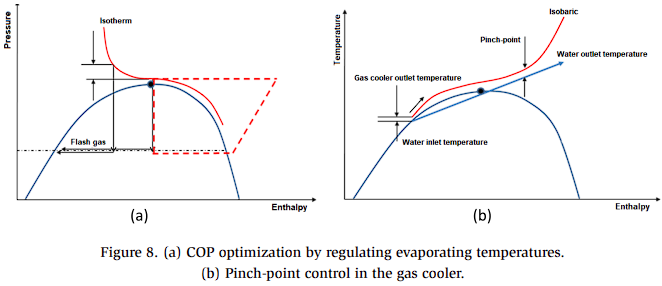
Table 2 summarizes the gas cooler operating conditions for warm-water temperatures ranging from 30°C (86°F) to 50°C (122°F) under different constant high-pressure setpoints. Increasing the high-pressure setpoint increases the heating capacity to an optimum value, beyond which further pressure increases reduce COPh without additional capacity gains. Gas cooler curve control (GC-Curve) yielded favorable COPh relative to compressor power, while a 1 K pinch-point delivered the highest COPh and possessed a greater heating capacity. All tests assumed constant water flow, compressor speed, and inlet temperatures. Measurements performed using a gravity and direct expansion evaporator in series without an internal heat exchanger; the results showed that the ejector opening closely followed the control signal. Pinchpoint control allowed for efficient heat extraction, consistent with results reported by Liao and Jakobsen (1998) across a range of evaporating temperatures.
Liquid Ejector Applications
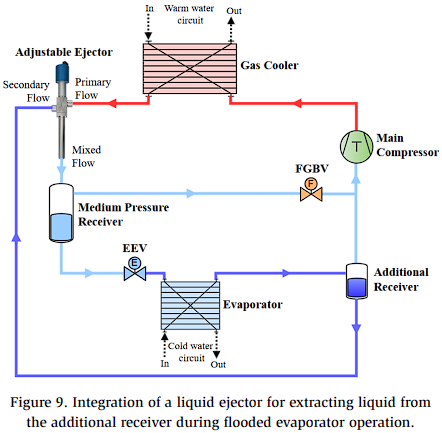
Figure 9 illustrates the application of liquid ejectors in transcritical R-744 systems. These configurations improve the stability of flooded evaporators by extracting liquid from the additional receiver in which the superheat is reduced to about 0 K (0°R). This allows for fully flooded evaporator operation, lowers the pressure ratio and compressor workload, and improves overall system efficiency. However, it also introduces the risk of liquid carryover into the compressor, potentially causing oil displacement, poor lubrication, and instability. To prevent this, these systems typically employ either an internal heat exchanger to ensure complete vaporization or a vapor-liquid separator that removes any excess liquid. The separator is periodically drained by a liquid ejector on the high-pressure side, which is activated when liquid levels exceed a predefined threshold. This configuration enhances energy efficiency and reliability while maintaining stable refrigerant levels under a variety of loads.
High-Pressure Lift Applications with Gas Ejectors
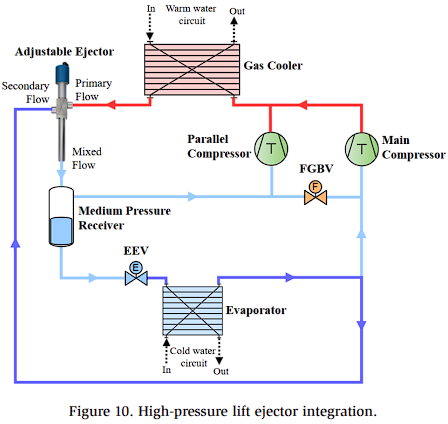
Figure 10 illustrates a high-pressure lift configuration in which the gas ejector transfers refrigerant from the evaporator suction level to the medium-pressure receiver. A fraction of the evaporator mass flow passes through the ejector to the medium-pressure receiver, while the remaining mass flow returns to the main compressor. If the ejector suction pressure decreases due to low discharge pressures or reduced mass flow, the main compressor will compensate accordingly. A check valve or a modulating valve is employed to prevent reverse flow, which opens only when the high-side pressure, refrigerant mass flow rate, and suction pressure meet predefined threshold conditions. The parallel compressor recompresses vapor extracted from the medium-pressure receiver and operates in conjunction with the flash gas bypass valve (FGBV). When the ejector suction pressure increases, the FGBV is reactivated, thereby maintaining proper mass-flow distribution, pressure stability, and efficient operation under varying load conditions.
Low-Pressure Lift Applications with Gas Ejectors
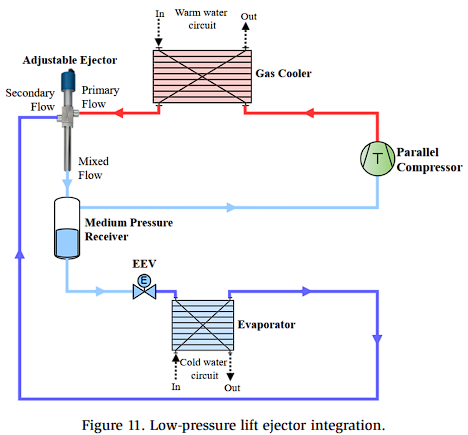
Figure 11 presents a low-pressure lift configuration in which the ejector returns the entire refrigerant mass flow from the evaporator to the medium-pressure level, thereby eliminating the need for a main compressor and a high-pressure control valve. In this configuration, the required pressure lift is maintained by the ejector operating at maximum motive flow. However, refrigerant backflow may occur since suction pressure control relies solely on the ejector. In some systems, a refrigerant pump or an appropriate valve arrangement allows the system to switch to a two-stage configuration. In such cases, the parallel compressor regulates both the intermediate and evaporator suction pressures, using pressure transducers to ensure dynamic stabilization and efficient operation under variable operating conditions.
Further Analysis of Ejector Control Strategies
Effective ejector control strategies in refrigeration and heat pump systems are vital for maintaining optimal performance and operational stability. Ejectors regulate suction power through the interaction of high, intermediate, and suction pressures, which must remain within stable limits to prevent efficiency losses. Traditional controllers such as PID, two-point, and three-point schemes are widely used for their simplicity but often exhibit limited adaptability under dynamic conditions. Supplementary controllers can improve responsiveness during transient events by compensating for large deviations from their standard operating conditions.
Adaptive control strategies provide systems with greater flexibility by adjusting control actions in real time in response to changing system conditions, particularly during transitions between subcritical and transcritical operations. These controllers integrate component-based models, such as evaporators and ejectors, to better predict mass flow and heat transfer behavior. Modern systems synchronize ejector, expansion valve, and compressor operations to maintain stable suction and intermediate pressures. Modifying the intermediate pressure setpoint can significantly affect ejector performance, especially in low pressure lift applications where the ejector regulates high pressure.
Conclusion
This study presents recent advancements in R-744 heat pump systems that employ ejectors, focusing on low-pressure lift configurations. Experiments at the SCHAUFLER Academy showed that adjustable-nozzle ejectors can enhance system efficiency, achieving heating capacities ranging from 28.6–39.1 kW (97.6–133.4 kBTU/h), COPh values between 3.91–5.44, and pressure lifts of 2.2–5.0 bar (31.9–72.5 psi) with efficiencies of 23–38.5% for the HDV-E08 ejector. Larger ejector models, such as the HDV-E65, achieved even higher lifts, emphasizing the importance of appropriate ejector sizing.
Advanced control strategies, including pinch-point regulation and adaptive algorithms, are effective at stabilizing pressures and improving heat exchange performance. Overall, the results show that R-744 heat pumps with adjustable ejectors can achieve high efficiency and operational stability under off-design conditions, providing a strong foundation for further optimization, digital twin development, and integration into district heating and heat recovery applications.
Nomenclature
Greek symbols
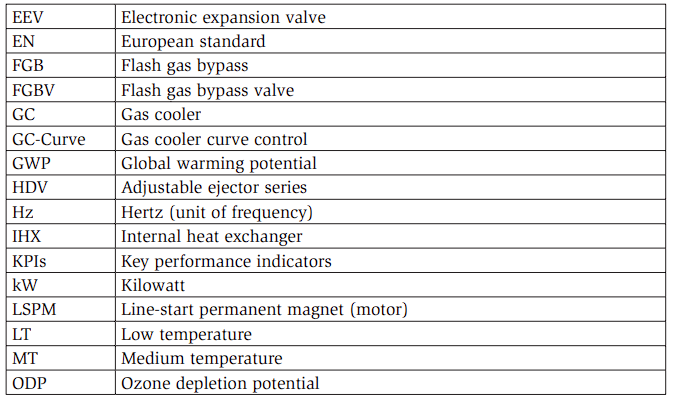
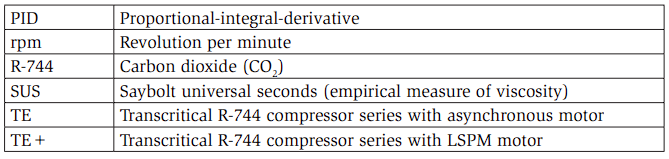
Acronyms
Acknowledgements
The authors gratefully acknowledge the support, technical assistance, and research materials provided for this investigation by the College of Engineering of the University of Alabama, BITZER US, BITZER Kühlmaschinenbau GmbH, SCHAUFLER Academy, Wurm GmbH & Co. KG, and E-jector AG.
References
ATMOsphere. (2024). Natural refrigerants: State of the industry—Refrigeration in Europe, North America, Japan, Australia, New Zealand and Latin America (2024 report). AtmoSphere. https://atmosphere.cool/wp-content/uploads/2025/02/2024_ATMO_Marketreport-compressed.pdf
Barta, R. B., Dhillon, P., Braun, J. E., Ziviani, D., & Groll, E. A. (2021). Design and optimization strategy for ejectors applied in refrigeration cycles. Applied Thermal Engineering, 189, 116682. https://doi.org/10.1016/j.applthermaleng.2021.116682
de Boer, R., Marina, A., Zühlsdorf, B., Arpagaus, C., Bantle, M., Wilk, V., Elmegaard, B., Corberán, J., & Benson, J. (2020). Strengthening industrial heat pump innovation: Decarbonizing industrial heat. Technical University of Denmark. https://orbit.dtu.dk/en/publications/aa0f3bc9-0556-43a1-8ef7-1d3e64723ddc
Ding, H., Dong, Y., Yang, Y., & Wen, C. (2024). Performance and energy utilization analysis of transcritical CO2 two-phase ejector considering non-equilibrium phase changes. Applied Energy, 372, 123810. https://doi.org/10.1016/j.apenergy.2024.123810
Elbel, S. (2011). Historical and present developments of ejector refrigeration systems with emphasis on transcritical carbon dioxide air-conditioning applications. International Journal of Refrigeration, 34(7), 1545 1561. https://doi.org/10.1016/j.ijrefrig.2010.11.011
Elbel, S., & Hrnjak, P. (2008). Experimental validation of a prototype ejector designed to reduce throttling losses encountered in transcritical R-744 system operation. International Journal of Refrigeration, 31(3), 411–422. https://doi.org/10.1016/j.ijrefrig.2007.07.013
EN 14825:2022. (2022). Air conditioners, liquid chilling packages and heat pumps, with electrically driven compressors, for space heating and cooling, commercial and process cooling—Testing and rating at part load conditions and calculation of seasonal performance. http://refhub.elsevier.com/S2352-7102(24)00586-2/sref15.
Gullo, P., Birkelund, M., Kriezi, E. E., & Kærn, M. R. (2021). Novel flow modulation method for R744 two-phase ejectors–Proof of concept, optimization and first experimental results. Energy Conversion and Management, 237, 114082. https://doi.org/10.1016/j.enconman.2021.114082
Gullo, P., Kærn, M. R., Haida, M., Smolka, J., & Elbel, S. (2020). A review on current status of capacity control techniques for two-phase ejectors. International Journal of Refrigeration, 119, 64-79. https://doi.org/10.1016/j.ijrefrig.2020.07.014
Javerschek, O. (2020, July 6). Calculation, simulation and applications of commercial and light industrial CO2 heat pumps. Eurammon Web Seminar. https://2020.eurammon.com/images/eurammon/events/symposium-2020/presentations/Day-5-Javerschek-Calculation-Simulation-and-Application-of-Commercial-and-LightIndustrial-CO2-Heat-Pumps.pdf
Javerschek, O., Silva, A., & Boscan, M. (2024). R-744 heat pumps with ejectors: Projects, objectives and results. In Proceedings of the 11th IIR Conference on Compressors and Refrigerants. https://cochkt.sk/a/conf/submissions/629?locale=en_GB
Lawrence, N., & Elbel, S. (2019). Experimental investigation on control methods and strategies for off-design operation of the transcritical R744 two-phase ejector cycle. International Journal of Refrigeration, 106, 570-582. https://doi.org/10.1016/j.ijrefrig.2019.04.020
Liao, S., & Jakobsen, A. (1998). Optimal heat rejection pressure in transcritical carbon dioxide air conditioning and heat pump systems. In Proceedings of the IIR Gustav Lorentzen Conference on Natural Working Fluids, June 2–5. https://iifiir.org/en/fridoc/optimal-heat-rejection-pressure-in-transcritical-carbon-dioxide-air-17036
Liu, G., Li, H., Lu, Z., Wang, Y., & Gong, Y. (2023). Self-optimized efficient operation of trans-critical CO2 ejector-expansion heat pump water heater system with twostage evaporation. Energy and Buildings, 300, 113659. https://doi.org/10.1016/j.enbuild.2023.113659
National Academies of Sciences, Engineering, and Medicine. (2021). Accelerating decarbonization of the U.S. energy system. The National Academies Press. https://doi.org/10.17226/25932
Nawaz, K., Shen, B., Elatar, A., Baxter, V., & Abdelaziz, O. (2018). Performance optimization of CO2 heat pump water heater. International Journal of Refrigeration, 85, 213-228. https://doi.org/10.1016/j.ijrefrig.2017.09.027
Okasha, A., & Müller, N. (2018). Simulation and performance correlation for transcritical CO2 heat pump cycle. In Proceedings of the 17th International Refrigeration and Air Conditioning Conference at Purdue, July 9–12. https://docs.lib.purdue.edu/cgi/viewcontent.cgi?article=3055&context=iracc
Rony, R. U., Yang, H., Krishnan, S., & Song, J. (2019). Recent advances in transcritical CO2 (R744) heat pump system: A review. Energies, 12(3), 457. https://doi.org/10.3390/en12030457
Silva, A., Javerschek, O., & Simon, F. R744 Heat Pumps with Ejectors for Heating and/or Cooling: Opportunities, Challenges, and Results. In Proceedings of the 16th IIR Gustav Lorentzen Conference on Natural Refrigerants, August 11-14. http://dx.doi.org/10.18462/iir.gl2024.1177
Simon, F., Pfaffl, J., & Javerschek, O. (2022). Introduction of an Ejector for Industrial Scale CO2 Systems. In Proceedings of the 19th International Refrigeration and Air Conditioning Conference at Purdue, July 11 14. https://docs.lib.purdue.edu/iracc/2493
Sisti, E., Rossetti, A., Minetto, S., Marinetti, S., Tosato, G., Beghi, A., & Rampazzo, M. (2023). Assessment of basic control strategies through dynamic simulations: A CO2-based chiller under extreme off-design conditions. Energy and Buildings, 289, 113066. https://doi.org/10.1016/j.enbuild.2023.113066
Xu, X. X., Chen, G. M., Tang, L. M., & Zhu, Z. J. (2012). Experimental investigation on performance of transcritical CO2 heat pump system with ejector under optimum high-side pressure. Energy, 44(1), 870–877. https://doi.org/10.1016/j.energy.2012.04.062
Zhu, J., & Elbel, S. (2020). Experimental investigation into the influence of vortex control on transcritical R744 ejector and cycle performance. Applied Thermal Engineering, 164, 114418. https://doi.org/10.1016/j.applthermaleng.2019.114418