




2021 Technical Paper #13
Sustainable Use Cases for Ammonia as a Refrigerant in Residential/Light-Commercial HVAC
Author:
Vikas Patnaik, PhD, MBA Vice President of Product Development, Modern Electron
Michael Garrabrant, President, Stone Mountain Technologies, Inc.
Abstract
A significant amount of research and development has gone into the deployment of ammonia as a refrigerant in air conditioning and heat pump systems, going back to the first half of the twentieth century. This presentation provides an overview of the basic thermodynamic cycles currently in application/development/consideration, the accompanying hardware systems in various stages of maturation, and the pros and cons of using this earliest of refrigerants that continues to provide some of the most promising performance – both in terms of all-around environmental impact and energy (resource) consumption.
Introduction
Ammonia is the oldest known refrigerant still in use in air conditioning and refrigeration equipment. Its early competitors, sulfur dioxide and methyl chloride, ceased to be used due to high toxicity. Ammonia persisted owing to its superior thermodynamic properties and plentiful availability as a natural refrigerant (and consequent low cost). However, its toxicity and mild flammability gave rise to the search for alternatives in the early part of the twentieth century, and ultimately to the advent of the chlorofluorocarbons (CFCs) and hydrochlorofluorocarbons (HCFCs).
The “designer” properties and long, successful implementation of these synthetic refrigerants notwithstanding, by the mid-1980s, the presence of CFCs and HCFCs in the Earth’s stratosphere was seen as the primary contributor to the widening hole in the ozone layer above the South Pole. Further development led to the promulgation of the hydrofluorocarbons (HFCs) in heating, ventilation, air-conditioning, and refrigeration (HVAC&R) equipment since the early 90s, but these in turn were found to be greenhouse gases, attributable to the growing warming of the planet and related climate change.
Today, governments from around the world have come together to define a roadmap for phasing out or phasing down the refrigerants known to be the most harmful to the environment. Starting with the Montreal and Kyoto Protocols from the previous century through the more recent Paris and Kigali Agreements, a clear pathway has been laid out for the phase-out of the CFCs and HCFCs, and the phase-down of HFCs, differing by socioeconomic region (e.g., developed vs. emerging nations). These global regulations are over and above regional regulations regarding refrigerant emissions, such as the F-Gas regulation in Europe or the CEC regulation in California.
While significant R&D efforts by the major refrigerant manufacturers, OEMs and academia have yielded some promising results in the form of new chemistries that possess substantially reduced global warming potential (GWP), the other requirements may sometimes be sub-optimally met. One group of new chemistries is the hydrofluoroolefins (HFOs), exhibiting varying degrees of success in thermodynamic and thermal performance, material compatibility and safety characteristics (Kujak, 2018).
From this group of refrigerants, R1233zd(E) and R514A are being rapidly adopted across the world, replacing the HCFC R123 in low-pressure, high-capacity cooling equipment. Similarly, R1234ze(E) and R513A are the front-runner medium-pressure refrigerants, replacing the HFC R134a in medium-tonnage equipment. However, an ideal replacement for HFC R410A in smaller, high-pressure residential and unitary equipment has been more elusive. Chiller products have been introduced in Europe using R32 and R454B, but these are flammable options.
R466A is the first non-flammable candidate with a GWP < 750, and may be an acceptable replacement for R410A, but it may have long-term stability issues and further evaluation is necessary. The above factors, and the original requirements of an environmentally benign solution (zero ozone depletion potential, low-GWP), have led to a growing consideration of the original “natural” refrigerants: ammonia, carbon dioxide, and hydrocarbons.
Of these, carbon dioxide is thermodynamically poor, with relatively low COPs (even as it has good thermal performance, as a heat transfer fluid) and the hydrocarbons are highly flammable, falling in the Class 3 classification of ASHRAE Standard 34 (2019a).
Ammonia, with its close alignment to R22 properties (R22 was the predominant refrigerant used in small-capacity/high-pressure equipment until the gradual phaseout of HCFCs), and excellent thermodynamic and thermal properties, is the subject of renewed interest. Its challenges remain its safety classification: B2, where B signifies toxic and 2 mildly flammable. Additionally, ammonia’s reactive nature with certain materials further restricts its deployment as a “drop-in” replacement (it readily reacts with copper and certain sealants, requiring equipment to be generally of steel – mild or stainless – construction, potentially adding to cost). Lastly, installation and operational codes and standards such as ASHRAE Standard 15 (2019b) have traditionally been relatively stringent with respect to the use of ammonia, often treating associated equipment as having large capacities or charge amounts.
The above factors have created some obstacles for ammonia to be more widely used in air-conditioning and heat pump equipment. Given the focus on the next generation of refrigerants over the past couple of decades, however, researchers and industry bodies such as ASHRAE have come to recognize the merits of ammonia, as evidenced in ASHRAE’s position paper on the refrigerant (ASHRAE, 2017). Codes and standards bodies have also played their part in the due diligence and revised standards such as IIAR 2-2014 for a more accurate treatment of ammonia-based systems. This could potentially lead to wider use of such systems.
The intent of this paper is to present a more technological view of ammonia-based systems, specifically for space conditioning that have been introduced or will soon be introduced commercially in the market, as well as the salient features that make them safer in operation and maintenance while retaining ammonia’s excellent thermodynamic performance.
Technological Developments to Make Ammonia Systems Safer and More Economically Feasible
Conventional air-conditioning and refrigeration systems are founded at their core on two broad thermodynamic cycles: vapor compression and absorption. The majority of HVAC&R systems adhere to the former, owing primarily to costs, both capital and operating, including service and maintenance. Nevertheless, both types of systems are prevalent across the world, and subject to the recent regulatory controls regarding refrigerant emissions and site (and primary) energy use. The predominant vapor compression systems are particularly under scrutiny owing to their widespread use of the synthetic refrigerants, while absorption systems have historically evolved for use with the more naturally occurring refrigerants such as water and ammonia.
And while vapor compression systems are under regulatory pressure to switch to low-GWP refrigerants (including natural refrigerants as ammonia and CO2), it is the absorption systems (already using natural refrigerants) where the most ammoniarelated innovation and new technology commercialization appears to be occurring. Nevertheless, there are some noteworthy product introductions from around the world in ammonia-based vapor compression systems for various applications.
Since the focus of this paper is residential and light-commercial space-conditioning systems, examples from refrigeration or large commercial/industrial cooling (e.g., chillers) are omitted. A brief overview of the smaller systems (defined as 50 tons and less) and associated components is presented below.
Based on the analysis of a leading ammonia refrigeration equipment manufacturer, there is the potential that 70% of all building types could use ammonia packaged units, including office and retail buildings (McLaughlin, 2017). However, the actual building stock using this natural refrigerant for air-conditioning is still likely in the single digits. Apart from psychological barriers to a transition away from synthetic refrigerants, the two biggest “real” concerns are the safety and cost of ammoniabased systems. These will be broken down into contributing factors, addressed individually and through examples.
Safety
Given that ammonia is acutely toxic at relatively high concentration levels in air (25 ppm is the OSHA 8-hr limit [ASHRAE, 2019a]), both amount of ammonia and potential for leakage are concerns. The measures to counter these involve designing low-charge, leak-tight systems. System charge is generally impacted by the type of heat exchangers used for the evaporator and condenser, while system penetrability relies on hermetic or semi-hermetic compressors that do not require shaft seals. Additionally, safe system designs may include leak-detection devices, ammonia scrubbers, and electrical circuitry placed away from major components, but these measures add to construction costs.
Lastly, and probably most importantly, ammonia-based systems for comfort cooling/ heating, including low charge systems, are almost always indirect systems in that all of the ammonia charge remains safely outdoors and does not enter the building. This fundamentally changes the safety question in favor of these type of systems.
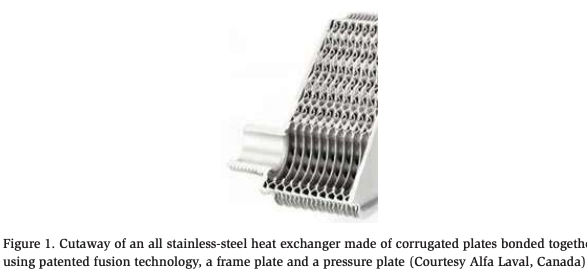
It is not uncommon to encounter packaged chillers that use less than 100 g per kW of cooling capacity (0.75 lbs per ton) (Pearson, 2008). These machines typically use plate heat exchanger evaporators and condensers. A leading heat exchanger OEM has introduced a plate heat exchanger made entirely of stainless steel, using unique active diffusion bonding technology (Alfa Laval, 2015). These fusion-bonded plate heat exchangers are hermetically sealed and gasket-free. The internal design and flow paths are similar to a conventional brazed-plate heat exchanger (Figure 1), and the counter-current flow leads to highly effective heat transfer with very tight temperature approaches. This, coupled with the corrosion-free operation from the use of stainless steel, yields low life cycle costs under a variety of operating conditions.
With the widespread deployment of aluminum-based microchannel heat exchangers in the HVAC industry, it is conceivable that these ultra-low charge configurations could be designed for use as air-cooled ammonia condensers (or evaporators [Nelson, 2016], in the case of heat pumps). Not surprisingly, numerous development efforts have been conducted to this end, both in academia (Hrnjak and Litch, 2008) and industry (Tomooka, 2011).
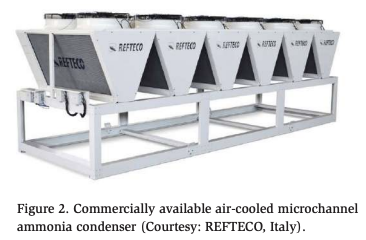
Tomooka showed that a microchannel condenser significantly improved system design and performance relative to a conventional round-tube plate-fin condenser in air-cooled applications. Both researchers have also shown that further charge and equipment size reduction is possible when the microchannel heat exchanger is coupled with a semi-hermetic (scroll) compressor, for the same capacity and an improved COP over synthetic refrigerants. Figure 2 shows an air-cooled ammonia condenser product that uses aluminum microchannels.
From a system design standpoint, ammonia is a close proxy for R22, with nearly overlapping saturation or vapor-liquid equilibrium curves in the air-conditioning operating range. At the typical 40°F evaporation saturation and 100°F condensation saturation temperatures (water-to-water chiller operating conditions), it has a slightly lower low-side (suction) pressure (73 psia, compared to 83 psia for R22) and a nearly identical high-side (discharge) pressure (around 211 psia). While the pressure ratio for ammonia is a bit more severe than R22, causing the compressor volumetric efficiency to be lower, cycle efficiency (COP) is much higher due to its favorable thermodynamic properties (enthalpies, heat of vaporization, etc.), and only increasing with higher evaporation temperatures (Patnaik et al., 2002).
In the context of heat pumps, compared with R-134a, the most popular mediumpressure HFC, ammonia offers more efficient heat recovery at higher temperatures as a result of its high latent heat and high critical temperature (Pearson, 2008), and thus higher COPs and lower operating costs. Not unlike the ammonia chillers installed on building rooftops, air-source ammonia heat pumps for space and/or water heating could be deployed. The biggest challenge to this has remained development of appropriate compressor technologies, which are now readily available.
Cost
Small ammonia HVAC systems have generally not been economical to build compared to CFC, HCFC, and HFC systems. One reason is the use of steel piping instead of copper, which requires uncommon fastening techniques like welding instead of soldering and flanging. Another is the limited availability of small components (heat exchangers, compressors, valves, etc.) designed for ammonia – and hence lack of economies of scale – compared to the ubiquitous conventional refrigerant components (Tiedemann et al., 1996). At the heart of the system, the compressor is a particularly challenging item.
Both reciprocating and single screw compressors have long been used for higher-lift refrigeration applications (Emerson Electric Co., 2020). These machines could be modified relatively easily for high-pressure ammonia heat pumps. However, these are typically open compressors with shaft seals to prevent leakage. To comply with the more-stringent safety requirements for space-conditioning applications, there appears to be two technology routes, but both add cost to the system.
The first is the use of hermetic or semi-hermetic compressors, where the reactivity of ammonia with copper in the motor requires use of material other than copper for its windings. Aluminum windings have been introduced by some OEMs, such as in a hermetic ammonia scroll compressor (Matsunaga et al., 2006). Alternatively, encapsulated copper windings can be used (Ciconkov and Ayub, 2009), typically using a lacquer resistant to ammonia.
With aluminum, electrical conductivity and connectivity issues must be considered. Aluminum’s conductivity is about two-thirds that of copper, thus there is a 4%-5% motor efficiency penalty with aluminum windings (Nemit et al., 2019). For equivalent conductance, aluminum magnet wire must have a correspondingly larger crosssection or more turns than copper wire. Asa a result, Thus, motors with aluminum windings will likely have greater volume – and cost – compared to an equivalent copper-wound motor. With regard to connectivity, aluminum oxidizes rapidly when exposed to air, forming a hard insulating layer that can impede electrical conduction. To make a proper connection, the oxide layer must be pierced in a way that prevents air from coming in any further contact with the aluminum. Motor manufacturers have developed high-pressure, piercing crimp connectors, but this adds to the cost of aluminum-wound motors (ACHR News, 2001).
Another concern related to the use of aluminum with ammonia involves the lubrication system. Polyalkylene glycol (PAG) synthetic oils are miscible with ammonia and are the recommended lubricant for ammonia compressors. However, these oils are hygroscopic, and aqueous solutions of ammonia can potentially cause corrosion of the aluminum components, greatly reducing operating life (IIAR, 1986). For these components, manufacturers offer various coatings for corrosion prevention, but again at a cost premium (Eurammon, 2012). PAG oils themselves are relatively expensive; about three times more than their polyalfaolefine (PAO) counterparts, which are immiscible with ammonia and require an oil return mechanism similar to standard mineral oils (Pearson, 2008).
Lastly, magnetic drives could serve as a workaround to the motor winding issue. However, these may be more suitable to centrifugal compression, similar to that in variable-speed, oil-free R134a compressors. This technology also obviates the need for an oil management system and oil separators, as well as issues related to low starting currents and vibration levels such as heat exchanger fouling (Danfoss, 2020). However, the cost of such compressor-drive assemblies tends to be higher than conventional positive-displacement (semi-) hermetic compressors.
In addition to pure aluminum, aluminum-based alloys can also produce some measure of cost parity for ammonia systems. These would typically be the material of construction for elements of the system design other than motor windings in the hermetic compressor, such as interconnecting piping and valves. In Germany, for example, two aluminum alloys are considered compatible with ammonia: AlMgSil and AlMnl. AlMnl consists mainly of aluminum and manganese, which is stable with ammonia and water (no corrosion found) and can be formed like copper (Tiedemann et al., 1996). These alloys typically show no stress corrosion cracking (Eurammon, 2012).
State-of-the-Art Ammonia-Based Systems
Ammonia Vapor Compression Cooling & Heating
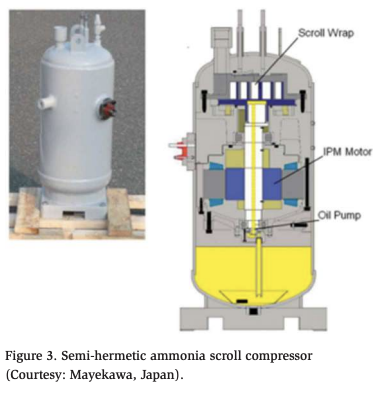
The culmination of the above technological efforts has started to appear in products and installations around the world. One OEM offers an ammonia hermetic scroll compressor featuring a cooling capacity from 5 to 15 kW (1.4 to 4.3 tons), suitable for residential applications (Figure 3) (Lobnig, 2009). The same manufacturer has also been involved with larger-scale projects that use more conventional ammonia heat pumps for residential district heating (e.g., an ammonia system that served 700 households). This particular system exhibited very high COPs compared to the traditional HFC system it replaced (5.35 vs. 3.57, a 15% boost) (McLaughlin, 2017).
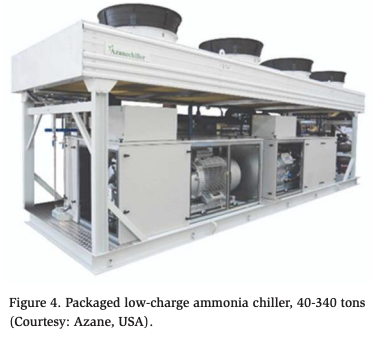
Another manufacturer makes low-charge ammonia packaged solutions for the U.S. market (Figure 4) (Star Refrigeration, 2016). Their business strategy is based on the belief that ammonia will increasingly be used for air-conditioning. Already, they have provided an air-conditioning system using ammonia chillers for a department store in a rooftop installation. The system contains 213 lbs of ammonia and provides chilled water at 43°F with an air-cooled condenser. Similar systems have also been installed at a food manufacturer in Napoleon, OH, and a bakery in Portland, OR, with similar charges per ton of cooling (300-ton capacity with a 450-lb charge).
An industrial refrigeration system manufacturer and contractor in Australia has expanded its portfolio to include air-conditioning. One of its premiere installations is a pair of ultra-low-charge water-cooled ammonia chillers providing air-conditioning at a government building in Queensland since 2011 (Yoshimoto, 2019). The equipment room with the chillers is shown in Figure 5.
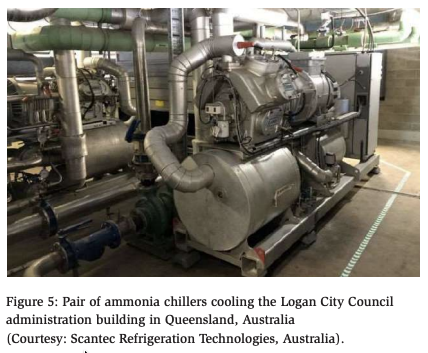
These chillers replaced an R22-based system at the Council Administration Center in Logan City, and in the eight years since commissioning have reported no refrigerant loss and very reliable operation. Furthermore, annual maintenance and service costs came in 50% under the original estimate of $50,000 a year, based on records over five years. Probably most importantly, the ammonia system yielded annual energy reductions in the range 900-1400 MWh (owing to a COP of ~ 5.79), resulting in a payback period of five years instead of the originally estimated 8.5 years.
The ultra-low charge (0.03-0.05 kg/kW or 0.25-0.39 lbs/ton) coupled with the best practices deployed in the installation – rooftop equipment room, with plentiful ventilation – make this a paragon of ammonia systems for air-conditioning that have successfully mitigated the risk of any catastrophic release of ammonia.
The challenge to wider deployment of such systems continues to come from synthetic-refrigerant applications, especially those involving next-generation refrigerants. HFO-1233zd is the growing refrigerant of choice for large centrifugal chillers, and Australia and other parts of the developed world have seen several such installations in the last couple of years.
Ammonia Absorption Cooling and Heating
The ammonia-water absorption cycle has been used for residential and smallcommercial comfort cooling for decades, using natural gas as the primary energy source. Shipments of these 3 to 5 RT models peaked in the early 1970s at about 250,000 units per year, offered by Whirlpool, Bryant, and Servel among other manufacturers. These products, installed outside as indirect systems (only chilled water entered the building), generally had a total ammonia charge less than 24 lbs. This industry had a very good safety record and included thousands of contractors nationwide with the training and tools to safely work on these ammonia-based systems. As the efficiency of vapor compression products increased, and cost decreased, the market for “gas cooling” was reduced to a niche, now primarily used for light-commercial applications where the electric power service to the building is constrained.
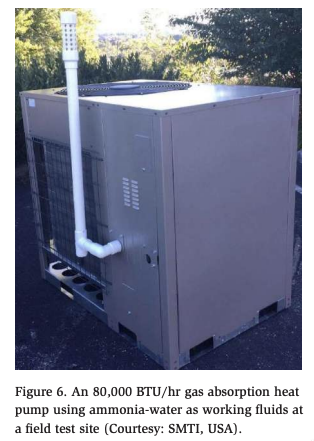
Although the efficiency for gas cooling is low (COP less than 1), reversing the cycle for heating results in very high COPs, approaching 2. Rising global concern about the impact of carbon emissions on climate change has triggered a renewed interest in gas absorption heat pumps (GAHP) for residential and light-commercial space and/or water heating applications. Given that the performance of GAHPs remains strong at cold ambient temperatures, and that the vast majority of space-water heating in coolcold climate zones is currently served by natural gas or propane, GAHPs are poised to play an important role in reducing carbon emissions in this very large market segment. In North America, where 90% of residential heating systems are forced-air, GAHPs will primarily be air-to-water indirect systems connected to a hydronic air handler (which replaces the gas furnace). Although only one company currently offers residential-sized ammonia-water GAHPs, with sales primarily in Europe, several companies in North America and Europe are expected to release products in the next few years. Figure 6 shows one such product in a field trial, from a start-up in eastern Tennessee.
On the cooling side, a unique ammonia absorption system has been developed in the UK and is currently in the process of commercialization. This is a solar (thermal)- fired system that utilizes the diffusion-absorption refrigeration cycle, also known as the Platen-Munters cycle (Adjibadea et al., 2017), with ammonia-water-hydrogen as the working fluids. With the buoyancy of hydrogen gas serving as the prime mover, this variation of the absorption cycle does not require an actual solution pump, and hence is even lower in cost than the standard single-effect cycle, albeit lower in COP as well. In a strategy similar to the ammonia-water heat pump discussed above, the simplest variation of the thermodynamic cycle is employed (i.e., sans internal heat recovery) for a robust and cost-sensitive solution. A battery of five cooling modules comprising the system is shown in Figure 7.
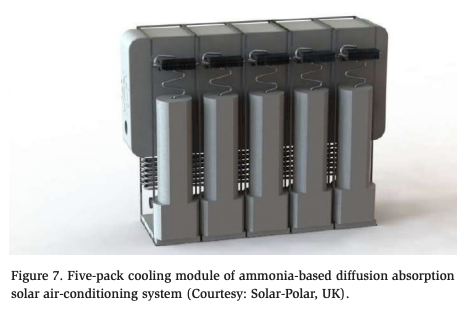
The motivation to develop this product was to bring solar cooling to the mass market (taking out the cost-prohibitive nature of this technology), and more importantly to bring it to developing parts of the world where cooling options – whether for space or preservation – are scarce (Edwards et al., 2018). This is an entirely off-thegrid solution, with the desirable option of integrated thermal energy storage. Once commercialized, it has the potential to help alleviate the increasing burden on energy resources diverted to provide the world’s cooling needs.
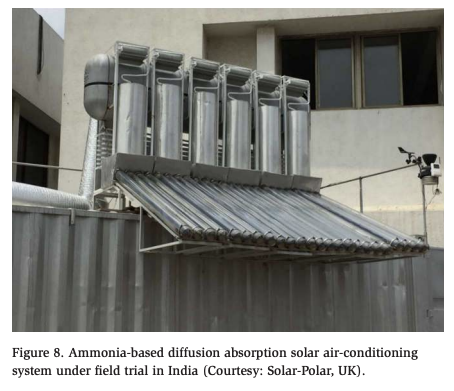
Individual module capacity is rated at 200 W (~0.06 tons of cooling), with an ammonia charge of up to about half a pound. There are no moving parts in this product, obviating many of the concerns (prime-mover related) for the ammonia systems discussed earlier. It is rugged and maintenance-free. Field trials in India and the United States (Jacksonville, Florida) are presently underway. Figure 8 shows a system being tested in India.
R&D Opportunities
Vapor compression and absorption systems have been in use for over 100 years and have seen significant maturation (even saturation) in terms of new technologies in this time. New R&D initiatives are better focused on how these systems integrate with other energy systems, both upstream (e.g., distributed power generation) and downstream (e.g., building architecture) in the value stream, or even with each other. Such integrated energy systems present an opportunity to provide optimized, here the higher cooling efficiency of the for sustainable solutions on a global scale.
An example of an integrated systems would be a hybrid vapor compression– absorption system, where the higher cooling efficiency of the former and the higher heating efficiency of the latter is brought together via a common refrigerant that is suitable to both in a best-of, ultra-high-efficiency, all-season, packaged, “super” system. The integration in such a system would be at the hardware level through piping, valves, and common heat exchangers. Products deploying such a system will find a place in an increasingly electrified world with their efficient use of natural gas resources.
The low cooling efficiency of ammonia-water GAHPs potentially limits their market penetration for residential heating, as the customer must still keep the vapor compression air-conditioner for the cooling season so that their cooling utility bill and carbon emission do not increase. The packaged “super” system offers a solution, and it is currently being developed by an American company with the support of a grant from the Canadian Gas Association’s NGIF program. The company is merging its air-to-water GAHP (configured for heating only) with an air-to-water ammonia vapor compression chiller. This “one box” hybrid solution provides year-round comfort heating and cooling, as well as domestic hot water, with the GAHP providing hot water during the heating and shoulder seasons, with waste heat from the chiller’s condenser providing hot water during the cooling season. By nesting the evaporator and condenser coils so that they share the same outdoor fan, common enclosure, and control system, the hybrid product can compete on a cost basis with a separate furnace-electric air conditioner-water heater installation while providing robust utility cost savings to the homeowner. Since this system is indirect, all of the ammonia charge (and gas combustion) remains safely outside the home, as shown in Figure 6.
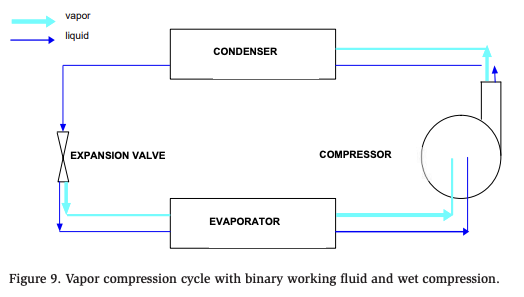
Integration at a more thermodynamically fundamental level is also possible. It is well known that the efficiency of the vapor compression cycle can be improved upon by adding an absorbent to the refrigerant at an appropriate concentration that depends on the properties of the working pair (Patnaik et al., 2002). Relevant to this context, Patnaik (2005) showed analytically that a vapor-compression system using ammonia-water as the working pair, similar to absorption systems (albeit at somewhat inverted concentrations with only small amounts of water as absorbent), shows a COP improvement of about 14% over the pure-ammonia vapor compression case under typical air-conditioning water temperatures. Such a system is represented schematically in Figure 9.
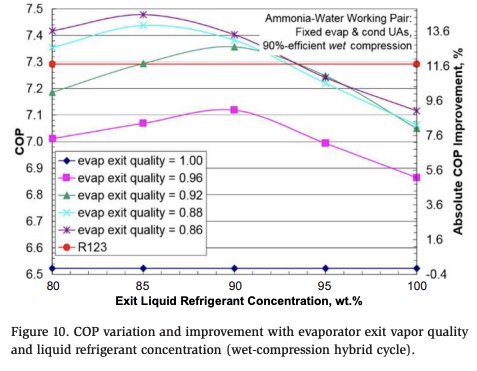
A key difference between the two cases is the nature (phase) of the fluid being compressed. The two-species case necessitates wet compression owing to some aqueous ammonia solution remaining in liquid phase exiting the evaporator/desorber. The improvement in COP comes from a combination of discharge temperature reduction (Second Law advantage) and non-ideal mixture thermodynamics, the latter contributing over two-thirds via pressure ratio reduction, negative heat of solution (increasing the heat of vaporization in the evaporator), and temperature glide in the (counterflow) phase-change components.
The thermodynamic performance of such a hybrid system can also exceed that of the low-pressure synthetic refrigerant HCFC-123 (or its next-generation replacement, HFO-1233zd) by as much as 8%, as shown in Figure 10.
The compressor in such systems must also serve as a liquid pump. This requires special design considerations owing to the high localized pressure points developed in the compressor as a result of the presence of liquid in the compression process. An air compressor was modified/redesigned and tested to this end by Infante-Ferreira and his team at Delft University (Zaytsev and Infante Ferreira, 2002). Furthermore, screw compressors are called upon to handle as much as 11% liquid (mostly oil) by mass through the compression process, similar to the qualities recommended by the 2005 Patnaik study. Combining these aspects, an ideal “wet compressor” would achieve rotor lubrication with the process fluid (here, ammonia-water solution) itself. Zaytsev and Infante Ferreira suggested that the rotors may additionally require lowertorque profiles, larger clearances, and possibly specially coated surfaces.
From an R&D perspective, experimental verification of the hybrid cycle for airconditioning conditions would be the first imperative. This work had been initiated in the previous decade but was not completed. The proof-of-concept was to be conducted with the R134a-DMETEG refrigerant-absorbent pair (Patnaik et al., 2002), in a system comprising a standard R134a screw compressor, and a brazed-plate evaporator and condenser for true counterflow heat exchange to take advantage of the temperature glide through the phase change process. Direct verification with the ammonia-water working pair, a specially designed wet compressor and ammoniacompatible plate heat exchangers such as the all-stainless steel, fusion-bonded type discussed earlier would be preferred.
With respect to plate heat exchangers, one challenge has been identified to be oil return, even with the soluble PAG lubricant (Tiedemann et al., 1996). The above referenced proof-of-concept could provide a further vehicle for investigation and improvement over a wide range of operating conditions, at least until a compressor is designed and available that is adequately lubricated by the ammonia-water process fluid.
Practical questions must be addressed beyond the compressor’s ability to handle 12% by mass liquid and even be lubricated by it (Patnaik, 2005). Are the isentropic efficiency of the compressor and the U(A) of the heat exchangers impacted by changes in absorbent concentration and vapor quality, thus affecting the overall COP improvement? The presence of a second species (water) introduces an additional mass transfer resistance in the latter, and the potential shortfall in “U” may have to be compensated for with larger components (more A). Similarly, changing liquid concentration and quality affects the pressure ratio, which in turn can affect the efficiency of positive displacement compressors. Lastly, and closer to commercialization, the proposed hybrid cycle calls for alternative refrigerant flow and concentration controls; new algorithms would have to be developed.
Standards
A final area of development is codes and standards. The smaller, low-charge, spaceconditioning systems described in this paper are not adequately represented in application standards such as ASHRAE 15 and IIAR 2. They warrant their own specialized standard(s), which may involve further R&D funded by these bodies.
In 2017, ASHRAE and IIAR agreed to transfer coverage for all ammonia systems from ASHRAE 15 to IIAR 2, an important step towards allowing increased future use of ammonia in small comfort systems. ASHRAE 15 included important language and exceptions specific to residential-sized packaged ammonia-water absorption heat pumps dating back to the widespread use of these products for cooling in the 1960s and 70s. IIAR 2-2014, Addendum A, was the first version of IIAR 2 to include the ASHRAE 15 exceptions, most notably the allowance for installation adjacent to residential and commercial buildings as long as the total ammonia charge is less than 24 lbs (direct systems are allowable up to a charge level of 6.6 lbs, otherwise they must be indirect). The new Chapter 18 of IIAR 2 was also modified to exclude ammonia absorption systems with less than 24 lbs from many of the other provisions in a standard that was developed for large industrial systems containing hundreds or thousands of pounds of ammonia.
The 2020 version of IIAR 2 extends some of the original ASHRAE 15 exceptions for small ammonia absorption systems to small, packaged ammonia vapor compression systems with charge levels less than 24 lbs. While this step should allow for increased use of ammonia for residential space heating and cooling, the next step should be development of a new standard focused on small, very-low-charge ammonia systems that does not carry any remnants of previous standards written for large industrial applications.
Conclusion
The use of ammonia as a refrigerant for residential and light-commercial cooling and heating applications is seeing renewed interest and growth. This growth is attributable to significant improvements in the safety and cost of ammonia-based systems, which in turn are the result of developments in materials and components critical to such systems as well as application practices. Components can now be designed/selected with low charge as a “CTQ” (critical to quality), such as plate or microchannel heat exchangers, and/or use aluminum or compatible aluminum alloys as the primary material of construction, such as in the motor windings of semi-hermetic rotary compressors.
System-level improvements leading to simplification and robust designs have also contributed to the promise of ammonia systems. Such improvements have occurred in both vapor compression and absorption systems, and they include the use of miscible lubricants such as polyalkylene glycol oils (enabling oil return to the compressor) in the former and basic single-effect and pump-free cycles in the latter. Manufacturers of absorption systems in particular are also targeting specific high value applications such as space heating, domestic water heating, and low-cost/ mass-market solar cooling. Both types of thermodynamic systems are thus witnessing increased commercialization efforts.
Additional system-level benefits can be attained via “hybrid” systems, from an overall energy efficiency as well as packaging/user acceptance standpoint. These integrated systems are in the R&D phase and examples of these – integrated both at the hardware and fundamental (thermodynamic cycle) level – have been presented here and elsewhere. The latter could be an area of further R&D as the more standard (sub) systems mature.
A final dimension contributing to the progress in ammonia-based technologies is the position of industry bodies such as ASHRAE and the modification (adaptation to ammonia application) of relevant standards that they develop and maintain. More work is needed here, especially in support of a standard dedicated to small-capacity ammonia systems. There is a sizable market here, driven by considerations of sustainability and regulation, and it’s poised for global expansion.
References
ACHR News, 2001, “Copper Vs. Aluminum Windings in Motors,” January 18, 2001, issue. https://www.achrnews.com/articles/83673-copper-vs-aluminum-windings-in-motors
Adjibadea, M. I. S., Thiama, A., Awantob, C., Ndiogoua, B. A. and Samboua, V., 2017, “Dynamic investigation of the diffusion absorption refrigeration system NH3- H2O-H2,” Case Studies in Thermal Engineering, Volume 10, September 2017, pp. 468- 474. https://www.sciencedirect.com/science/article/pii/S2214157X17300515#:~:text =Introduction,and%20hydrogen%20as%20inert%20gas.
ASHRAE, 2019a, “Designation and Safety Classification of Refrigerants,” ANSI/ ASHRAE Standard 34-2019, ISSN 10412336.
ASHRAE, 2019b, “Safety Standard for Refrigeration Systems,” ANSI/ASHRAE Standard 15-2019, ISSN 10412336.
Ciconkov, Risto and Ayub, Zahid H., 2009, “New Technologies in Ammonia Refrigerating and Air-Conditioning Systems,” Heat Transfer Engineering, Vol. 30:4, pp. 324-329, DOI: 10.1080/01457630802467811.
Danfoss, 2020, Turbocor. https://www.danfoss.com/en-us/products/compressors/ dcs/turbocor/#tab-overview
Emerson Electric Co., 2020, Vilter Industrial Products. https://climate.emerson.com/ en-us/brands/vilter
Eurammon, 2012, “Aluminium as Construction Material in Ammonia Refrigeration Cycles,” Eurammon-Information No. 10 / Updated Version, March 2012. https://silo. tips/download/aluminium-as-construction-material-in-ammonia-refrigeration-cycles
Kujak, Steve, 2018, “Update on Next Generation Low GWP Refrigerants for Chillers Products,” presented at the International Symposium on New Refrigerants and Environmental Technology, JRAIA, December 6-7, 2018, Kobe, Japan.
Hrnjak, Pega and Litch, Andy D., 2008, “Microchannel heat exchangers for charge minimization in air-cooled ammonia condensers and chillers,” International Journal of Refrigeration, Volume 31, Issue 4, June 2008, pp. 658-668.
IIAR, 1986, “Guidelines for: Water Contamination in Ammonia Refrigeration Systems,” Bulletin No. 108.
IIAR, 2014, “American National Standard for Safe Design of Closed-Circuit Ammonia Refrigeration Systems,” ANSI/IIAR 2-2014.
Infante Ferreira, C. A., and Zaytsev, D., 2002, “Experimental Compression–Resorption Heat Pump For Industrial Applications,” Proceedings of the Ninth International Refrigeration and Air Conditioning Conference at Purdue University, West Lafayette, IN, July 16-19, 2002, R14-1.
Lobnig, Sabine, 2009, “Ammonia in small systems: challenges & compressors,” Ammonia21 News. https://www.ammonia21.com/articles/1690/ammonia_in_small_ systems_challenges_compressors
Matsunaga, Mutsunori, Yasunori, Shunsuke and Tojo, Kenji, 2006, “Scroll compressor and refrigerating system using ammonia group refrigerant,” US Patent 7,082,786 B2 (Filed: 09/25/2003, Issued: 08/01/2006, Current Assignee: Hitachi-Johnson Controls Air Conditioning, Inc.).
McLaughlin, Charlotte, 2017, “Ammonia in HVAC: Time to use your imagination!,” Ammonia21 News. https://ammonia21.com/articles/7700/ammonia_in_hvac_time_ to_use_your_imagination
Nelson, Bruce I., 2016, “Comparing Ammonia Evaporator Construction: “Which One is Best?”” Technical Bulletin, Colmac Coil Manufacturing, Inc.
Nemit, Paul, Harrington, Dennis A. and Huber, Paul A., 2019, “Semi-hermetic compressor motor for ammonia service,” European Patent 3,421,792 A1, (Filed: 10/23/2013, Issued: 01/02/2019, Current Assignee: Johnson Controls Technology Company, Milwaukee, WI 53209, USA. https://data.epo.org/publication-server/rest/ v1.0/publication-dates/20190102/patents/EP3421792NWA1/document.pdf
Patnaik, V., Schultz, K. J., and Xia, Peter, 2002, “A Thermodynamic Investigation of the R22-DMF, R134ADMETEG and NH3-H2O Working Pairs for Enhanced Vapor Compression via a Solution Circuit In Air-Conditioning Applications,” Proceedings of the International Sorption Heat Pump Conference at Shanghai Jiao Tong University, Shanghai, China, September 24-27, 2002.
Patnaik, V., 2005, “A Thermodynamic Investigation of the NH3-H2O Working Pair for Enhanced Energy Efficiency of Air-Conditioning Equipment via Wet Compression,” Proceedings of the International Sorption Heat Pump Conference in Broomfield (Denver), Colorado, June 21-24, 2005.
Star Refrigeration, 2016, “Azanechiller 2.0,” Our Products (Azane). http://www. azane-inc.com/products/azanechiller-20.aspx
Tiedemann, T., Burke, M. and Kruse, H., 1996, “Recent Developments to Extend the Use of Ammonia,” Paper 354, presented at the International Refrigeration and Air Conditioning Conference, Purdue University, West Lafayette, IN. http://docs.lib. purdue.edu/iracc/35
Tomooka, Mark, 2011, “Application of Micro-channel Heat Exchangers to Compact Ammonia Systems,” Technical Paper #7, presented at the 33rd Annual Meeting International Institute of Ammonia Refrigeration and 2011 Industrial Refrigeration Conference & Heavy Equipment Show, March 27–30, 2011, Orlando, Florida.
Yoshimoto, Devin, 2019, “What about ammonia for air conditioning?,” Ammonia21 News. https://ammonia21.com/articles/9087/what_about_ammonia_for_air_ conditioning_
Zaytsev, D., and Infante Ferreira, C. A., 2002, “Screw Compressor for Ammonia-Water Heat Pump Lubricated by the Process Mixture,” Proceedings of the Ninth International Refrigeration and Air Conditioning Conference at Purdue University, West Lafayette, IN, July 16-19, 2002, C19-2.
Acknowledgements
The authors would like to thank Dr. Robert Edward, CEO, Solar-Polar Limited, for the information furnished on their novel, solar-fired, diffusion-absorption cooling system.