


2026 White Paper: Absorbing the Future: Innovative Waste Heat Recovery for F&B and Data Center Cooling
Author:
Adrian Marticorena, Product Manager Industrial Chillers and Heat Pumps, Johnson Controls
Abstract
The food and beverage industry is extremely energy-intensive, and there is significant potential in the waste thermal energy generated by its processes. This energy can be utilized to drive lithium bromide water absorption chillers, capable of producing low-temperature leaving evaporator fluids at temperatures as low as 18°F (−7.8°C). This innovative technology uses water as a natural refrigerant and requires minimal electrical input.
Similarly, data centers have significant cooling demands that require a lot of electrical energy, often placing a substantial strain on electrical grids. Many data centers are adopting on-site power generation, often producing substantial quantities of waste heat as a byproduct. Absorption cooling technology, which uses heat instead of electricity to drive the cooling process, offers a sustainable and highly efficient solution to these problems, allowing more of the generated power to be directed to computing loads instead of cooling.
Capturing waste thermal energy allows operators to reduce their environmental footprint, increase their operational resilience, and alleviate stress on electrical grids. This paper examines innovative heat recovery solutions and demonstrates how absorption cooling can transform a critical challenge into a strategic advantage.
Introduction
Industrial and digital infrastructure is facing increasing pressure to reduce energy consumption and mitigate environmental impacts. Food and beverage (F&B) plants require substantial quantities of thermal energy for processing, while data centers require continuous cooling to maintain uptime. Both sectors generate waste heat—often in the form of medium-grade thermal energy—that is either vented or dissipated without recovery.
Absorption cooling systems represent a thermally driven alternative to conventional electric chillers. By utilizing waste heat as the primary energy source, these systems can reduce electrical demand while providing reliable cooling. This paper explores the technical feasibility and strategic advantages of deploying absorption chillers for these applications.
Absorption Cooling Technology Overview
Operating Principles
Absorption chillers do not use a mechanical compressor; instead, they operate on a closed-loop thermochemical cycle using a refrigerant–absorbent pair, most commonly water and lithium bromide (LiBr). These systems operate under vacuum conditions to allow water to act as a refrigerant by boiling at low temperatures of approximately 39°F (4°C). These vacuum conditions are critical for the absorption cooling cycle: without them, water would not evaporate at the required low temperature, and the cooling process would not occur.
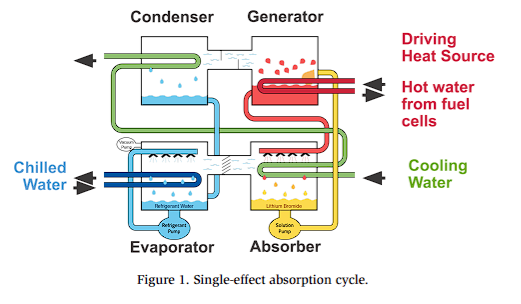
Thermal energy supplied to the system drives the refrigerant from the absorbent, allowing it to evaporate and absorb heat from the cooling load. The single-effect absorption cycle—the simplest configuration among the different absorption cycle variants—is used to illustrate the internal operations of this system. It is composed of four primary components as described below and shown in Figure 1:
- Generator: Uses heat to separate water vapor from the lithium bromide solution.
- Condenser: Refrigerant water vapor is condensed into a liquid state before it is returned to the evaporator.
- Evaporator: Liquid refrigerant water evaporates, absorbing heat from the chilled water (cooling load) flowing through the tubes. During this process, the liquid refrigerant transitions into refrigerant water vapor.
- Absorber: Water vapor from the evaporator is absorbed into the lithium bromide solution.
Temperature Limitations of the Leaving Chilled Water
For many years, absorption chillers were limited to producing chilled water at temperatures of 39°F (4°C) and above. This limit was directly associated with the freezing point of the water refrigerant. Figure 2 illustrates a diagram of a single-effect absorption chiller.
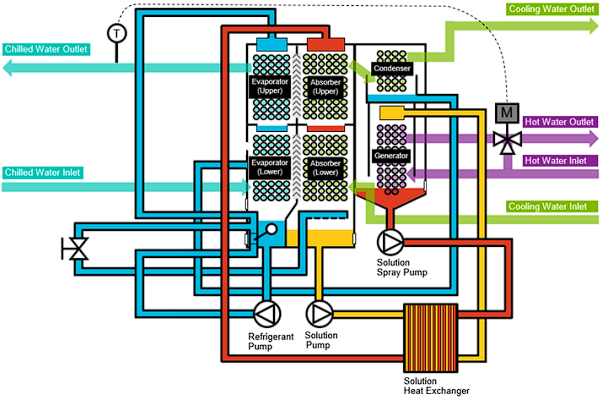
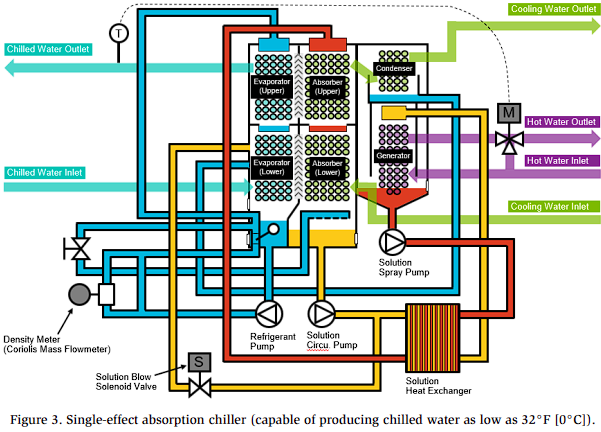
Recent advancements have overcome this 39°F (4°C) limitation; modern configurations can incorporate additional instrumentation to monitor refrigerant concentration in real time. When necessary, lithium bromide solution from the absorber can be added to the evaporator to reduce its freezing point. With these modifications, the chilled water temperature range can be extended to 32°F (0°C). A modified single-effect chiller that allows for the production of chilled water temperatures as low as 32°F (0°C) is presented in Figure 3.
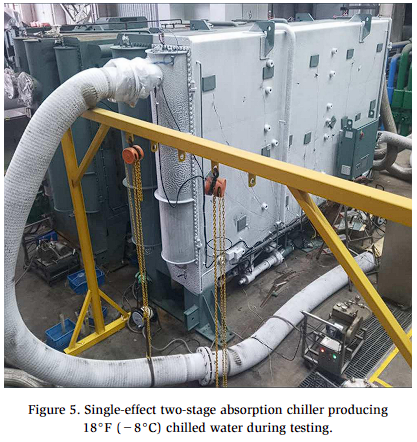
If an application requires chilled water temperatures below 32°F (0°C), a “lowtemperature” module can be integrated into the standard configuration, allowing for chilled water temperatures as low as 18°F (−7.8°C). This configuration is known as the two-stage cycle design (Figure 4). This configuration is no longer merely theoretical; it has been experimentally validated under controlled test conditions, as demonstrated in Figure 5.
In this two-stage configuration, the high-temperature module produces intermediate chilled water in the same manner as a conventional absorption chiller. The lowtemperature module uses the intermediate chilled water produced by the hightemperature module as cooling water to lower the temperature within the machine, producing brine at temperatures below the freezing point of pure water.
Both modules use water as the refrigerant and lithium bromide as the absorbent. However, since the refrigerant temperature in the low-temperature module is below the freezing point of water, a mixed refrigerant is used in which lithium bromide is mixed with water to prevent freezing.
When maintained at appropriate temperature and concentration conditions, the lithium bromide solution exhibits a much lower saturated vapor pressure compared to water at the same temperature. The difference in saturated vapor pressure can be used to remove heat from the chilled water, allowing for the evaporated refrigerant vapor to be absorbed by the lithium bromide solution.
Both modules use the latent heat of vaporization of the refrigerant for cooling.

Performance Characteristics
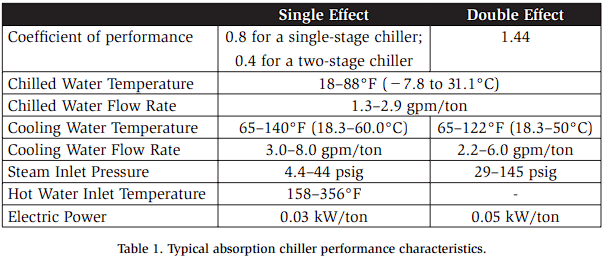
Typical performance characteristics of water–lithium bromide absorption chillers are presented in Table 1. These values are only meant to serve as a reference and do not represent any specific commercial products.
The Food and Beverage Industry
Heat Sources
The F&B industry represents an excellent opportunity to exhibit how waste thermal energy can be recovered and utilized. Common sources of waste thermal energy in this industry include boilers, ovens, pasteurizers, sterilizers, and process heating loops. These systems operate in temperature ranges suitable for absorption chillers, and with recent advancements in absorption cooling technology allowing for chilled water temperatures to be expanded to 18°F (−8°C), the range of potential cooling applications within the industry has also expanded.
Characteristics
- Typically medium-grade heat (180–250°F; 82–121°C).
- Available either continuously or in batch cycles.
- Frequently vented or cooled passively, representing wasted potential thermal energy.
Example Application
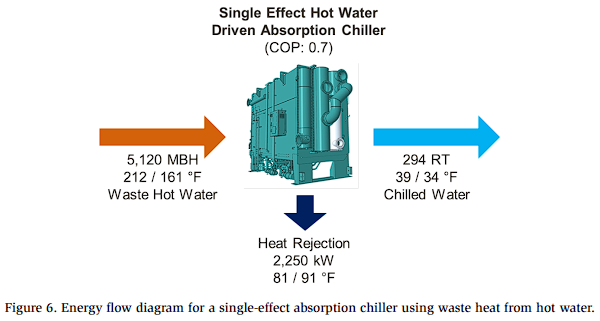
A dairy processing plant generates a steady supply of high-temperature water as a byproduct of its internal processes, while simultaneously relying on electric chillers for cooling milk and to refrigerate storage areas.
Proposal: Install lithium bromide absorption chillers to utilize their waste heat while providing the required cooling. This proposed configuration and additional information are presented in Figure 6.
Data Centers
Heat Sources
Due to increasing grid constraints, there has been a significant increase in demand for on-site power generation for data centers. Nearly all dispatchable forms of power generation produce reusable waste heat as a byproduct. This waste heat can be recovered and used by absorption chillers.
- On-site generation: Common waste heat sources include gas turbines, gas generator sets, microgrids, fuel cells, and small modular nuclear reactors.
- Server exhaust: A high-volume source of low-grade heat.
Cooling Requirements
- Continuous (24/7) operation.
- High reliability and redundancy.
Example Application
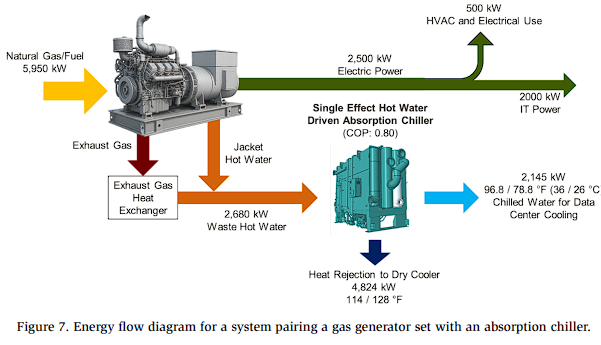
A hyperscale data center equipped with an on-site natural gas generator produces significant waste heat, while cooling loads consume valuable kilowatts that adversely affect the facility’s PUE.
Proposal: Installing exhaust gas-to-hot water heat exchangers and deploying hot water-driven absorption chillers to utilize the waste heat. This system can be configured in a modular manner, with one absorption chiller dedicated to each engine. The system can be replicated as many times as needed. The proposed configuration is illustrated in Figure 7.
If combined heat and power (CHP) systems are not employed and electrically driven chillers are used instead, the required electrical power can be estimated (assuming a typical COP of 5) using the following equation:

This 429 kW of electric chiller load is effectively avoided by using absorption chillers that are driven by readily available waste heat. This represents 17% of the electric power produced by the gas generator suite and represents significant savings in a behind-the-meter scenario. This effectively frees up extra electrical capacity that can be devoted to GPUs instead of compressors.
Conclusion
Absorption cooling technology allows the F&B industry and data center operators to convert waste heat into strategic cooling capacity. Lithium bromide-water systems offer a scalable, resilient, and sustainable solution with minimal electricity demands and significant environmental benefits. Absorption technology stands ready to absorb the future.