



2026 White Paper: 2026 White Paper: Evaporators: Why Material Matters
Author:
Tania Herrera Serna, Product Engineer and Key Account, Guntner US LLC
Abstract
The selection of materials in finned evaporator construction plays a critical role in determining the performance, durability, and overall efficiency of refrigeration systems. This white paper examines the importance of selecting the appropriate material for the construction of finned heat exchangers based on the specific operating conditions and requirements of each application, with particular emphasis on systems exposed to aggressive or corrosive substances. This paper highlights the consequences of inappropriate material selection, including premature failure, increased maintenance costs, and compromised food safety, through a technical and theoretical analysis supported by real-world case studies. The paper also outlines best practices and key considerations related to material compatibility, corrosion resistance, and regulatory compliance. By examining both successful and problematic installations, this paper aims to guide engineers, facility managers, and procurement specialists in making informed decisions when designing evaporators for commercial and industrial refrigeration systems.
Introduction
Selecting an appropriate evaporator for a given application not only involves the selection of an optimal design but also the careful selection of suitable materials that can ensure the long-term performance and durability of the equipment.
In refrigeration and air conditioning technology, corrosion and corrosion protection are key considerations, particularly for heat exchangers and evaporators. A clear understanding of the mechanisms and causes of corrosion is critical for material selection, especially since evaporators are employed across a wide range of applications and environments that have a corrosive effect on metal.
Material Importance
A variety of substances can have a detrimental impact on metals, the most important of which are carbon dioxide, ammonia, nitrogen oxide, hydrocarbons, sulfur compounds, fluorides, chlorides, carbon monoxide, and their reaction products.
Corrosive environments are not limited to industrial emissions; natural conditions can also significantly affect material durability. For example, coastal regions are exposed to high concentrations of airborne chlorides, which can cause pitting corrosion, particularly on aluminum surfaces. Without adequate protective coatings, heat exchangers operating in such environments may suffer irreversible damage over time. Other environmental factors, such as heat, humidity, and airborne contaminants, can further accelerate corrosion. Effective corrosion protection thus begins with the careful selection of the appropriate materials that can preserve the functionality of the heat exchanger.
Materials used in heat exchangers are exposed to demanding operating conditions on both internal and external surfaces. Internally, refrigerants impose chemical, thermal, and pressure-related stresses on tubes and profiles. Externally, the surrounding air—which often contains corrosive agents—exposes the equipment to additional environmental challenges. Through careful, application-specific material selection, heat exchangers can be designed to reliably withstand these stresses while meeting performance and durability requirements under most operating conditions.
Material Recommendations
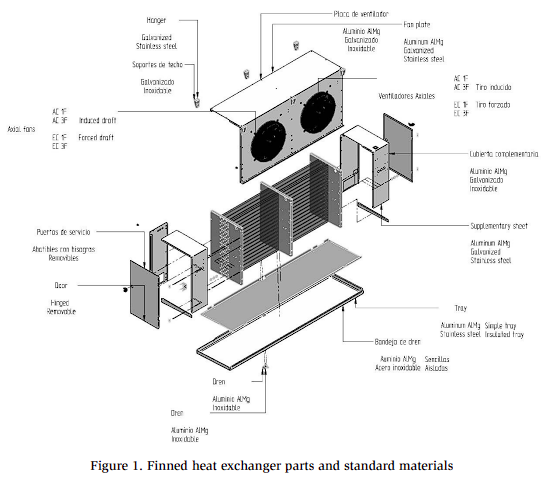
Figure 1 presents an exploded view of a typical air-cooled finned evaporator, illustrating its principal components and the materials that are most commonly used in standard construction. Each component is exposed to different mechanical loads, thermal conditions, and environmental stresses, all of which directly influence material selection. Components such as the heat exchanger coil, casing panels, fan plates, service doors, and drain trays are typically manufactured from aluminum alloys, galvanized steel, or stainless steel. The choice of material depends on their proximity to moisture, cleaning chemicals, food products, and condensate accumulation.
This overview provides a reference framework for understanding how material selection varies across evaporator components based on mechanical requirements, corrosion exposure, hygiene considerations, and maintenance practices. Ultimately, application-specific requirements will dictate the choice of material for each component.
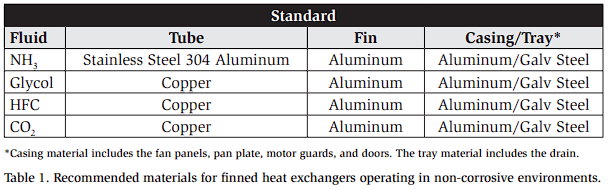
If no aggressive or corrosive components are expected in the operating environment and the heat exchangers are not subjected to frequent cleaning with aggressive agents, established standard material combinations can be used without compromising performance or service life. Typical applications where standard materials may be considered include cold rooms for dry or packaged products, such as distribution centers, or storage facilities for pre-packaged perishable or frozen goods. In these installations, the ambient air is generally clean, characterized by low concentrations of corrosive agents, and cleaning routines are usually infrequent and carried out using neutral detergents. Under these conditions, evaporator components manufactured with standard material combinations (see Table 1) offer reliable performance, long service life, and technically and economically efficient solutions.
In applications characterized by aggressive ambient conditions, the materials described in Table 2 should be carefully considered. Such environments, which are common in food processing, storage, and fermentation facilities, often contain corrosive agents such as moisture, salt, and organic acids. To ensure long-term durability and reliable performance, the appropriate selection of tube, fin, and casing materials is essential.
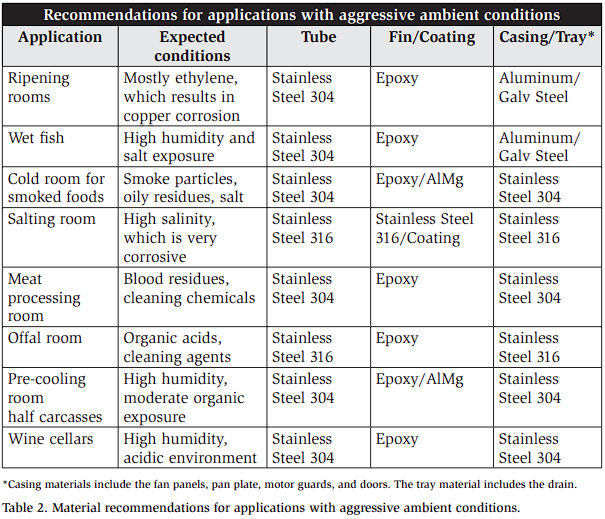
It is important to note that the recommended material combinations do not prevent the long-term degradation of heat exchangers operating in aggressive environments; rather, they serve to slow the progression of corrosion-related damage.
When considering non-traditional materials for evaporator construction, such as 316L stainless steel, epoxy-coated aluminum fins, or other polymer-based coatings, both the performance benefits and potential disadvantages must be carefully evaluated. Polymer coatings are typically applied over the entire coil assembly, including tubes, fins, and headers, to minimize the risk of aggressive substances coming into direct contact with the base material. When evaluating non-traditional materials for evaporator construction, the following factors should be considered:
- Heat Transfer Properties. Stainless steels offer superior corrosion resistance compared to standard galvanized or aluminum fin-and-tube designs; however, they generally exhibit lower thermal conductivity, which can lead to reduced heat transfer efficiencies unless compensated by increased surface area, which in turn results in larger and more expensive heat exchangers. In contrast, aluminum and copper alloys offer significantly higher thermal conductivity but may require protective coatings when used in highly corrosive environments.
- Cost Considerations. It is well-known that 316L stainless steel is 30–50% more expensive than 304L stainless steel and considerably more costly than aluminum or copper. This premium is primarily associated with the molybdenum content in 316L, which enhances its resistance to pitting and corrosion in chloride-rich or otherwise aggressive operating environments. In contrast, 304L stainless steel is generally suitable for use in clean or mildly corrosive conditions but may experience premature corrosion when exposed to salts, cleaning chemicals, or elevated humidity levels. Alternative options include coatings that can offer corrosion resistance at a fraction of the cost of stainless steel construction; however, these solutions may have shorter service lives and typically require periodic inspection, maintenance, and potential recoating.
Although non-traditional materials can significantly improve durability in aggressive environments, they do not always provide the optimal balance between cost, heat transfer efficiency, and maintenance requirements. In many applications, a targeted coating or treatment strategy can provide adequate corrosion protection while maintaining higher thermal efficiency and lower upfront costs.
Coatings
Polymer-based coatings are widely used in finned heat exchangers to protect metallic components—such as tubes, fins, and headers—from corrosion, chemical attack, and environmental degradation. These coatings function as both physical and chemical barriers between the base metal (typically aluminum, copper, or steel) and aggressive operating conditions.
Coatings represent an effective alternative in environments characterized by high humidity, chlorides, acids, or alkaline cleaning agents. By limiting direct metal exposure, coatings can significantly reduce pitting, galvanic corrosion, and material loss, thus allowing the use of aluminum or carbon steel in applications that might otherwise require higher-cost stainless steels. However, polymer coatings introduce an additional thermal resistance layer that can slightly reduce heat transfer efficiency, which may necessitate an increase in the heat transfer surface area to maintain capacity. Furthermore, coatings can degrade over time, especially under aggressive chemical exposure. Improper application can lead to pinholes or poor adhesion, potentially accelerating localized corrosion.
Common types of polymer coatings used in finned heat exchangers include the following:
- Epoxy coatings. Provide strong adhesion and good chemical resistance and are commonly used in moderately aggressive environments.
- Polyurethane (PU) coatings. Offer good flexibility, impact resistance, and tolerance to thermal cycling.
- Phenolic coatings. Highly resistant to chemicals and moisture; often used in food processing facilities or industrial cold rooms with aggressive cleaning regimes.
- Fluoropolymer coatings. Excellent resistance to corrosion, chemicals, and fouling, but associated with higher costs. Typically used in highly corrosive or hygienic applications.
Cleaning
To prevent corrosion and maximize the service life of heat exchangers, regular cleaning should be incorporated into routine maintenance programs. This is particularly important in food-processing facilities, where the use of cleaning agents is essential. However, under certain conditions, these may have corrosive effects comparable to aggressive ambient atmospheres, which are often influenced by the refrigerated goods themselves.
The pH value of the cleaning agent is a key parameter that determines the effectiveness of the agent with respect to certain substances as well as their compatibility with materials. As a general rule, the acidic agents (pH < 7) are typically used to remove mineral residues, such as scale and rust. Neutral agents (pH ≈ 7) are commonly used as multi-purpose cleaners and often serve as disinfectants. Alkaline cleaners (pH > 7) are effective at dissolving organic contaminants, including grease, oils, and proteins.
To minimize the risk of material degradation during cleaning, the following practices should be observed:
- Prior to cleaning, the compatibility of the cleaning agent with the materials used in the heat exchanger coil should be verified. This information is typically provided by the manufacturer of the cleaning agent.
- Cleaning agents should be applied strictly in accordance with the dilution ratios prescribed by the manufacturer.
- After the removal of contaminants, all cleaning agents must be thoroughly rinsed from the unit using clean water to ensure that no residues of the cleaning agent remain.
Material Compatibility Case Studies
Corrosion by Sulfites
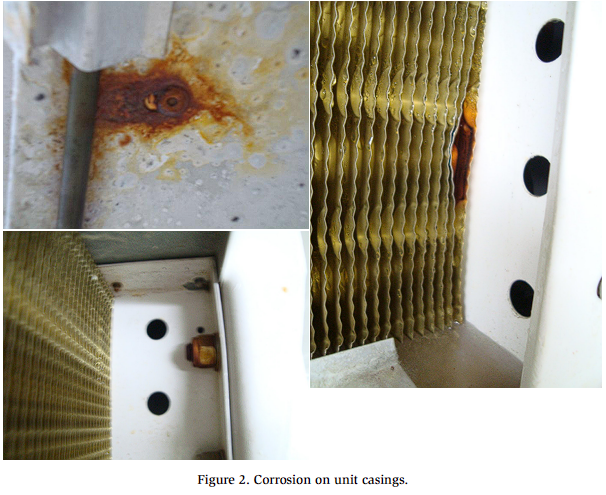
In this case study, an evaporator constructed with copper tubes, epoxy-coated fins, and a galvanized casing was installed in a grape cold storage room. However, within a few weeks of operation, significant corrosion was observed on the fins, frame, and drain pan, ultimately leading to the development of visible holes as a result of prolonged exposure. Further inspection also revealed damage to several rivets as well as certain sections of the coil tubing (see Figure 2 in the Annexes).
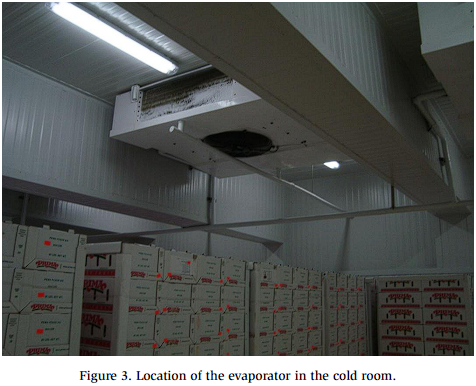
An investigation determined that the corrosion was caused by elevated sulfite concentrations in the cold room atmosphere, a condition worsened by the lack of ventilation (Figure 3), which allowed these compounds to accumulate. Sulfites are commonly used in grape storage to inhibit yeast and fungal growth as well as to control fermentation; sulfite compounds were detected in the condensate collected in the evaporator. Sulfites are often released into the storage environment in the form of sulfur dioxide (SO2) gas or as residue from treated packaging materials. Over time, these compounds interact with moisture in the air, resulting in the formation of corrosive condensate that can severely degrade metal components.
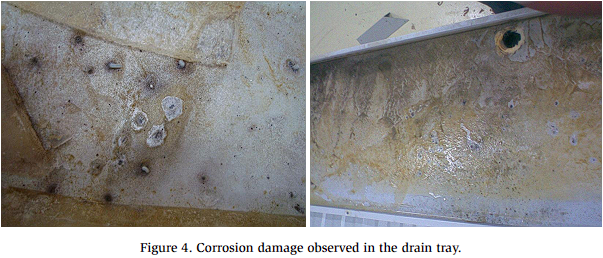
The drain pan was identified as the most severely affected component, as it remained in direct contact with the sulfate-laden condensate (Figure 4). The corrective measures included replacing the damaged evaporator components with corrosionresistant materials better suited to sulfite-rich environments, enhancing ventilation in the cold room to reduce the buildup of sulfur compounds, and implementing a structured inspection and preventive maintenance program to identify early signs of corrosion and prevent recurrence.
Corrosion by Chlorine and Poor Maintenance
Repeated instances of evaporator corrosion were observed in a vegetable processing facility that handled products such as lettuce and green peppers. The corrosion primarily affected tubes and casings constructed from 304L stainless steel, in contrast to other equipment in the facility constructed from 316L stainless steel. After an extended period of operation, the evaporators exhibited severe corrosion within the coil, affecting both tubing and casing materials. Numerous coil leaks were identified during inspection (Figure 5).
The root cause of the corrosion was traced to the daily use of chlorine-based cleaning and sanitizing agents throughout the facility. These chemicals entered the evaporators and were deposited on coil surfaces (Figure 6). It should be noted that some facilities use drain pan tablets to sanitize drain pans in air units. These chlorine-rich tablets continuously release chemicals throughout the day, leading to significant corrosion.
This issue was aggravated by the lack of a proper maintenance program. The internal surfaces of the evaporators were not regularly cleaned, leading to the accumulation of chlorine residues and the subsequent corrosion. Furthermore, incoming produce is rinsed in 12% chlorine solution tanks as part of a conveyor-based pre-wash system, contributing to elevated airborne chlorine levels within the cold room. Although the facility is cleaned daily, the absence of a Clean-In-Place (CIP) system or regular internal cleaning procedures prevented the effective removal of chemical residues within the evaporators.
Conclusion
This paper demonstrates that the appropriate selection of materials for the design and construction of finned heat exchangers is a critical factor in ensuring reliable performance, durability, and safety in refrigeration systems. The case studies presented in this paper illustrate that inappropriate material selection, particularly when combined with inadequate maintenance practices, can significantly accelerate corrosion and structural degradation, ultimately leading to evaporator failure. Furthermore, the analysis highlights how cleaning procedures and the chemical composition of cleaning agents can adversely interact with unsuitable materials, thereby further compromising the integrity of the equipment.
These findings emphasize that material selection should be treated as a generic decision or based solely on cost. Instead, it must be grounded in a thorough understanding of the atmosphere, operating conditions, hygiene requirements, and maintenance protocols of the intended application. Consequently, effective communication between the system design engineer or contractor and the heat exchanger manufacturer is essential in determining whether the components will be exposed to a corrosive environment; based on this assessment, an appropriate material should be selected. By selecting evaporator materials based on the environmental and chemical exposures associated with the intended application, system reliability can be improved, maintenance costs reduced, and premature equipment failures effectively prevented.
References
American Society of Heating, Refrigerating, and Air-Conditioning Engineers. (2022).
ASHRAE handbook: Refrigeration.
Begell House Publishers. (2021). Heat exchanger design handbook (HEDH).
European Hygienic Engineering & Design Group. (2021). Guidelines on hygienic
design and material selection in refrigeration equipment.
Güntner GmbH & Co. KG. (2023). Material options and surface coatings for
evaporators [Technical bulletin]. www.guentner.com
Annexes