



2026 White Paper: Forklift Safety in Refrigerated Facilities
Author:
Martin L. Timm, PE, CSP, B11 Licensed Machinery Safety Specialist
Introduction
Technological innovations have occurred in the movement of palletized goods into, out of, and within refrigerated facilities. Much recent attention has been on technologies such as AGVs (automated guided vehicles), automated pallet shuttles, high-density vertical storage, and hydrogen fuel cell forklifts. These technologies are important but beyond the scope of this paper. In most facilities, an older tried-andtrue technology, battery-operated rider forklifts, still plays an integral part in product movement. This paper reviews the risks inherent in the use of rider forklifts for product movement, traditional methods for controlling those risks, and innovations that have emerged to improve safety and efficiency.
Forklift Use
Forklifts, also known as powered industrial trucks (PITs), are commonly found in general industry and in refrigerated facilities. A study published in 2017 stated that over 200,000 forklifts are sold in the United States each year and over 1,000,000 worldwide (Oxford Economics, 2017).
Driving a forklift may not appear much different than driving a car, but appearances are misleading. A loaded forklift is significantly heavier than most cars and has a very tight turning radius. As such, the stopping distance can be longer than expected, especially on wet or icy surfaces. Lateral or longitudinal tipping of the forklift can occur, especially when loaded to near nameplate capacity, turning on a slope, turning at high speed, or carrying an elevated load.
An online query to the U.S. Bureau of Labor Statistics showed that in May 2024, over 322,000 persons were employed in the United States to “operate industrial trucks or tractors equipped to move materials around a warehouse, storage yard, factory, construction site, or similar location” (U.S. Bureau of Labor Statistics, 2025). In the United States, across all industries (not just refrigerated facilities), forklifts were the source of (National Safety Council, 2025):
- 67 work-related deaths in 2023
- 24,960 DART cases in 2021–2022 (Days Away from Work, Job Restriction, or
Transfer) - 15,480 DAFW cases in 2021–2022 (Days Away from Work, included in the DART
total).
While a breakdown of these statistics for refrigerated facilities is not readily available, these statistics illustrate the potential for injuries or fatalities when operating forklifts. It has been stated that working in the USA food and beverage supply chain is a relatively hazardous occupation: one contributing factor is that products are palletized and moved, loaded, and unloaded with forklifts (Michael & Gorucu, 2023).
Regulatory Requirements
In the United States, OSHA has regulations regarding the use of forklifts. Basic requirements include (OSHA, 2003, 2016, n.d.)
- No one under the age of 18 drives a forklift in non-agricultural operations.
- Forklift operators are required to be trained and certified prior to operating a forklift.
- Refresher training is required when
- the operator has been observed to operate the vehicle in an unsafe manner,
- the operator has been involved in an accident or near-miss incident,
- the operator has received an evaluation that reveals that the operator is not operating the truck safely,
- the operator is assigned to drive a different type of truck; or
- a condition in the workplace changes in a manner that could affect safe operation of the truck.
- Operator performance must be evaluated at least every 3 years.
- The user must ensure nameplates and markings are in place and maintained in legible condition.
- Wheel chocks or other means of preventing trailer or railcar movement are required.
- When unattended, load-engaging means shall be fully lowered, controls shall be neutralized, power shall be shut off, and brakes set; wheels shall be blocked if the truck is parked on an incline.
Failure to comply with these requirements puts facility personnel at risk and exposes the employer to possible OSHA citations and fines.
Forklift Challenges In Refrigerated Facilities
Refrigerated facilities have particular challenges due to their cold spaces, including worker fatigue and discomfort due to cold exposure, wet or icy driving surfaces, movement between warm and cold spaces, the possibility of fog formation at doorways between warm and cold spaces, narrow aisles, obstructed sight lines at intersections, possible ice accumulation on racks and pallets, and frost heaving of floors.
Additional challenges include electronics and battery degradation, condensation on the forklift, and the effect of cold on hydraulic fluid (Yale, 2024).
Effect of Cold on Forklift Operators
Working long hours in a cold environment can hasten fatigue, reduce dexterity, and slow mental and physical reaction time. Measures that can help operators deal with the cold include (Crown Equipment Corporation, n.d.):
- Periodic breaks in a warm environment
- Heated cabins on the forklift; heated ergonomic seats
- Operator enclosures sized to allow for bulky outerwear
- Controls suitable for operation while wearing thick gloves
- Wearing of appropriate personal protective equipment, outerwear, and gloves (Jones, 2025)
- Footwear with a tread pattern optimized for the environment.
More extensive guidance on mitigating cold exposure can be found in ISO 15743 (ISO 2008). ISO 15743 “was created to specify methods and practices for assessing and managing occupational health and performance risks in cold work. The choice of when these are to be used is at the discretion of those responsible for occupational health and/or safety.”
Condensation
When forklifts move from cold rooms to warmer areas, the cold surfaces of the forklift tend to condense moisture from the warmer, more humid air. This presents several issues:
- If a forklift moves back into an area below 32°F (0°C) while still wet, the water can freeze, creating slippery surfaces on the forklift.
- Repeated wetting by condensation from the air can accelerate corrosion and deterioration of mechanical and electrical components on the forklift over time.
Many manufacturers offer special forklift models designed for operation in cold environments. Modifications to enhance reliability in this environment include:
- Sealing of electrical wiring, conduit, penetrations, and sensors to prevent the entry of moisture
- Gaskets or seals at mechanical openings for maintenance access
- Mechanical design details, such as folds, lips, and ledges, that tend to divert water droplets away from sensitive mechanical or electrical components
- Corrosion-resistant materials or coatings.
Other methods for minimizing the effects of condensation include (Yale, 2024; Toyota Forklifts, 2018):
- Storing forklifts in dry areas, just above freezing, 32°F (0°C), when not in use.
- Once a forklift moves from the cold space to the warm space, it is left there long enough for it to warm up and for the condensation to evaporate. The warming and evaporation of moisture can be accelerated with fans.
- Dedicating one or more forklifts to the cold areas and one or more forklifts to the warm areas. This reduces the number of temperature transitions the forklifts endure but increases the number of drops and lifts required to transfer products through openings between the cold and warm spaces.
- Performing a battery exchange in a cold area.
- More frequent forklift inspections, reducing the maintenance interval.
- Reducing infiltration at dock doors by installing and maintaining efficient dock door weather seals that keep out warm air, moist air, and insects.
Reducing infiltration at interior doors by strategically using air curtains and quickopening, quick-closing doors, and controlling the pressure differential between warm and cold spaces.
Effect of Cold on Electronics, Batteries, and Battery Chargers
Condensation and freezing water can play havoc with sensors and controls that are not designed for the environment. The temperatures in refrigerated storage and freezer areas tend to reduce battery capacity and can create operational issues with battery chargers. Appropriate battery specifications and a thoughtful battery management strategy may reduce the number of operator interactions required to charge batteries, and reduce the frequency with which forklifts or batteries are moved between cold and warm spaces (ISO, 2008; Bond, 2018; Concentric USA, 2021).
Lead-acid batteries are more susceptible to capacity loss at low temperatures. Lithium-ion batteries using either nickel manganese cobalt oxide (NMC) or lithium iron phosphate (LiFePO4) chemistry allow for faster charging turn-around times and are less susceptible to capacity loss at low temperatures.
Each type of battery has its own considerations for fire safety. Lead-acid batteries emit hydrogen gas during charging, while lithium-ion batteries may be difficult to extinguish if a thermal runaway occurs. The use of other power sources, such as hydrogen fuel cells, solves some problems but creates others, such as water emitted in the fuel cell exhaust that can condense or form ice in the refrigerated environment.
Frost Heaving of Floors
Cracking and heaving of floors in freezer areas are well-known hazards in the industry (ASHRAE, 2022; Ballou, 1981; Liu, Jiang, & Sun, 2025; Powers, 1981; Rein & Burrous, 1981; Webber, 1981). Floors can become uneven if the ground beneath the freezer freezes. Uneven floors are a safety issue for forklifts, as they can affect stability, increasing the risk of tipping or losing a load.
If the subfloor is not heated, moisture in the ground can be drawn to the cold freezer floor, where it freezes, forming an “ice lens” below the floor. Expansion of the ice and of the soil can heave the floor upwards, creating cracks and an uneven floor surface, and buckling walls. Heaving can be prevented by:
- Insulating the underside of the freezer floor,
- Providing a vapor barrier below the insulation, and
- Installing heat under the insulation, in the form of electric cables, or air ducts operating by natural or forced ventilation, or piping circulating heated glycol.
For long-term reliability, the subfloor heating system should receive the following scheduled preventive maintenance:
- Frequent inspections of the heating system to ensure it is functioning as designed
- For glycol heating systems, maintaining proper flow rate and concentration
- Periodically measuring soil temperature in strategic locations below the floor, to verify that the soil temperature is being maintained above freezing
- Installing an alarm on the soil temperature sensors to alert operations immediately if the soil temperature is approaching the freezing temperature.
Failure to do appropriate maintenance on the heating system can lead to floor failures that are very expensive to correct.
Effect of Cold on Hydraulics and Lubricants
Greases used on mechanical parts and fluids used in forklift hydraulic systems tend to thicken when exposed to cold temperatures for extended periods. This can make the operation of the lifting mechanisms sluggish or erratic. Methods for minimizing this effect include:
- Use lower-viscosity greases and hydraulic fluids suitable for the temperatures in the space, while always consulting and following the manufacturer’s recommendations.
- Upon boarding a forklift, before attempting a lift, allow the hydraulic fluid to circulate and warm up. Consult the manufacturer’s manual for the appropriate warm-up time.
Forklift Operational Risks – Collisions
Collisions with Overhead Piping (Ammonia, CO2, Sprinkler Systems)
Warehouses often have overhead piping within their internal spaces. It is not uncommon for this piping to be above (or to cross over) the lanes in which forklifts travel. It is also possible that when storage racks within a space are reconfigured or expanded, piping that was previously out of the way of forklift travel now becomes vulnerable. If the mast of a forklift, or the elevated load it is carrying, comes into contact with the piping, damage can occur, releasing its contents. Contact between a forklift’s load and overhead piping may also dislodge the load from the forks, potentially dropping it on the forklift operator. IIAR-2-2021 section 13.4.2. requires that refrigerant piping be protected from impact (IIAR, 2021).
Whether refrigerant or sprinkler system water, the release of the contents can range from a minor incident to a catastrophic one. If the piping is bent out of place, but does not leak, the incident may be in the minor category. If the piping is sheared off and the contents are spewing into the space, it may be a major incident with the potential for injury or fatality, product loss, and business interruption.
Methods of reducing the likelihood of impact, or reducing the consequences of impact, include:
- Forklift operator training to understand the risks and safeguards
- Inherently safe design, that is, keeping the piping out of the space by placing refrigerant mains and control valves on the roof or in a mezzanine above the ceiling in the room, or by placing sprinkler heads and mains above the racking and out of the vertical space in which the forklifts operate
- Placing structural barriers capable of absorbing impact in strategic locations to prevent contact between the piping and elevated loads or the forklift mast
- Placing warning barriers that make noise when impacted in proximity to the vulnerable piping, alerting the forklift driver to the impending danger of impact
- Guidance systems that keep forklifts centered in an aisle within the racking
- Speed limits, either administrative or enforced through controls on the forklift, that limit the magnitude of the impact forces should an impact occur
- Maintaining tire traction through proper tire pressure (if pneumatic) and use of forklift tires specifically designed for cold temperatures, which may include special materials, micro-grips, or siping patterns (Forklift Tire Company, 2025)
- The FOPS (falling object protective structure) feature of forklifts is a reinforced roof or overhead guard that provides some level of protection for the operator against falling objects.
In cold spaces within a building, additional considerations include:
- Release of refrigerant poses an immediate risk of asphyxiation or toxic inhalation to personnel in the area. The facility emergency action plan or response plan should take into account the possibility of such a release, and employees should be trained to respond appropriately.
- Release of sprinkler water in a facility operating below 32°F (0°C) will likely result in ice formation on the rack structure and on stored products. The rack structural design should take this into account.
- Piping, pipe guards, and barriers may be more brittle due to cold temperatures and may be subject to additional forces from thermal cycling. Material specifications for these items should account for the temperature of the environment in which they are used.
Collisions with Pressure Vessels, Tanks, Totes, or Storage Racks
Forklifts, with or without a load being carried, are capable of inflicting significant impact forces. Impacts with pressure vessels, tanks, or totes can result in loss of containment of the contents. Impacts with racks can weaken the structure and, in extreme cases, cause partial or total collapse, posing a danger to the forklift operator and other employees nearby and incurring high costs due to lost product, equipment damage, and business interruption.
Methods of reducing the likelihood of impact, or reducing the consequences of impact, include:
- Forklift operator training to understand the risks and safeguards
- Bollards placed to absorb an impact and keep the forklift from reaching the vulnerable item
- Rack structural design capable of resisting collapse with one or more members compromised
- Rack padding or cushioning at strategic locations to absorb the impact without distorting the underlying structural member
- Guidance systems that keep forklifts centered in an aisle within the racking
- Secondary containment below tankage located in areas frequented by forklifts
- Speed limits, either administrative or enforced through controls on the forklift, that limit the magnitude of the impact forces should an impact occur
- The FOPS of the forklift
- Geofencing technology to limit operation or reduce speeds in areas vulnerable to collisions (Fainaro, 2024).
In cold spaces within a building, additional considerations include:
- The stopping distance of the forklift may be increased due to wet or icy floors being more slippery than dry surfaces in warm spaces within the facility.
- Depending on the construction materials, physical protection systems, such as column protectors and impact barriers, may become more brittle and less effective in cold environments.
- Sensor degradation in cold environments due to low temperature or condensation.
Under-ride or Pinch/Crushing Injuries with Stand-Up Rider Forklifts
One study of stand-up forklifts concluded that the majority of forklift accidents involved collisions of one type or another (Berry, 2011).
Stand-up rider lift trucks may have less protective structure surrounding the operator than a sit-on forklift. A crushing injury can occur if a limb or appendage, such as a foot, is outside the operator compartment when accidental contact with fixed objects, such as racking, occurs. A crushing injury can also occur if the lift truck is traveling with forks trailing, and an “under-ride” occurs, in which a horizontal rack member enters the operator compartment (OSHA, 2009; Railsback & Ziernicki, 2015; Ziernicki, 2022).
Figure 1 is reproduced from an OSHA bulletin and illustrates the under-ride hazard (OSHA, 2009).
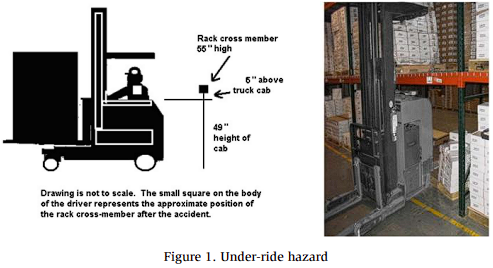
OSHA requires that forklift operators look in the direction of travel (OSHA, 2016). When followed, this requirement reduces the likelihood of under-ride accidents. This OSHA bulletin includes the following recommendations to protect operators of standup rider lift trucks:
- Adjust the shelf heights so that the body of the forklift or the forklift’s overhead guard will strike the rack in the event of contact, preventing under-ride from occurring.
- Install a barrier, curb, or floor-level structural member so that the bottom of the forklift will strike the curb or member in the event of contact, preventing an under-ride.
- Purchase, where appropriate, stand-up forklifts that have corner posts, extended backrests, rear post guards, or other features to prevent an under-ride from occurring.
- Contact the manufacturer to discuss installing rear post guards or other equivalent protections that address the under-ride hazard on existing stand-up forklifts.
- Evaluate control methods to ensure that guards do not limit visibility, present pinch-point hazards, or add any additional hazards to forklift operators or other employees on the site.
Collisions with Pedestrians
Many injuries and fatalities have occurred when forklifts ran into or over persons who were in the vicinity of an operating forklift, often due to the forklift operator either not seeing the person or being unable to stop in time when the person was spotted. Stopping suddenly as an avoidance maneuver can cause a carried load to topple off the forks. Injury or death can occur due to impact with the forklift or impact by a dropped load falling on the pedestrian.
Methods of reducing the likelihood of impact with a pedestrian include:
- Limiting pedestrian access to authorized personnel
- Training for forklift operators and personnel allowed to walk in the area
- Separating movement paths for forklifts from walking paths for people
- Administrative controls to ensure forklift operators know when pedestrians may be working in their area
- Sensors on the forklifts that can detect pedestrians in the direction of travel and slow or stop the forklift before impact
- Lights on the forklifts that shine a bright blue spot on the floor ahead in the direction of travel, alerting pedestrians to the presence of the oncoming forklift (especially useful in noisy environments or at blind corners)
- Training the forklift operators to honk their horn when approaching a blind intersection.
In cold spaces within a building, additional considerations include:
- As with other collision risks, stopping distance increases in wet or icy environments.
- Eyewear is more likely to fog up, especially when transitioning from a cold space to a warmer, more humid space such as a food processing area.
- Headgear worn to keep the ears warm may reduce the hearing acuity of pedestrians, allowing for a closer approach before the pedestrian senses the presence of the forklift.
Forklifts Colliding at Intersections or Doorways
When operating in the close confines of product storage racks or when transiting from one space to another through doorways, two forklifts may reach an intersection or opening at the same time and collide.
Methods of reducing the likelihood of impact between two forklifts include:
- Limiting the number of forklifts simultaneously operating in a given area
- Providing separate travel lanes for forklift traffic moving within the space in different directions
- Providing separate doors for incoming and outgoing traffic
- Lights on the forklifts that shine a bright spot on the floor ahead in the direction of travel, alerting other forklift operators who may be approaching a blind intersection to the oncoming presence of the forklift
- Training the forklift operators to honk their horn when approaching a blind intersection
- Prohibiting forklifts traveling in the same direction from passing one another
- Sensors and warning systems on the forklifts that can detect other forklifts on a collision course and slow or stop the forklift before impact.
Sensors and lights permanently mounted at intersections and blind corners that alert approaching forklift operators to other forklifts also approaching the blind spot.
In cold spaces within a building, additional considerations are similar to those for other types of collision, including reduced visibility, reduced auditory acuity, and increased stopping distance.
Other Forklift Operational Risks
Lateral or Longitudinal Tip-Over
Forklifts can tip over for various reasons. Longitudinal tipping can occur if an excessively heavy load is placed on the forks, causing rotation around the fulcrum point of the front wheels. Lateral tipping can occur if the combined line of action of the center of gravity of the forklift and the load center of gravity falls outside the machine’s “triangle of stability”, causing the forklift and load to tip over sideways.
Methods of reducing the likelihood of tip-over incidents include:
- Operator training regarding the “triangle of stability”
- Operator attention to always operating within the rated load capabilities as stated on the fixed nameplate on the machine
- Updating the forklift nameplate when lifting attachments are added that were not included on the original nameplate
- Derating the allowable load when lifting objects whose load center of gravity dimensions exceed those stated on the nameplate of the machine
- Avoiding turns on sloped surfaces such as ramps
- Slowing down when lifting loads at or near the rated capacity
- Lowering the load to within 6–8 inches (15–21 cm) of the ground after picking and before traveling with the load
- Avoiding sharp turns when moving at speed
Methods of avoiding injury to the operator should a tip-over occur while seated in a counter-balanced forklift include:
- Always wear a seat belt while operating the forklift
- The ROPS (rollover protective structure), which encloses the operator, in conjunction with wearing a seatbelt, keeps the operator inside the enclosure and offers some level of protection during a rollover incident.
- If a tip-over does occur, keep all body parts within the forklift cabin, lean away from the direction of tipping, and brace for impact. Never attempt to jump clear of the forklift during the tip-over.
In cold spaces within a building, additional considerations include:
- Ice accumulation on the floor may create an uneven driving surface, making the forklift more susceptible to tip-over incidents.
Forklift operators should report ice accumulations to supervisors so steps can be taken to remove it.
Load Falling Off the Forks on Ramps or Other Sloped Surfaces
If the forks of a forklift are pointed in the downhill direction when traveling on a ramp or a slope, the load is more likely to slide off. Normally, this is mitigated by traveling with the forks pointing uphill when traversing a ramp carrying a load. When a forklift is not carrying a load, it is considered safe to allow the forks to point downhill if it is most convenient.
In cold spaces within a building, additional considerations include:
- Ramps may be wet or icy, which makes it particularly difficult to stop within a reasonable distance.
Dock Operations
Products are often delivered or shipped from facilities through loading docks using straight trucks, semi-trailers, or rail cars. Successful movement of product requires that the opening in the delivery transport be aligned with the loading/unloading position at the loading dock. A ramp, or “dock leveler,” is required to span the gap between the building and the transport, and is adjusted as needed to accommodate height differences. The figure below (Figure 2) illustrates the height differences that must be accommodated by dock ramps/levelers (Fikiin, 2014).
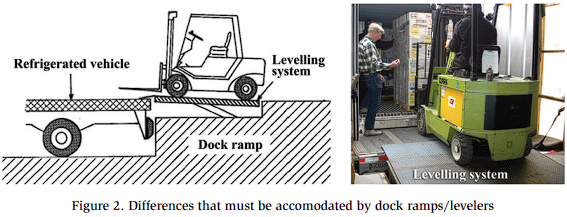
The ramp should incorporate features to prevent forklifts from driving off the side of the ramp and off the dock when no transport is present or when the dock ramp/leveler is not in place. Administrative or engineering controls should be in place to prevent a transport from driving away while the ramp/leveler is in place, particularly when the forklift remains inside the transport. Design details should minimize the likelihood of a person inadvertently walking over the edge of the dock and falling to the ground outside. The air gap between the transport and dock should be minimized to prevent warm, moist outside air from entering the building while also blocking airborne particulates, insects, and rodents.
Dock Operations – Trailer Creep and Early Departure
Trailer creep and early departure are separate issues but require similar measures for prevention or mitigation.
- Trailer “creep” or “dock walk” is the phenomenon in which the impact of forklift wheels repeatedly striking the dock ramp incline as they enter a trailer tends to push the trailer back from the edge of the ramp. If the trailer is pushed back far enough, the dock ramp can drop off the back edge of the trailer floor, potentially catastrophically dropping the forklift to ground level. The tendency for creep is exacerbated in trailers equipped with air-ride suspension. Simple wheel chocks can slow progression, but repetitive impacts can move them as well.
- Early departure occurs when a truck driver pulls a trailer away from the dock while it is still being loaded or unloaded. This can be highly hazardous for the forklift operator, as the forklift may be in the trailer or on the dock ramp, and the forklift can fall to the ground or be ejected from the back of the trailer, with a very high probability of injury.
Administrative procedures, such as manual installation of wheel chocks or sequestration of ignition keys until loading/unloading is complete, can be effective, but are subject to human error and miscommunications.
In the hierarchy of controls, engineered controls are generally considered more effective than administrative controls. Various engineered methods have been devised to prevent trailer movements associated with trailer creep or early departure. These include:
- Automatic vehicle restraints with rotating hooks that capture the “RIG”, the trailer rear impact guard, some optimized for the newer pentagonal shape of RIG bars vs. the older square RIG bars ( “Can vehicle restraints prevent loading dock separation accidents?,” 2021; Poweramp, 2023; Rite-Hite, 2024)

- Wheel chocks, some with improved profiles to reduce failure modes (Rancourt, 2018), others with mechanisms to lock them in position when placed
- Trailer axle suspension modifications (they prevent creep, but not early departure) (Berg, 2012).
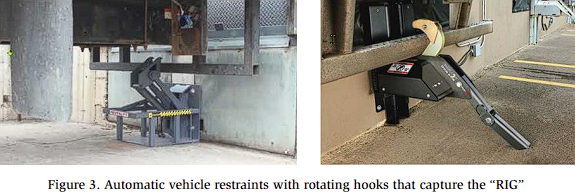
Multiple sources mention that the efficacy of these measures is enhanced when indicator lights are installed to communicate the status of the restraints to both drivers (Bond, 2011, 2014b;, McCrea, 2015). Some authors have noted that automatic vehicle restraints are less labor-intensive than manual wheel chock placement (Bond, 2014a).
A 2009 publication by CNA (an insurance company) discusses the loading and unloading risks at loading docks (CNA, 2010). It describes exposure risk to workers’ compensation, general liability, and auto liability. It discusses the importance of wheel chocks (wheel stops) and other protective measures.
“Vehicle Restraints 101” was published by the Loading Dock Equipment Manufacturers Industry group (LODEM) with MHI in 2013. It contains detailed recommendations for equipment and, in passing, notes that the restraint equipment can not only improve safety but also reduce theft of unattended trailers. This document provides definitions and illustrations of various restraint types, lights, and signage. Restraint recommendations from LODEM, updated in 2023, are available in “Dock Planning 101” (Loading Dock Equipment Manufacturers, 2023).
A 2013 article pointed out that RIG bar capture devices are ineffective on some types of trailers, including those hauling shipping containers and those equipped with hydraulic lifting gates, due to interference between the chassis geometry and the capture device (Swietlik, 2013). In these situations, a chocking device with a locking mechanism may be more appropriate. Information on trailer restraints is also available from other sources (Bond, 2011; Swietlik, 2013).
Dock Operations – Trailer Tipping and Landing Gear Collapse
Two other related issues are trailer tipping and landing gear collapse. Consider a heavy forklift carrying a load into an empty trailer. As the forklift moves into the nose of the trailer, the weight of the forklift and load may cause the landing gear to collapse. If the landing gear does not collapse, as the forklift moves further into the trailer, it may pass the fulcrum provided by the landing gear. Depending on the weight of the trailer behind the fulcrum vs. the weight of the trailer and forklift in front of the trailer, the trailer and contents may tip forward (away from the loading dock) or sideways. Whether the tipping is caused by landing gear collapse or rotation around the fulcrum of the landing gear, there is a high probability of severe injury to the forklift operator.
Methods of reducing the likelihood of trailer tipping or landing gear collapse include:
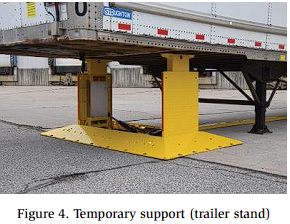
- Placing a temporary support, “trailer stand”, at the front of the trailer as shown below (Michel, 2022). The one shown (Figure 4) retracts at the push of a button.

- Using the same automatic vehicle restraints that prevent trailer creep and early departure, or a restraint with rotating hooks that captures the trailer rear impact guard
In the cold space of a refrigerated trailer, additional considerations include:
- A slippery floor may increase stopping distance, creating additional dynamic force if the forklift does not come to a stop in time, and the load impacts the inner wall of the nose of the trailer.
Dock Operations – Forklift Driving Off Dock When No Trailer is Present
When the tractor-trailer pulls away from a loading dock, there is a wide opening with an approximately 48 in (1.2 m) drop off to ground level outside the dock. Unless a barrier is present, a forklift can drive off this “cliff”, with possible catastrophic injury to the forklift operator.
Methods of preventing a forklift from driving off the dock edge include barriers robust enough to resist the impact force of a moving forklift, such as:
- Scissor gates
- Dock netting
- Gates that rotate down into position
- Roll-down or sectional doors that descend on tracks on either side of the door to block the opening
- Dock levelers that rotate to create a lip to prevent forklifts from driving off the edge.
As with other cold spaces within a building, additional considerations for refrigerated loading docks include:
- Driving surfaces may be wet or icy, which makes it particularly difficult to stop within a reasonable distance.
When specifying such items, the specifier should clearly understand whether they are intended as a warning, incapable of actually stopping a moving loaded forklift, or if they are structurally adequate to stop a moving forklift.
Conclusions
The hazards associated with rider forklifts are well known. The mitigations are also well known. The most important mitigations are:
- Measures to prevent collisions between forklifts and overhead piping, air units, vessels, and other ammonia-containing equipment
- Measures to prevent collisions between forklifts and between forklifts and people.
Other important mitigations include:
- Training for drivers, supervisors, and pedestrians
- Use of seat belts
- Reducing speed where water or ice on the floor may be present
- Operating within the rated load capacity of the forklift
- Lowering the load when traveling with a load
- Avoiding turns on ramps and slopes
- Selection of forklifts appropriately equipped for operating in cold environments
- Loading dock appurtenances, such as chocks, restraints, gates, status lights, and interlocks, that reduce the likelihood of unintended trailer/railcar movement and prevent forklifts from driving off the side of the dock leveler or the open edge of a dock.
Technological innovations will continue to occur. Facilities can reduce the likelihood of product loss, property damage, accidents, injuries, and fatalities by complying with OSHA regulations, applying safety fundamentals, adopting inherently safe design, and applying technology where appropriate.
References
ASHRAE. (2022). Refrigerated-facility design. In ASHRAE Refrigeration Handbook (Chap. 23). American Society of Heating, Refrigerating and Air-Conditioning Engineers.
Ballou, D. F. (1981). A case history of a frost-heaved refrigerated freezer floor. ASHRAE Transactions, 87(2), 1099–1105.
Berg T. (2012) Preventing Dock Walk. Trucking Info. https://www.truckinginfo. com/152265/preventing-dock-walk
Berry, T.A. (2011) An analysis of stand-up forklift accidents from the 1970’s to 2006. In: Volume 9: Transportation systems; safety engineering, risk analysis and reliability methods; applied stochastic optimization, uncertainty and probability. ASMEDC. https://asmedigitalcollection.asme.org/IMECE/proceedings/ IMECE2011/54952/703/353528
Bond, J. (2011). Quad/Graphics loads safely, on the level. Modern Materials Handling, https://mmh.com/article/quad_graphics_loads_safely_on_the_level
Bond, J. (2014a). Dock overhaul secures employees, trailers, and productivity. Modern Materials Handling, https://mmh.com/article/dock_overhaul_secures_ employees_trailers_and_productivity
Bond, J. (2014b). Light-based communication system improves safety and efficiency at the dock. Modern Materials Handling. https://www.mmh.com/article/light_based_ communication_system_improves_safety_and_efficiency_at_the_dock
Bond, J. (2018). Don’t get left out in the cold: The right preventative measures can ensure safe, productive and efficient forklift operation in even the harshest freezers. Modern Materials Handling, 73(11), 14–15.
Can vehicle restraints prevent loading dock separation accidents? (2021). https://loadingdock.com/blog/can-vehicle-restraints-prevent-loading-dock-separationaccidents
CNA. (2010). Dock safety guide: Loading and unloading risks. https://www.cna.com/sites/default/files/assets/bbcf9b5f-d8e8-47e4-b3a8-cab6a9218b6d/RC_Guide_ML_DockSafetyGuide.pdf
Concentric USA. (2021). Guide to forklift battery types. https://blog.concentricusa.com/engineering-uptime/a-users-guide-to-forklift-battery-types
Crown Equipment Corporation. (n.d.). Braving the cold year-round: Five tips for cold storage lift truck operation. https://www.crown.com/en-us/blog/articles/fleetmanagement/five-tips-for-cold-storage-lift-truck operation.html
Fainaro, Y. (2024). Taking Industry 4.0 to the next level with disruptive RTLS (Part 4). RGo Robotics. https://www.rgorobotics.ai/post/taking-industry-4-0-to-the-next-levelwith-disruptive-rtls-part-4
Fikiin, K., & Markov, D. G. (2014). Efficient loading and unloading of a food cold store. New Food, 17. https://www.researchgate.net/publication/348550383
Forklift Tire Company. (2025, March 23). Cold storage forklift challenges & solutions: Prevent downtime and improve efficiency. https://www.forklifttire.com/articles/coldstorage-forklift-challenges-solutions-prevent-downtime-and-improve-efficiency/
International Institute of Ammonia Refrigeration. (2021). IIAR 2-2021: Standard for design of safe closed-circuit ammonia refrigeration systems. https://www.iiar.org
International Organization for Standardization. (2008). ISO 15743: Ergonomics of the thermal environment—Cold workplaces—Risk assessment and management.
Jones, R. (2025). Forklift operator tips for your cold storage facility. https://jitny.com/blog/forklift-operator-tips-for-your-cold-storage-facility
Liu, M., Jiang, X., & Sun, J. (2025). The design strategy and testing of an efficient floor anti-freezing ventilation system in a large cold store. Science and Technology for the Built Environment, 31(1), 126–137.
Loading Dock Equipment Manufacturers. (2023). Dock planning 101. https://www.mhi.org/downloads/industrygroups/lodem/Dock%20Planning%20101.pdf
McCrea, B. (2015). Safety: Protecting workers at the loading dock. Modern Materials Handling. https://www.mmh.com/article/safety_protecting_workers_at_the_loading_dock
Michael, J. H., & Gorucu, S. (2023). Severe injuries from product movement in the U.S. food supply chain. Journal of Safety Research, 85, 234–241. https://www.mmh.com/article/making_loading_docks_safer
National Safety Council. (2025). Forklifts. Injury Facts. https://injuryfacts.nsc.org/work/safety-topics/forklifts/
Occupational Safety and Health Administration. (2003). Protecting young workers: Prohibition against young workers operating forklifts (SHIB No. 03-09-30). https://www.osha.gov/sites/default/files/publications/shib093003.pdf
Occupational Safety and Health Administration. (2009). Stand-up forklift underride hazards. https://www.osha.gov/sites/default/files/publications/shib072709.pdf
Occupational Safety and Health Administration. (2016). 29 CFR § 1910.178 — Powered industrial trucks. https://www.osha.gov/laws-regs/regulations/standardnumber/1910/1910.178
Occupational Safety and Health Administration. (n.d.). Powered industrial trucks (forklift) eTool. https://www.osha.gov/etools/powered-industrial-trucks
Oxford Economics. (2017, June). Lifting America: The economic impact of industrial truck manufacturers, distributors, and dealers. https://www.oxfordeconomics.com/resource/lifting-america/
Poweramp. (2023, October 16). Loading Dock Safety with New Trailer Designs. Modern Materials Handling. https://www.mmh.com/article/loading_dock_safety_with_new_trailer_designs
Powers, G. L. (1981). Ambient gravity airflow prevents freezer floor heaving. ASHRAE Transactions, 87(2), 1107–1116.
Protective Insurance. (n.d.). Loading dock safety tips. https://www.protectiveinsurance.com/docs/librariesprovider3/default-document-library/loadingdock-safety-tips.pdf
Railsback, B. T., & Ziernicki, R. M. (2015). Forensic engineering evaluation and testing of horizontal intrusion protection equipment for stand-up forklifts. Journal of the National Academy of Forensic Engineers, 32(2).
Rancourt, D., Khazoom, C., Blanchette, C., Giraud, L., Lemire, J., & St-Amant, Y. (2018). Wheel chock key design elements and geometrical profile for truck vehicle restraint. SAE International Journal of Transportation Safety, 6(1), 69–84.
Rein, R. G., & Burrous, C. M. (1981). Basic concepts of frost heaving. ASHRAE Transactions, 87(2), 1087–1097.
Rite-Hite. (2024). Trailer separation accidents at the loading dock. https://ritehite.com/en/am/solutions/solutions-by-need/loading-dock-safety-and-security/loadingdock-accidents
Swietlik, W. (2013). Next generation of dock safety equipment. Occupational Safety and Health, 82(9), 80, 82, 84.
Toyota Forklifts. (2018). Cold room forklifts and the battle against condensation. https://www.toyotaforklift.com/resource-library/blog/toyota-solutions/cold-roomforklifts-and-the-battle-against-condensation
U.S. Bureau of Labor Statistics. (2025). Employment of industrial truck and tractor operators as of May 2024. https://data.bls.gov/oes/#/indOcc/Multiple%20occupations%20for%20one%20industry
Webber, J. F. (1981). Circulating liquid in pipe grid system for floor heave prevention in refrigerated warehouses. ASHRAE Transactions, 87(2), 1117–1121.
Yale. (2024). Efficient ways to operate a forklift in cold storage. https://yale.com.vn/en/news/03-efficient-ways-to-operate-a-forklift-in-cold-storage/
Ziernicki, R. M. (2022). Current assessment of stand-up forklifts’ underride accidents. Journal of the National Academy of Forensic Engineers, 39(2).