




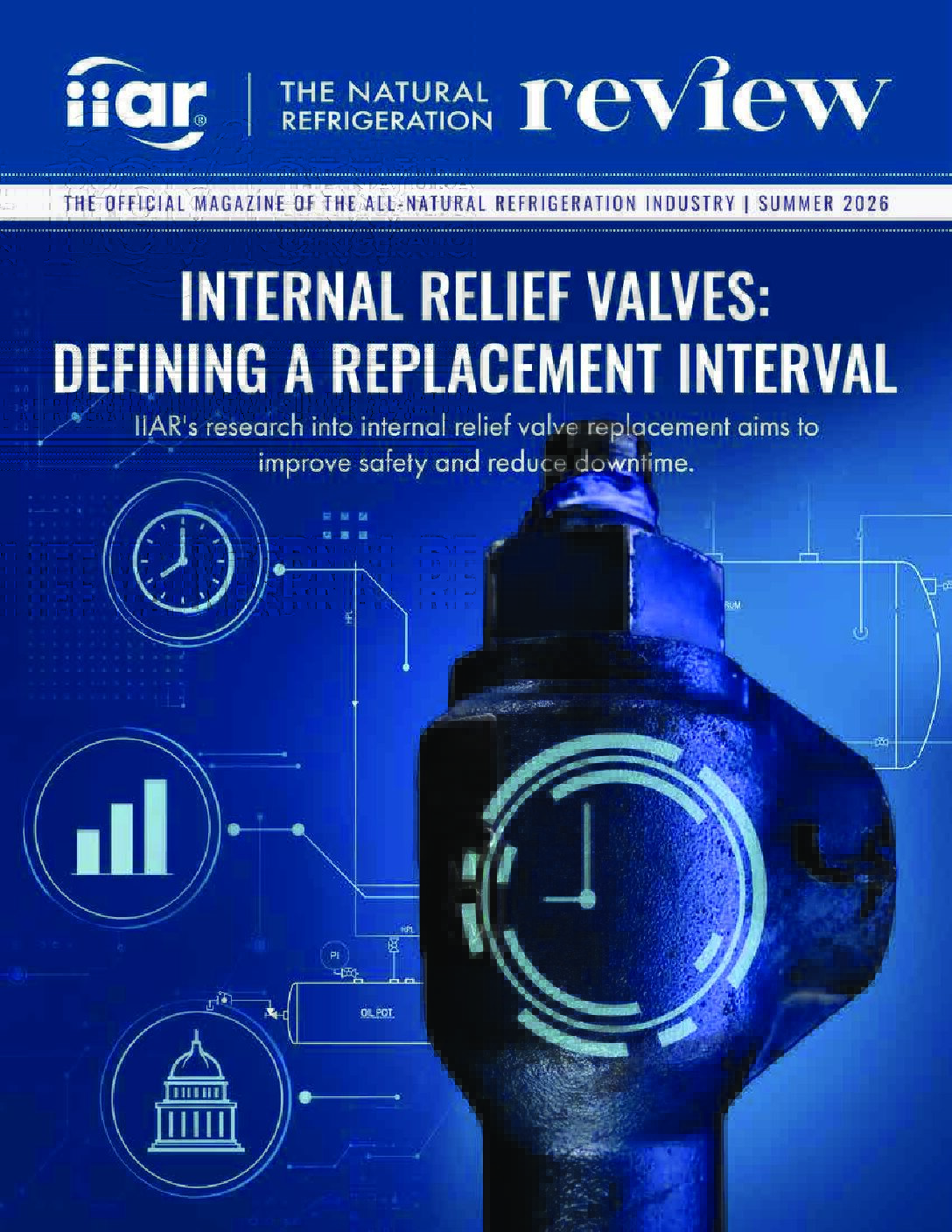
Internal Relief Valves: Defining a Replacement Interval

The testing or replacement interval for pressure relief valves that discharge back into an ammonia refrigeration system, commonly known as “internal relief valves,” may be redefined based on a new IIAR research project that aims to collect the valves from members and test them. The project, which is currently underway, is being managed by IIAR staff and members of the IIAR research committee and is being carried out by ioMosaic, a process‑safety engineering firm that provides testing for the petrochemical and chemical industries.

Read More
Everything You Ever Wanted to Know – IIAR Standards

To understand how far the industrial refrigeration industry has come in the last decade, and where it’s headed, the best place to look is its standards. The International Institute of All-Natural Refrigeration has nine standards, a suite of consensus-based, ANSI-approved guides covering everything from putting a system together to taking it out of service.

Read More
Costa Rica Adopts National Standards

A set of Costa Rican refrigeration standards based on IIAR’s Suite of Standards is poised to become law in the country, paving the way for other countries in the region to follow suit. In Costa Rica, the National Fire Protection Association, NFPA, codes already incorporate IIAR standards for anything to do with refrigeration, creating a deference to IIAR standards. However, the new national standards will represent the first time Costa Rica has implemented its own set of standards and codified them into law.

Read More
Three Questions to Consider for a Good Inspection Plan

In an age of proliferating diagnostic tools, visual inspections are still needed, and equally important, an inspection plan a facility can follow. And while IIAR – 6 Inspection, Testing, and Maintenance of Closed‑Circuit Ammonia Refrigeration Systems provides a starting point, system owners must develop a complete plan. “There are no Cliff Notes for IIAR-6, though there is a huge opportunity for teams that lean on the standard – it is a tool in their quiver,” said Suzy Vohsen Bos, Director, Marketing and Client Services of Gamma Graphics Services and the instructor of IIAR’s latest webinar, The Nitty Gritty of Visual Inspections.

Read More
IIAR Eyes AHJ’s to Replace Federal Enforcement

A new picture of how regulatory activities might function in the future is emerging, thanks to efforts by the International Institute of All-Natural Refrigeration’s “NH3 Overdue Regulation Modernization,” or NORM, task force. The task force is currently asking regulators to remove PSM/ RMP requirements that duplicate across agencies or defer to IIAR standards where the standards and regulations overlap.

Read More
IIAR Reduces Student Membership Rate

Membership in IIAR, the industrial refrigeration technical association of record, has changed since its inception nearly four decades ago. What began as a small standards-creation effort led by a group of engineers has ballooned into a community of contractors, end users, manufacturers, students and even regulators.

Read More
Don’t Overlook Mechanical Integrity

Smaller facilities are starting to pay more attention to mechanical integrity, as it remains one of the most cited violation types. Adding to the pressure on facilities to renew focus on mechanical integrity, IIAR 6‑2019: Inspection, Testing, and Maintenance of Closed‑Circuit Ammonia Refrigeration Systems was adopted into the 2024 edition of model codes as the minimum requirement for ITM (Inspection, Testing, and Maintenance) standard for ammonia refrigeration systems, regardless of the system charge.

Read More
Lesson Learned: Where Are You?

Is it helpful, sometimes even really important to know how things are going? The answer is yes! If you don’t audit, check, measure, and/or observe what’s happening you may end up with results you didn’t expect or want. A correction might take a significant effort depending on what is happening and how much time passes between your observations.

Read More
Understanding the Importance of Passivation

In recent years, the quality of the circulated water in evaporative condensers and cooling towers has declined as air and water pollution has increased. As regulations limit the use of many corrosion inhibitors for the hot dip galvanizing process, such as chromates, the passivation process for protection has become even more critical.

Read More
State Regulations, PFAS, Cause Uncertainty for Synthetic Refrigerants

When the U.S. Environmental Protection Agency finalized its Reconsideration of the Technology Transitions Rule in May 2026, it introduced extended compliance dates, relaxed interim GWP limits, and installation flexibility for several subsectors including cold storage. While many in commercial refrigeration saw the reconsideration as a reprieve, it may have introduced unanticipated regulatory challenges from several states.

Read More
Legislative Update: Trump Administration Publishes Updated Regulatory Agenda

On July 4th, 2026, the Trump Administration released its updated Unified Regulatory Agenda for 2026. The Regulatory Flexibility Act requires federal regulatory agencies to publish their regulatory plans on a semiannual basis. The target dates for release are April and October.

Read More
Standards: IIAR Answers Member Questions

The timeliest issues in the industry – from IIAR-2’s relief calculation formula to hot work permits for sulfur sticks – are being discussed in standards subcommittee meetings. This year, at the IIAR Natural Refrigeration Conference & Expo, March 15 - 18, IIAR standards subcommittee leaders convened to give IIAR members a chance to ask their own questions. The Q&A format illuminated some of the biggest issues the industry is working on with regulators and settled some common misconceptions around standards.

Read More
Your Support of NRF Pays for Important Industry Research Projects

The ioMosaic internal relief valve project and others like it are funded by the Natural Refrigeration Foundation, which is supported in large part by the Foundation’s Legacy 100 Club, a new way to contribute to the work of NRF.

Read More