






The Natural Refrigeration Review is a quarterly publication that contains technical articles, regulatory and code updates, industry news and information about IIAR activities and publications. It is distributed by email to all IIAR Members and IIAR Contact lists.
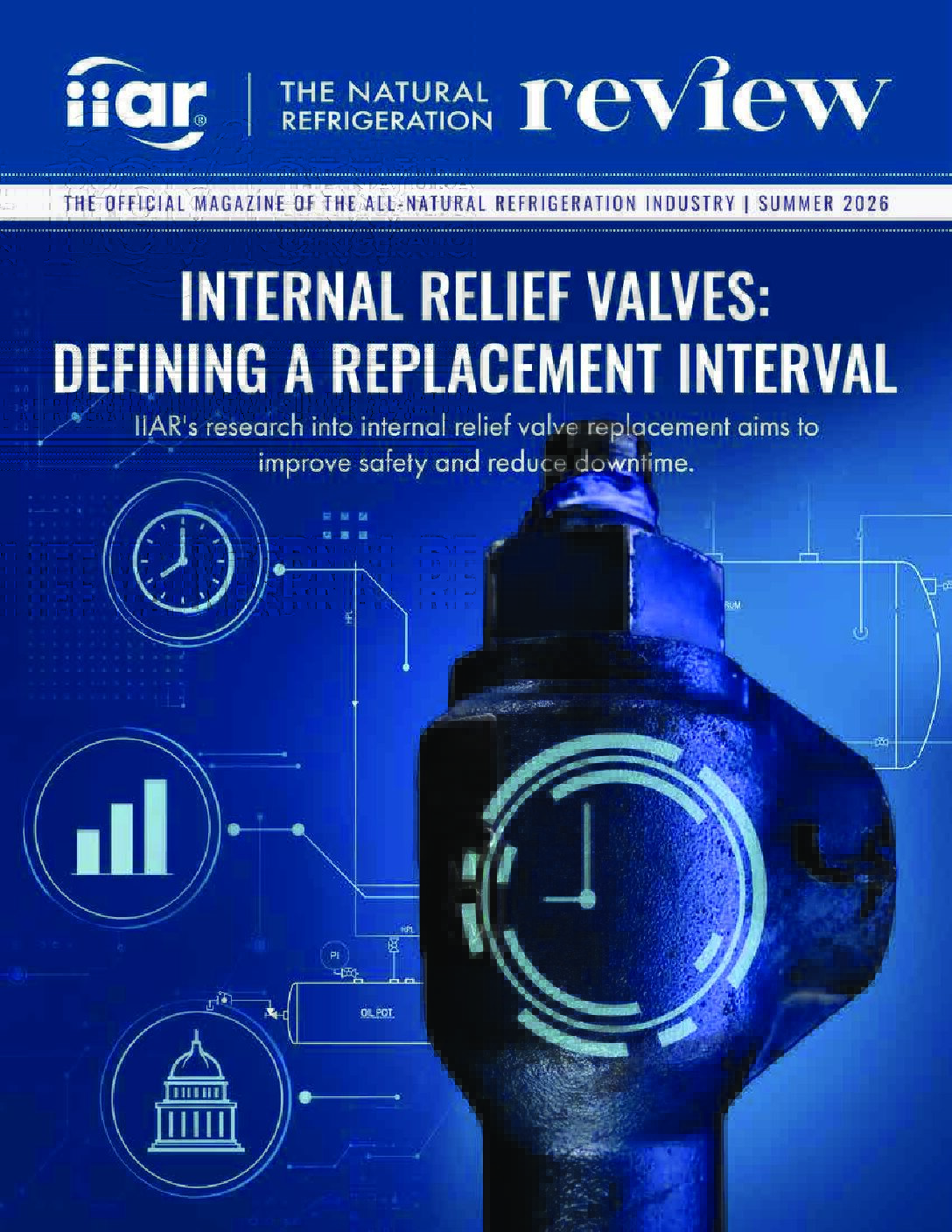
SUMMER 2026 THE NATURAL REFRIGERATION REVIEW
The Natural Refrigeration Review issues are available as PDF downloads for both lIAR members and non-members, or as individual article posts below. Click the button to view the full issue, or scroll through all the individual issue articles below.

IIAR Chile Chapter Breaks Attendance Record, Paraguay Adopts IIAR-2
IIAR's Chile Chapter, along with The Chilean Chamber of Refrigeration and Air Conditioning, said the organizations' twenty-eighth Seminar on Natural Refrigeration for Latin America drew over 350 attendees, the largest number of attendees in the event's history. “This was the largest IIAR event yet in Chile,” said Yesenia Rector, Vice President of Education, Outreach, and Events.
Read More
Creating Your Pressure Vessel Replacement Framework
When it’s time to replace a pressure vessel in an industrial refrigeration system, the stakes can be high and the questions are many. To help operators, engineers, and manufacturers navigate this complex process, IIAR recently hosted a member webinar titled Considerations for Pressure Vessel Replacement. The presentation laid out a question-and-answer framework designed to guide decision-making and ensure long-term mechanical integrity for your refrigeration system.
Read More
IIAR Delivers IIAR 9 Training at RETA
The International Institute of All-Natural Refrigeration delivered its IIAR 9 Certificate Course at the RETA 2025 National Conference Oct 18 and 19 in Spokane, WA. IIAR said it plans to deliver a course for IIAR 6-2025 during the RETA 2026 National Conference. IIAR 9 provides the minimum safety requirements for existing closed-circuit ammonia refrigeration systems as well as provides a method to determine if existing stationary closed-circuit refrigeration systems using ammonia as a refrigerant comply with the minimum system safety requirements. Tony Lundell, IIAR’s Senior Director of Standards and Safety delivered the course.
Read MoreEnergy Efficiency: To Reduce Energy Expenditure, Lower Cost, Clean Evaporator Coils
Numerous factors can contribute to decreases in a refrigeration system’s energy efficiency, not the least of which is its cleanliness. Much of the time, when facility operators see a facility’s efficiency drop, they believe that indicates they must replace the systems with larger units, when in fact, they often simply need to clean the systems they’re currently using - particularly the evaporators. The evaporator is the component of a closed-circuit refrigeration system that absorbs heat by vaporizing liquid refrigerant. The evaporator coil is the part of the system not enclosed in a pressure vessel. There are two types of evaporators: forced draft, in which air is pushed through the coils, and induced draft, with air pulled through the coils by fans.
Read More
Lesson Learned: Where’s that vapor going?
Where’s that vapor going? Sooner or later that question must be answered when some type of work is required on an ammonia refrigeration system. To accomplish the work, the system may have to be opened, and later that portion of the system pressure tested. The pressure testing process will typically involve some amount of ammonia used in the final test, after which the pressure is removed again before the portion of the system tested is placed back into operation.
Read More
IIAR Government Affairs
On September 30th, The Environmental Protection Agency (EPA) announced a proposed rule to reconsider policies contained in the Technology Transitions Rule under the American Innovation and Manufacturing (AIM) Act. The AIM Act, passed in 2020, directs EPA to address hydrofluorocarbons (HFCs) in three main ways.
Read MoreIIAR Releases Hydrocarbon and Ammonia Fact Sheets
The International Institute of All-Natural Refrigeration (IIAR) has released two new fact sheets – the Hydrocarbon and Ammonia fact sheets to meet growing demand for accessible, technically sound guidance on natural refrigerants. The newly released fact sheets are part of a trio of refrigerant summaries, including one previously released for CO2. All three cover safety considerations, system guidelines, and design considerations.
Read More
Condenser Debuts Name Change: Flagship Publication to Become Natural Refrigeration Review
After a 30-plus-year run as the Condenser magazine, the International Institute of All-Natural Refrigeration said its long-running member journal will be rebranded in 2026 to become the Natural Refrigeration Review. IIAR said the organization's Board of Directors voted for the change as a way to reflect the expansion of the publication in recent years. The rebranding follows the IIAR's name change for both the Institute and the Foundation.
Read More
President’s Message: Announcing the IIAR Resource Center
One of the greatest strengths of IIAR is our ability to turn out educational and informational resources with the technical rigor you’d expect from a group of engineers that first convened to develop safety standards for their industry and haven’t quit since. In these days of information overload, our commitment to producing real, vetted resources for our industry – and each other – carries that energy forward. It comes out at our meetings, where I can’t make it down a hallway without hearing a new proposal for a new fact sheet, whitepaper, policy analysis or obscure detail that needs addressing in our ever-evolving suite of standards.
Read More
Are Natural Refrigerants Breaking Climate Change? IIAR’s Standards and the Evolving Global Cold Chain
As climate goals and efficiency become the central focus behind cold chain decisions, both at the individual and government level, natural refrigerants are becoming a global movement, increasingly unencumbered by regional political landscapes. In Latin America, a surge in CO₂ systems is happening, while in Europe, focus is growing on a policy-driven adoption of refrigerants like ammonia and hydrocarbons. The global regulatory landscapes remain uneven, but in many places, the tide is turning. Natural refrigerants are outgrowing national constraints, propelled by international climate agreements . . .
Read More
Momentum Builds for CO2 at District Energy Conference
Nearly 900 district energy professionals from 30 countries convened in Minneapolis, Minnesota, for the Annual IDEA District Energy Conference and Trade Show, held June 2–5, 2025, where the International Institute of All-Natural Refrigeration (IIAR) was invited to attend and contribute to IDEA’s business meeting. The meeting with IIAR was organized to explore ways for IIAR members and equipment manufacturers to expand the use of natural refrigerants—particularly in heat pumps and chillers—across the district heating and cooling industry.
Read More
IIAR Exhibitors Plan for 2026 San Antonio Conference
The International Institute of All-Natural Refrigeration will host its largest-ever Natural Refrigeration Conference & Expo from March 15 – 18, 2026, in San Antonio, Texas—featuring a packed exhibit hall, approximately 30 educational sessions, including technical papers, white papers, workshops and panels as well as educational programming for students and end users. Rym Omniewski, IIAR’s Meetings, Conference & Expo Coordinator, said three new factors, introduced this year, are attracting interest from the event’s exhibitors and attendees.
Read More
IIAR Suite of Standards Update: IIAR 5, 6, and 7 2025 Revisions Approved
The International Institute of All-Natural Refrigeration standards revisions presently has IIAR 2 under review for its targeted 2026 revision. Standards IIAR 4, IIAR 8, and IIAR 9 are currently open for review as well, and IIAR 5, IIAR 6, and IIAR 7 revisions were ANSI “approved” in July 2025. Meanwhile, IIAR’s first hydrocarbons standard is targeted for an ANSI approval in 2025, while the ANSI/IIAR CO2-2021 Safety Standard for Closed-Circuit Carbon Dioxide Refrigeration Systems is finalizing an Addendum A soon and will sequentially be opened for its targeted 2026 revision.
Read MoreIIAR to Release CO₂ Fact Sheet
In response to growing demand for accessible, technically sound guidance, the International Institute of All-Natural Refrigeration (IIAR) has released a new CO₂ Refrigeration Fact Sheet—a concise overview of the use of CO₂, including safety considerations, system guidelines, and design considerations. Additional fact sheets for ammonia and hydrocarbons will follow. IIAR Marketing Committee Chair, Stephanie Smith, said her committee was responsible for producing the fact sheets to help business owners choose which natural refrigerant applications may fit best for them.
Read MoreIIAR Peru Chapter Meeting Draws Full House, Focuses on Sustainability and Standards
The IIAR Peru Chapter's latest International Seminar, June 4-5, drew a packed house, with almost 300 attendees from over 14 countries and a high-caliber lineup of technical presentations, underscoring the region’s growing commitment to natural refrigerants and the standards that support them. Held in Lima, the two-day event maxed out its registration capacity and delivered what organizers called “a great industry turnout” with strong engagement from engineers, end users, and government representatives.
Read More
IIAR Represents North America at World Refrigeration Day
In a year defined by climate urgency and supply chain volatility, the International Institute of Refrigeration, IIR, said it convened a landmark event in Paris to mark World Refrigeration Day 2025. With over 170 participants from 60-plus countries, IIR said the gathering spotlighted the global cold chain as the foundation of modern civilization and called on all countries to establish National Refrigeration Committees to take climate action.
Read More
Know Your Incident Timelines
Like a good science fiction plot, any ammonia-related incident has two parallel timelines. Making sure you’re aware of both of them, even before anything happens, can make the difference between public relations and operational horror story, and a good outcome.
Read More
Department of Labor Advances Regulatory Reforms
As the Trump Administration enters the second half of its first year, efforts continue to reform the structure and operation of the federal government. President Trump signaled deregulation would be a priority for his administration early in his term with the signing of an Executive Order entitled “Unleashing Prosperity Through Deregulation." In his first term, President Trump implemented aggressive deregulation efforts by mandating that two federal regulations be eliminated for each new rule issued. The President has directed federal agencies to take an even bolder step by eliminating ten existing regulations for every new rule. Since the signing of the order, federal agencies have begun the process of identifying regulatory changes.
Read MoreApplying Psychrometrics in Refrigeration
Psychrometrics isn’t just a chart on the wall – it’s the language of air. And for many facility or production issues, speaking that language often means looking beyond refrigeration as the only option available to solve moisture control problems. “Refrigeration can only solve your moisture problem to a certain point, whereas with a desiccant, you can go way beyond what refrigeration alone can do,” said Tom Peterson, founder and CEO of Climate by Design International. Many people don’t think of applying psychrometrics as a solution to the problems they encounter because they’re just not used to a thought process that might involve beyond-the-refrigerant reasoning, he added. “Not everyone has that experience factor [that would lead them to consider psychrometrics]. They may have been taught to think only in tons of refrigeration, because our industry is so focused on refrigeration alone,” he said. “But there are limits to how dry you can get with just refrigeration before you start dealing with things like frost, sequential defrost, and other problems.”
Read More President’s Message
IIAR has created several different membership tiers to meet a wide range of needs. Individual Company membership is a single membership class where a member is registered under their company of employment. If additional employees from the company would like to join, companies can upgrade to a Group Membership, which includes up to 25 members. If companies would like to add more than 25 employees, they can do so at a significantly discounted rate, only $100.
Read More