





The Natural Refrigeration Review is a quarterly publication that contains technical articles, regulatory and code updates, industry news and information about IIAR activities and publications. It is distributed by email to all IIAR Members and IIAR Contact lists.
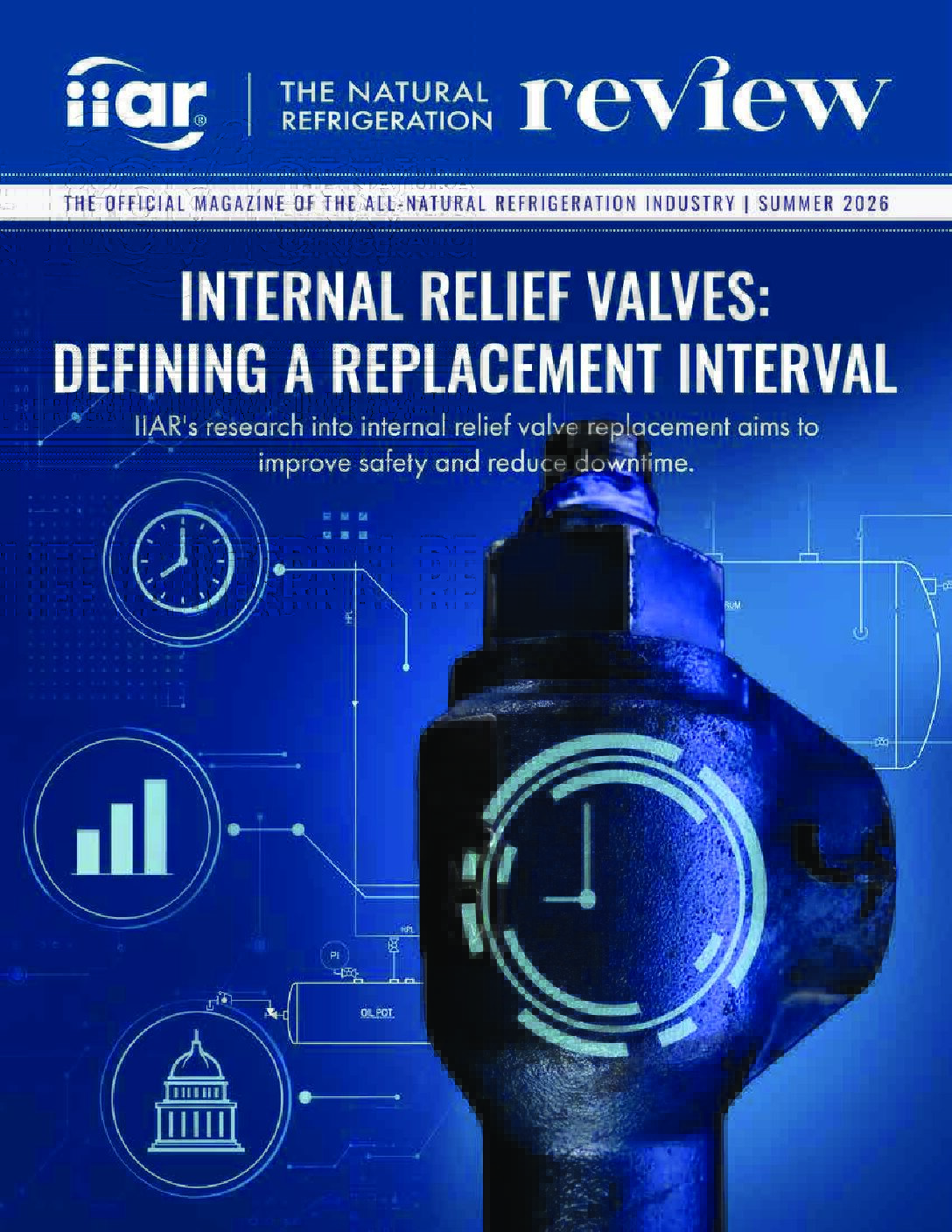
SUMMER 2026 THE NATURAL REFRIGERATION REVIEW
The Natural Refrigeration Review issues are available as PDF downloads for both lIAR members and non-members, or as individual article posts below. Click the button to view the full issue, or scroll through all the individual issue articles below.
Chairman’s Message
We are officially three months away from the 2016 IIAR conference, and while most people are busy getting ready for the holidays, the IIAR team is also hard at work adding the final touches to our annual conference programming.
Read MorePresident’s Message by Dave Rule
As you’ve likely noticed, this issue of the Condenser is all about the re-release of IIAR-2, the first comprehensive code standard for the safe, reliable and efficient design of ammonia refrigeration systems. We’re dedicating so much space to IIAR-2 because it is perhaps one of the most important, long reaching projects our association has completed in recent years.
Read MoreIIAR-2 GOES TO WORK
With the completion of IIAR-2, the most comprehensive standard for the safe design of closed-circuit ammonia refrigeration systems, the International Institute of Ammonia Refrigeration has written a single authoritative source document that provides a path forward for the ammonia refrigeration industry.
Read More
EPA, International Community Moves Forward with HFC/ HCFC Phase Out
The U.S. Environmental Protection Agency is continuing its phase-out of certain hydrofluorocarbons and hydrochlorofluorocarbons in favor of safer, more climate-friendly alternatives, which is expected to create new opportunities for the natural refrigerants industry. So far, the EPA has focused on commercial applications, although a rule on industrial applications may emerge eventually
Read More
OSHA Urges Employers to Verify Authenticity of Inspectors
The Occupational Health and Safety Administration recently warned employers of a situation in which an imposter posed as an OSHA inspector and requested unaccompanied access to a workplace. The agency asked company officials to utilize due diligence anytime they interact with someone claiming to be an OSHA official.
Read MoreIIAR-2 Committee Recognized for FourYear Publication Effort
Updating the IIAR-2 standard was a massive four-year effort, during which IIAR’s volunteer committee – working to achieve consensus – took a “divide and conquer” approach to handle the approximately 1,500 comments and more than 1,000 off-the-record suggestions, said standards committee vice chairman Don Faust.
Read More
IIAR-2: Addressing the Machinery Room
The recent release of IIAR-2 provides an updated standard that clarifies previously cloudy codes and regulations and provides new information that enables facilities to meet the highest safety standards. Specifically where safe machinery room operation is concerned, the standard is critically important to the future of the ammonia refrigeration industry.
Read MoreHands-On Facilities Improve Ammonia Refrigeration Training
The ideal training for ammonia systems should include classroom training coupled with a hands-on component in which operators and technicians can combine book learning with practical application, according to some industry training specialists.
Read More
Re-Learning the Most Important Lessons
Most facility op erators believe that they and - LESSON their employees know what needs to be done in an ammonia release situation. But knowing what needs to be done is very different than knowing you will be able to do what needs to be done when the stress of an event makes reaction time and clear thinking crucial.
Read More
Planning for Piping
Advances in technology have produced ammonia refrigeration piping systems capable of withstanding dramatic climate changes, leading many in the industry to locate as much of their facilities’ equipment as possible on the roof, which is a safer alternative in the event of an accident than the traditional location inside the building.
Read More
EPA Proposes Rule to Strengthen Refrigerant Management Requirements
On November 9, 2015, the Environmental Protection Agency (EPA) published a Notice of Proposed Rulemaking entitled “Protection of Stratospheric Ozone: Update to the Refrigerant Management Requirements under Section 608 of the Clean Air Act.”
Read MoreA Preview of Upcoming Model Codes
Codes march on… Difficult as it may seem to believe, the 2018 editions of some model codes are already well on their way to completion. The 2018 International Mechanical Code is already completed, pending final ratification of recommended changes by members of the International Code Council.
Read More
Pressure Vessel Replacement Considerations
When it’s time to replace a pressure vessel on a closedcircuit ammonia refrigeration system, considerations such as facility design, installation, operation, and maintenance can help operators determine what to purchase.
Read More
Eliminating Vapor Drive
Energy represents the second greatest cost in industrial ammonia refrigeration, and a compromised vapor barrier is a significant contributor to energy losses.
Read MoreREFRIGERANT CHARGE REDUCTION: STRATEGIES AND RESULTS IN BUILDING ULTRA LOW CHARGED AMMONIA SYSTEMS
This paper presents an overview of the reasons for charge reduction in air conditioning and refrigeration systems and discusses strategies for charge reduction: in compressors (oil), vessels, pipes, and heat exchangers. The focus is on heat exchangers, microchannel in particular. In addition to a trivial reduction of internal volume as a strategy for charge reduction, the effect of mass flux on void fraction and needed manipulation of circuiting is presented. A framework and example of comparison between refrigerants based on their potential for low condenser charge is provided.
Read MoreChairman’s Message
We’re nearing the second half of the year, and for IIAR staff, committee, and volunteer members, that means building on the substantial work completed so far in 2015 on a variety of different initiatives. You’ll read in this issue of the Condenser about two important research projects, a new scholarship initiative and work to reach our funding goal for the Ammonia Refrigeration Foundation.
Read MorePresident’s Message by Dave Rule
In this issue, we’re presenting news on many exciting activities in our industry and our organization. IIAR is working harder than ever to deliver on its promise to membership: to promote the ongoing growth and health of industrial refrigeration.
Read MoreCOOLING WITHOUT WATER?
Agriculture and food processing operations across the American West are scrambling to find new water sources amid a record drought. And although their water problems continue to be seen as a mostly regional issue for many in the industrial refrigeration industry, there’s no mistaking that water scarcity will loom larger in the years to come.
Read More
Executive Order 13650 — Improving Chemical Facility Safety and Security
On August 1, 2013, President Obama signed Executive Order 13650 entitled: Improving Chemical Facility Safety and Security. The action was driven in response to an explosion at a fertilizer facility in West, Texas
Read MoreARF Launches New Research Project Selection Process
The Ammonia Refrigeration Foundation has launched a new process to select its research projects, which now starts with a simple, one-page form.
Read More