




The Natural Refrigeration Review is a quarterly publication that contains technical articles, regulatory and code updates, industry news and information about IIAR activities and publications. It is distributed by email to all IIAR Members and IIAR Contact lists.
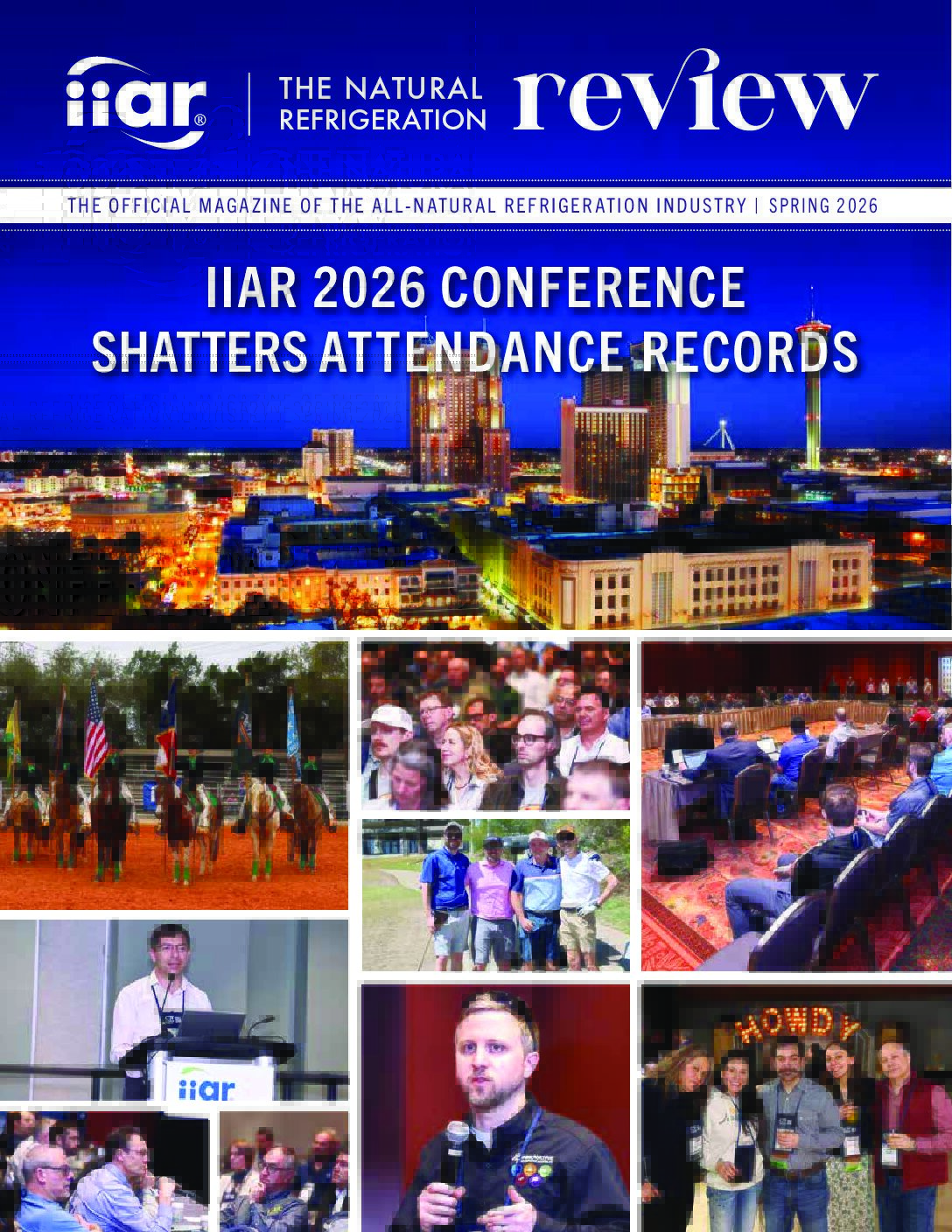
SPRING 2026 NATURAL REFRIGERATION REVIEW
The Natural Refrigeration Review issues are available as a PDF downloads for both lIAR Members and Non-members, or as individual article posts below. Click the button below to view the full issue, or scroll through all the individual issue articles below.

Remembering Mike Laucks
Mike Laucks, remembered by many of his colleagues and friends in the ammonia refrigeration industry for his quick wit and welcoming spirit, passed away peacefully on April 11, 2026. Laucks retired as vice president of engineering at GEA Refrigeration in 2006, where he spent his career in industrial refrigeration.
Read More
IIAR Releases Greenpaper
The International Institute of All-Natural Refrigeration released a new IIAR Greenpaper, a member resource for natural refrigerants. The Greenpaper, which is available on IIAR’s newly launched Resource Center, is an industry reference document that outlines the basics of natural refrigerants, and the direction the industry’s technology is taking.
Read More
Can Natural Refrigerants Save us from PFAS?
In the mid-2000’s, when PFAS “forever chemicals” were first classified by the United Nations Environmental Programme, they were just beginning to be understood as dangerous pollutants. As the evidence mounted for their role in cancer and other health problems, regulators and activists began to outlaw PFAS sources, chief among them, many pesticides commonly used in agriculture.
Read More
IIAR Scholars Attend 2026 Conference
IIAR’s annual conference this year showcased the organization’s growing scholarship program, which saw twelve new IIAR scholarships awarded. The 2026 scholars attended IIAR’s annual conference as part of a fast-growing mentorship effort led by the Natural Refrigeration Foundation. NRF has continuously increased the number of scholars each year, said John Flynn, Chairman of the IIAR Education Committee. The recipients get the benefit of a scholarship which helps defer the cost of their education, but IIAR also covers the cost of travel to the annual conference.
Read More
The Importance of Awareness
Are you aware of changes that happen around you? When a smell changes, or a sound changes, etc. are you so focused on your work or another activity that you don’t even notice? There are five primary senses. Smell, hearing, sight, taste, and touch. However, we actually have considerably more. Researchers have identified approximately 22 to 33 different senses. These additional senses are internal and specialized senses like balance, temperature, pain, proprioception, etc. As we become more aware of the many inputs we have, we can be better equipped to make good decisions.
Read More
Safe Work Practices (SWPs) for End User Operators & Technicians of Closed-Circuit Ammonia Refrigeration Systems
Safe Work Practices(s) are critical for operating and maintaining closed-circuit ammonia refrigeration systems. Developing safe working practices is not just good for workers’ well-being, it is also good for business. The loss of systems’ functionality because of accidents, and the loss of employees’ skills because of injury is costly. It is far more fruitful to spend time to develop and practice safe work than to recover from accidents. Further, the development and engagement of safe work practices is a legal requirement in many jurisdictions and is broadly required in some countries.
Read More
IIAR Introduces Legacy 100 Club Members
The International Institute of All-Natural Refrigeration posted remembrance videos for each of its seven inductees into the Natural Refrigeration Foundation’s Legacy 100 Club. Each inductee to the Legacy 100 Club represents an impactful contribution to the advancement of natural refrigerants, said Mike Chapman, IIAR’s Vice President of Operations. “This is a chance for us to collectively name and acknowledge individuals for their contributions to our industry so that everyone is aware of the history of contributions that have helped to shape what our industry has become today.”
Read More
EPA Adopts “Compliance First” Policy for Enforcement Activities
In December 2025, Craig J. Pritzlaff, Acting Assistant Administrator for the Office of Enforcement and Compliance Assurance (OECA), issued a memorandum that reinforces a “compliance first” orientation as the guiding principle for the U.S. Environmental Protection Agency (EPA). The policy prioritizes environmental compliance “in the most efficient, most economical, and swiftest means possible, while ensuring that our actions align with the clearest, most defensible interpretations of statutory and regulatory mandates.”
Read MoreIIAR Task Force to Propose PSM/RMP Changes
IIAR’s newest task force has completed a gap analysis to assess OSHA and EPA’s 30-year-old PSM/RMP programs. The “NH3 Overdue Regulation Modernization,” or NORM, task force will ask regulators to remove regulatory burdens that overlap across agencies or defer to IIAR standards when the standards and regulations overlap. The task force's long-term effort will be to shift some funding and enforcement from federal regulators to state and local authorities. The NORM task force was formed to operate in a rare federal environment in which the Trump administration has opened the door to regulatory reform through Executive Order 14192, which requires agencies to take 10 deregulatory actions for every new regulation.
Read More
IIAR Gives 2026 Awards for Presentation Excellence
Each year, IIAR recognizes the best technical paper presentations offered at the annual Natural Refrigeration Conference. This year’s event took place March 15 – 18 in San Antonio, Texas. The IIAR Award for Presentation Excellence, offered to the top English and non-English language technical papers and previously named the “Andy Ammonia Award,” was created to acknowledge the crucial role that education and information-sharing play within the natural refrigeration industry, and to provide acknowledgment of the expertise that is generously shared by association volunteers.
Read More
IIAR 2026 Conference Shatters Attendance Records
Over 2,000 attendees participated in the International Institute of All-Natural Refrigeration’s Natural Refrigeration Conference & Heavy Equipment Expo in San Antonio, Texas. The event focused on networking, equipment exhibition, and a technical education track that featured industry trends and practical discussion of operational processes and details. “Overall, the conference was better attended than ever before in years past, said Yesenia Rector, IIAR’s Vice President – Education, Outreach and Events.
Read More
IIAR Approves Consensus Body Replacements
IIAR approved 18 Consensus Body replacements on its three consensus bodies for IIAR standards. The replacements are routine maintenance required by the American National Standards Institute (ANSI) and are completed a minimum of every five years or when individuals are no longer participating. IIAR maintains three consensus bodies, 1357, 24689 and CO2&HC. The bodies are the near-final stage of approval for IIAR standards 1,3,5, and 7, and 2,4,6,8, and 9, respectively. The CO2&HC body manages CO2 and hydrocarbons (HC).
Read More
IIAR Greenpaper: Natural Refrigerants for a Sustainable Future
Industrial food production around the globe depends on natural refrigerants. Ammonia (NH₃), carbon dioxide (CO₂), and hydrocarbons such as propane (R290) make up the foundation of the technologies that support the global cold chain. Often called one of the world’s “century-proof” technologies, natural refrigerants have been used for over 100 years and continue to outperform synthetic alternatives in terms of energy efficiency and environmental impact. Natural refrigerants pose the only truly climate-neutral solution for the technical systems and infrastructure required to feed the world’s population.
Read More
IIAR White Paper: Environmental and Health Risks of Synthetic PFAS Refrigerants
This white paper examines the growing global concern over per- and polyfluoroalkyl substances (PFAS), focusing on trifluoroacetic acid (TFA), a persistent byproduct of modern hydrofluoroolefin (HFO) refrigerants. While designed to reduce global warming potential (GWP), HFOs degrade in the atmosphere to form TFA – a short-chain PFAS that accumulates in water and soil. TFA’s resistance to degradation and lack of large-scale remediation methods make it a mounting ecological and regulatory challenge.
Read More
IIAR adds Resource Center in 2025, Begins Analysis of US Ammonia System Regulations
IIAR began a closer examination of the federal General Duty clause, Process Safety Management and Risk Management programs for ammonia refrigeration systems, built a new website section to highlight member resources, automated its peer review process for technical papers, and expanded events in Latin America in 2025.
Read More
NRF Research Validates CO2 Standard
A new research project funded by IIAR’s Natural Refrigeration Foundation has validated a key calculation used in the ANSI/IIAR CO2-2021 Safety Standard for Closed-Circuit Carbon Dioxide Refrigeration Systems. The calculation is used to generate a formula that determines the CO2 relief valve sizing recommendations in the CO2 safety standard.
Read More
IIAR 2026 Conference to Feature New Program, Expanded Exhibit Hours
IIAR’s annual conference will deliver a tech-heavy program this year, featuring two auxiliary training and certification programs from the Refrigerating Engineers & Technician’s Association, RETA, and the North American Sustainable Refrigeration Council, NASRC, as well as thirty one sessions comprising six educational tracks and expanded exhibit hall hours.
Read More
2026 IIAR Technical Papers Address AI, Heat Pumps, Data Centers
Heat pumps, real life stories from PSM coordinators and the use of AI in refrigeration and waste heat recovery for data centers are a few of the hot topics slated for discussion at IIAR’s 2026 conference in San Antonio. This year’s papers will address several categories spanning safety, CO2 optimization, heat exchangers, cold storage, ammonia charge and more. In addition, a series of panels and workshops will address many of the industry’s focus areas. This year’s papers will address several categories spanning safety, CO2 optimization, heat exchangers, cold storage, ammonia charge and more.
Read More
NRF Unveils Legacy 100 Club
IIAR’s Natural Refrigeration Foundation unveiled a new fundraising effort intended to make the foundation financially secure as it funds scholarships and industry research into the next decade and beyond. The foundation said the new Legacy 100 Fund will be built by contributions of $100,000-each to induct 100 leaders of the refrigeration industry into the Club.
Read More
Jeopardy-Style Conference Session will Highlight IIAR Standards
A new conference session format is brewing ahead of the IIAR annual conference in March according to IIAR conference planners. The session, which will take place during the event’s closing day will include a lively jeopardy-style question and answer format and will focus on IIAR’s standards.
Read More