





The Natural Refrigeration Review is a quarterly publication that contains technical articles, regulatory and code updates, industry news and information about IIAR activities and publications. It is distributed by email to all IIAR Members and IIAR Contact lists.
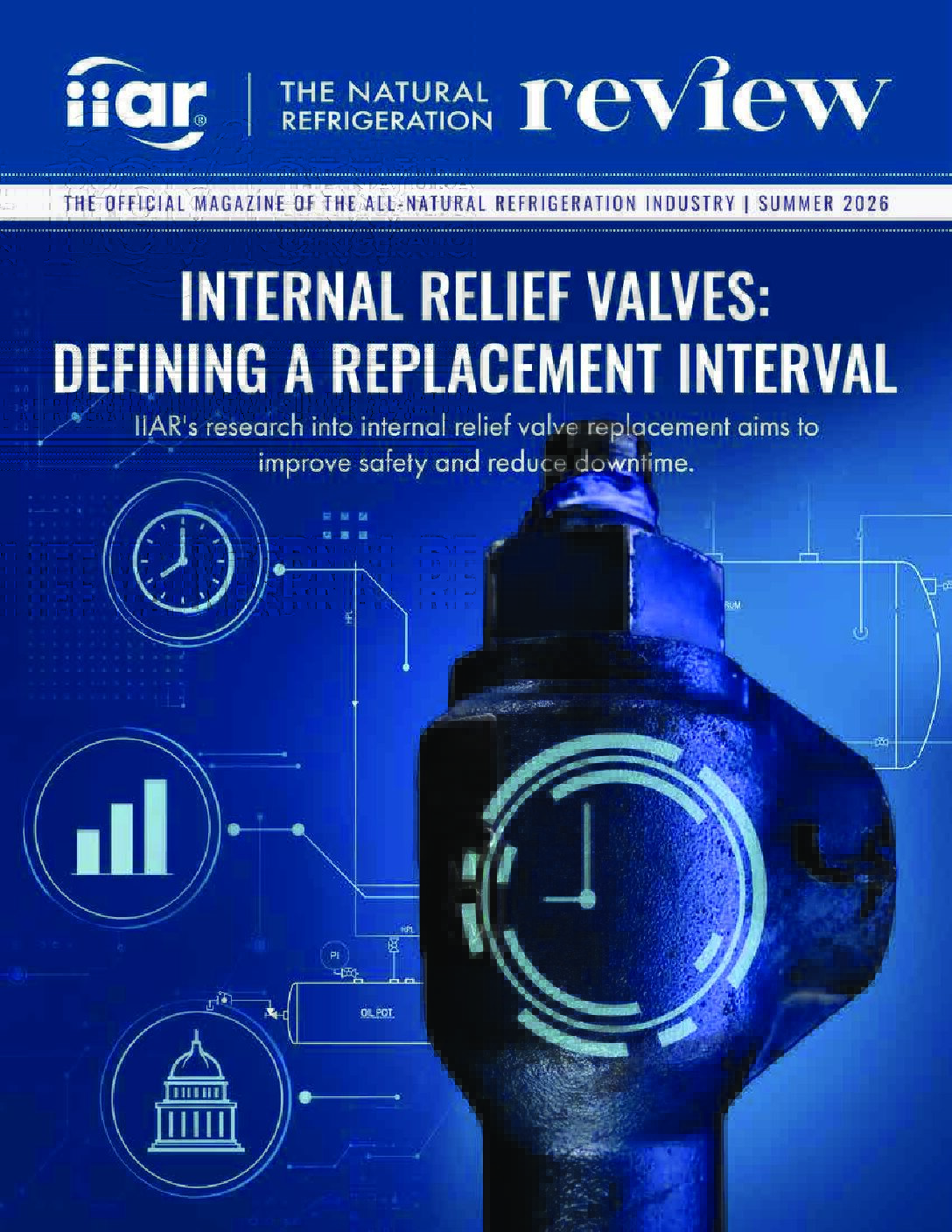
SUMMER 2026 THE NATURAL REFRIGERATION REVIEW
The Natural Refrigeration Review issues are available as PDF downloads for both lIAR members and non-members, or as individual article posts below. Click the button to view the full issue, or scroll through all the individual issue articles below.
IIAR Announces Awards for Presentation Excellence
Each year, some of the best minds and top talent in the industrial and commercial refrigeration industry gather from around the world at the IIAR Natural Refrigeration Conference & Expo. These experts present technical papers at the IIAR Technical Program in conjunction with this event, and each year the best, most informative presenters are honored with awards of excellence. Below are 2019’s recipients.
Read MoreInternational Committee Focuses on Standards Adoption
The International Committee of the IIAR is working across Latin America to educate leaders in several countries in the region, helping them adopt IIAR standards to better promote safety, sustainability and international commerce.
Read MoreIIAR, NASRC, Partnership Delivers New Technical Track
At this year’s IIAR Natural Refrigeration Conference and Expo, held in Phoenix, the IIAR announced its partnership with the North American Sustainable Refrigeration Council. Through this partnership, educational programming at the conference was expanded to include a Commercial and Food Retail education Track.
Read More
Safety Committee Working on Hazardous Energy Lockout Standard for Manual Valves
The IIAR’s safety committee is continuing its efforts to draft a guideline for the application of the Occupational Safety and Health Administration Standard 29 CFR 1919.147, more commonly called “the control of hazardous energy (lockout/tagout),” or LOTO for short.
Read More
Charitable Giving
An outright gift is one that benefits the charity immediately and exclusively. With an outright gift you get an immediate income and gift tax deduction.
Read More
Who’s Prepared?
I have been in the industrial refrigeration industry for, well, a long time. Over the decades LESSON I have seen many changes in technology and regulations. However, one thing that in more recent years really stands out is who is prepared to take over a position?
Read MoreCorrosion Allowance
The latest version of IIAR 2, Standard for Safe Design of Closed-Circuit Ammonia Refrigeration Systems will soon be published as “IIAR 2-2014, with Addendum A”. Among other important changes to the standard, there will no longer be a requirement for an additional 1/16” corrosion allowance (CA) on ammonia refrigeration vessels. The design of pressure vessels results in a calculation for the minimum thickness (Tmin) at various places on a vessel (e.g., shell, seams, heads, and nozzels).
Read More
Green New Deal and Climate Policy
Climate policy is taking center stage with Democrats in Congress who gained control of the House of Representatives after the 2018 elections and the over 20 candidates vying for the Democratic presidential nomination in 2020. The debate, and rhetoric, is heating up and looks to continue as we head into the presidential election next year.
Read MoreAvoiding Brittle Fracture When Repressurizing Carbon Steel CO2 Vessels That Have Lost Pressure
A vessel containing liquid CO2 may form dry ice and be at a temperature below -100°F (-73.3°C) if a leak or control malfunction causes its pressure to drop to atmospheric pressure. If the upset condition is corrected and the vessel is repressurized too quickly with warm high-pressure CO2 , there is a possibility of brittle fracture if the vessel material of construction is carbon steel. The industrial gas industry has developed safe and acceptable methods of repressurizing carbon steel CO2 vessels that have lost pressure. These are described in the Compressed Gas Association guideline CGA-6.7.
Read MorePresident’s Message by Dave Rule
Once again, our industry is facing a major decision as to the preferred refrigerant that will provide appropriate performance and efficiency while considering the impact on the environment and public safety. This is a complicated question that must address the many diverse applications that are required for industrial and commercial refrigeration, many types of process cooling requirements ranging from manufacturing needs to pharmaceutical production and the general comfort cooling needs of public buildings to residential.
Read MoreHydrocarbons — A Natural Next Step For IIAR
Many hydrocarbons such as Propane, Propylene, and Iso-Butane, make great refrigerants. They are natural, have zero ODP, GWP less than 4, and are categorized as non-toxic. Compared to the HFC’s and HFO’s (also known as “F-Gases”) they have:
Read MoreFuture Focus
As refrigerants with highglobal-warming potential are phased out, natural refrigerants are being considered for new applications, and the industry is seeing increased use of secondary refrigeration units that allow users to lower their ammonia charge.
Read MoreIndustry Research Leads to New Insight on Optimum Pipe Sizing
After extensive research and analysis, IIAR’s Ammonia Refrigeration Foundation has released new information on the economics of piping selection and on the proper selection of ammonia wet suction risers, which can help end users prevent oversizing of piping and using more energy than is necessary.
Read MoreCurbing Confined Space Confusion
As code interpretations continue to change and improvements slowly morph into normal practice, when the time comes to tackle OSHA’s confined space standard, where do you start?
Read MoreEducation Committee Reports Scholarship Program Growth
Your Foundation’s scholarship program has been steadily growing since it was launched in 2016, helping address the industry’s growing need for specifically trained engineers.
Read More
Selecting the Right Compressors
For a refrigeration system to run at optimal energy efficiency, it’s important to carefully select the right type of compressors need to be selected, and the correct cooling method employed.
Read MoreShipping Bay: Safety & Reduced Energy Usage Overlap (a Win-Win)
While working as the utilities and facilities manager, to bring on a new major expansion at a large food manufacturing facility, “Safety Always” was part of the culture. The new expansion called for growing from a facility with eight lines of existing production to an immediate addition of sixteen production lines - and targeted to expand to thirty-two lines of production within two more years.
Read More
IIAR Extends Safety, Education to Global Partners
IIAR continues to be active internationally, participating in and sponsoring conferences and natural refrigeration education in India, Mexico, Chile, Argentina and Colombia, with the goal to share IIAR’s message to important global stakeholders.
Read MoreThe Catch 22 of R22 Replacements
If you’ve recently googled “it’s almost 2020 and I still have R22” then hopefully this article grants you some timely insights. The world of refrigerants has become much more complex since you could refer to your refrigerant as “Freon” and not make an embarrassing social blunder because you were actually using a halogenated hydrocarbon and not a fluorinated hydrocarbon mixed with an unsaturated fluorinated alkene.
Read More
IIAR Webinar Series Addresses Safe Work Practices
The International Institute of Ammonia Refrigeration has researched and gathered information from several members over the past year to develop a series of seven “Permit to Work: Safe Work Practices” webinars to help members of the industry stay safe and remain OSHA compliant.
Read More