






The Natural Refrigeration Review is a quarterly publication that contains technical articles, regulatory and code updates, industry news and information about IIAR activities and publications. It is distributed by email to all IIAR Members and IIAR Contact lists.
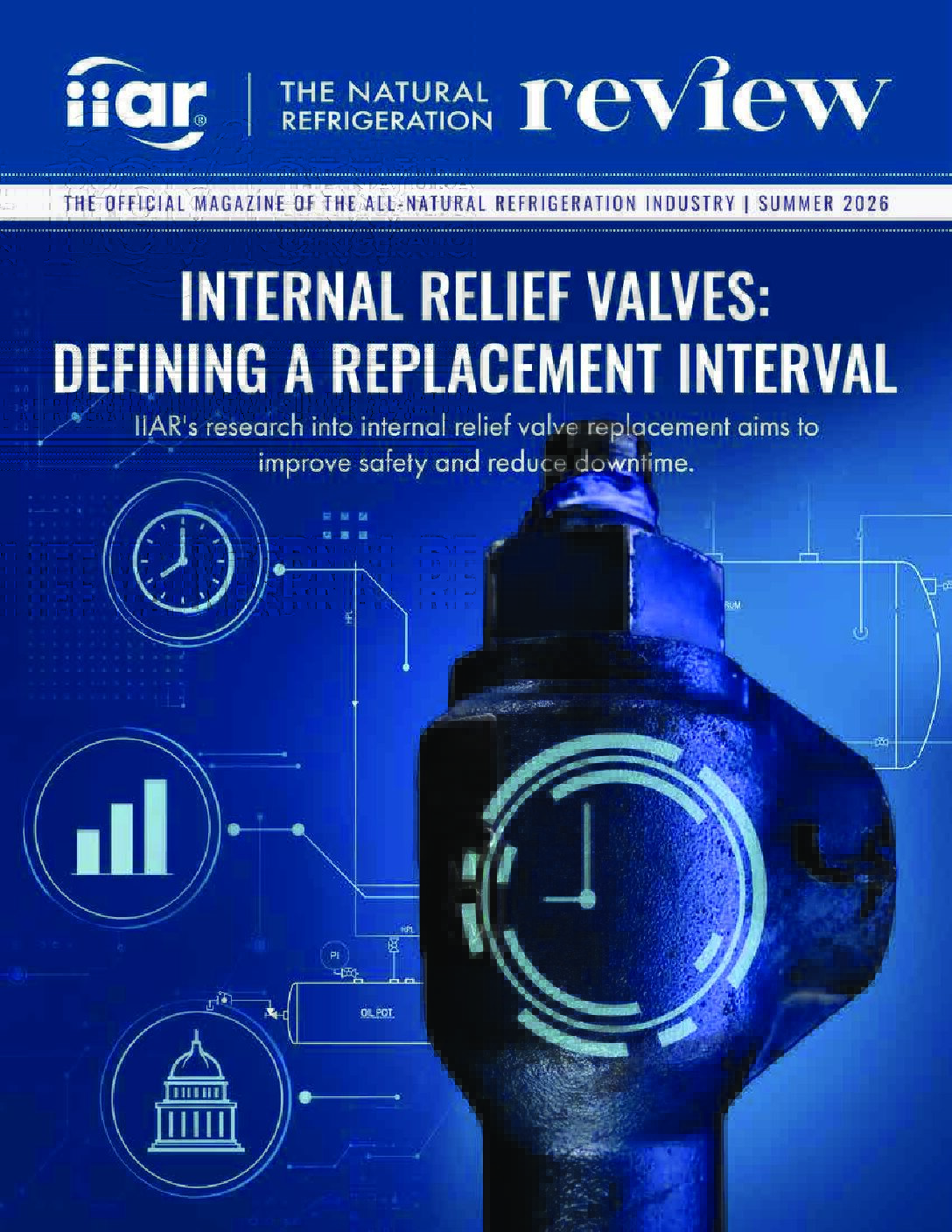
SUMMER 2026 THE NATURAL REFRIGERATION REVIEW
The Natural Refrigeration Review issues are available as PDF downloads for both lIAR members and non-members, or as individual article posts below. Click the button to view the full issue, or scroll through all the individual issue articles below.
Europe’s F-Gas Phase-Out, Price Increases, Leave the Industry Looking for Solutions
In Europe, the phase out of fluorinated gases with high global warming potential, known as F-gases in Europe and HFCs in the U.S., is resulting in severe shortages, causing prices to skyrocket and creating challenges for those that operate and maintain the systems.
Read MoreCONFERENCE CHAIR’S MESSAGE
It’s the beginning of a new annual conference for all of us at IIAR, and that means it’s time to meet new colleagues, network, and catch up with friends and business partners at our industry’s largest event. Welcome to the 2018 IIAR Natural Refrigeration Conference & Exhibition!
Read MoreARF Message
The International Institute of Ammonia Refrigeration, in partnership with other industry leaders — including The Foundation, RETA, IIAR, GCCA, Lanier Technical College, and Fastport — has created an apprentice program for mechanics and technicians to help bolster the refrigeration workforce. The program is designed to train ammonia refrigeration technicians in all phases of their careers and combines well-developed on-thejob learning with related instruction.
Read MoreFrom Threat Assessment to Employee Engagement: IIAR Tech Papers Unveil Research, Analyze Data
Utilizing bow-tie graphics to assess and prevent potential threats to an industrial ammonia refrigeration system, the importance of employee engagement and building relationships with first responders, and the benefits of ammonia scrubbing with C02 are among the technical papers and workshops that will be presented at this year’s annual IIAR Natural Refrigeration Conference and Expo.
Read More
Efficiency Can be Just Another Controllable Cost
Energy efficiency can be achieved in ways other than with new technology. It can also prove to be a controllable cost, just as with labor and equipment. By developing an energy management system that establishes clear, measurable goals for energy performance, end users of industrial refrigeration facilities can realize a significant reduction in energy consumption, delivering cost savings that fall straight to the bottom line.
Read More
Little Details Add Up
When big things happe they really draw our attention, but in most cases it’s the little things we miss that can result in unexpected and sometimes undesirable results. We might breeze along taking account of larger items, not realizing or taking time to think that little details can make a big difference.
Read More
Social Security: Claim Early and Invest Versus Delaying Receipt for Increased Benefits
Financial Advisors are occasionally asked to provide an analysis of the potential results of claiming Social Security early and investing the proceeds versus delaying receipt for increased benefits, which can be claimed as late as age 70. The following are the reasons that delaying social security income can be a prudent strategy.
Read More
Using the Right Type of Monitor for CO2
The use of CO2 is becoming common in the industrial refrigeration industry, especially with cascade refrigeration systems. But many people are not as familiar with CO2 as they are with ammonia, some believing that the only respiratory issue with CO2 is that it is an inert gas like nitrogen or argon.
Read More
Appeals Court Denies Rehearing of Ruling Against EPA Regulation of HFCs
On January 26, 2017, the United States Court of Appeals for the District of Columbia Circuit denied petitions requesting a rehearing by the full court of a decision finding that the Environmental Protection Agency (EPA) had exceeded its authority by regulating the use of HFCs through the Significant New Alternatives Policy program (SNAP).
Read MoreEnergy Performance of Low Charge, Central Type, Dual Stage NH3 Refrigeration Systems in Practice
In the wake of the pending global phase-down of HFCs due to their contribution to global warming, users and owners of refrigeration systems are faced with decisions that at times appear difficult. These decisions relate to whether or not users continue to employ HFC-based refrigeration systems, switch to low GWP synthetic refrigerants or consider future-proof natural refrigerants such as NH3 , CO2 , hydrocarbons, water, or air in their new and/or expanded systems. In this decision-making process, one very important factor is often either overlooked or underestimated. This factor is energy performance—particularly the energy performance of low charge NH3 systems.
Read MorePresident’s Message by Dave Rule
This month you’ll be hearing from IIAR about one of our most important annual activities, our membership renewal drive. As an IIAR member, we all depend on you to take that essential first step to participate in the activism and advocacy of our industry, by
Read MoreChairman’s Message by Mike Lynch
As your new Chairman, my first priority this year is to extend a warm welcome to all our new IIAR members. You are joining a community passionate about its work. Your participation and spirit of volunteer leadership is essential in creating the growth and change that will help our natural refrigeration industry meet the new challenges ahead.
Read MoreUNLOCKING AMMONIA
Ammonia refrigeration systems are becoming more compact, portable and simpler to install, widening the potential for adoption of ammonia, carbon dioxide and other natural refrigerants in previously untapped industries.
Read MoreWith New Technology, Buying Decisions Hinge on Efficiency
The focus on efficiency and more important in every arena, and a growing number of companies are prioritizing the potential for long-term efficiency gains, reduced labor costs and streamlined maintenance - over initial cost - when designing their facilities.
Read MoreIndustrial Refrigerant Apprenticeship Program Nears Completion
A consortium of agencies including RETA, IIAR, ARF, the Global Cold Chain Alliance, FASTPORT and Lanier Technical College has been working diligently to build the Industrial Refrigerant Apprenticeship Program and to get it up and running with the U.S. Department of Labor. It is with great pleasure that we announce that the process is nearly complete.
Read MoreARF Message
In an effort to attract more young people to the industrial refrigeration industry using natural refrigerants, a high school in Azle, Texas, is taking a novel approach. By offering a fully dedicated ammonia refrigeration class, the school gives students unprecedented hands-on training, meaningful work experience and even industry credentials long before their peers are even considering what their careers might be.
Read MoreDocumenting RAGAGEP
The Occupational Safety and Health Administration’s Process Safety Management (PSM) standard (29 CFR 1910.119) was issued as a final rule in 1992. The Environmental Protection Agency’s Risk Management Program (RM Program) regulation (40 CFR 68.79) was issued as a final rule in 1994.
Read MoreStandards Committee Focuses on CO2
One of the main focuses this year for the Standards Committee has been the development of a CO2 standard. As this refrigerant is growing in popularity, it’s becoming clear the industry needs guidance on its development, deployment and safety measures.
Read MoreInternational Committee Expands Outreach
Over the past year and a half, IIAR’s International Committee has established working chapters in several Latin American countries and has its sights set on more countries across the region and the world.
Read MoreMarketing Committee’s Report Quantifies Member Data
This year the IIAR Marketing Committee released its first State of the Industry report. The objective of the report was to compile various data sets and information about the industry and present it to IIAR members in an easily digestible way to share valuable information.
Read More