





The Natural Refrigeration Review is a quarterly publication that contains technical articles, regulatory and code updates, industry news and information about IIAR activities and publications. It is distributed by email to all IIAR Members and IIAR Contact lists.
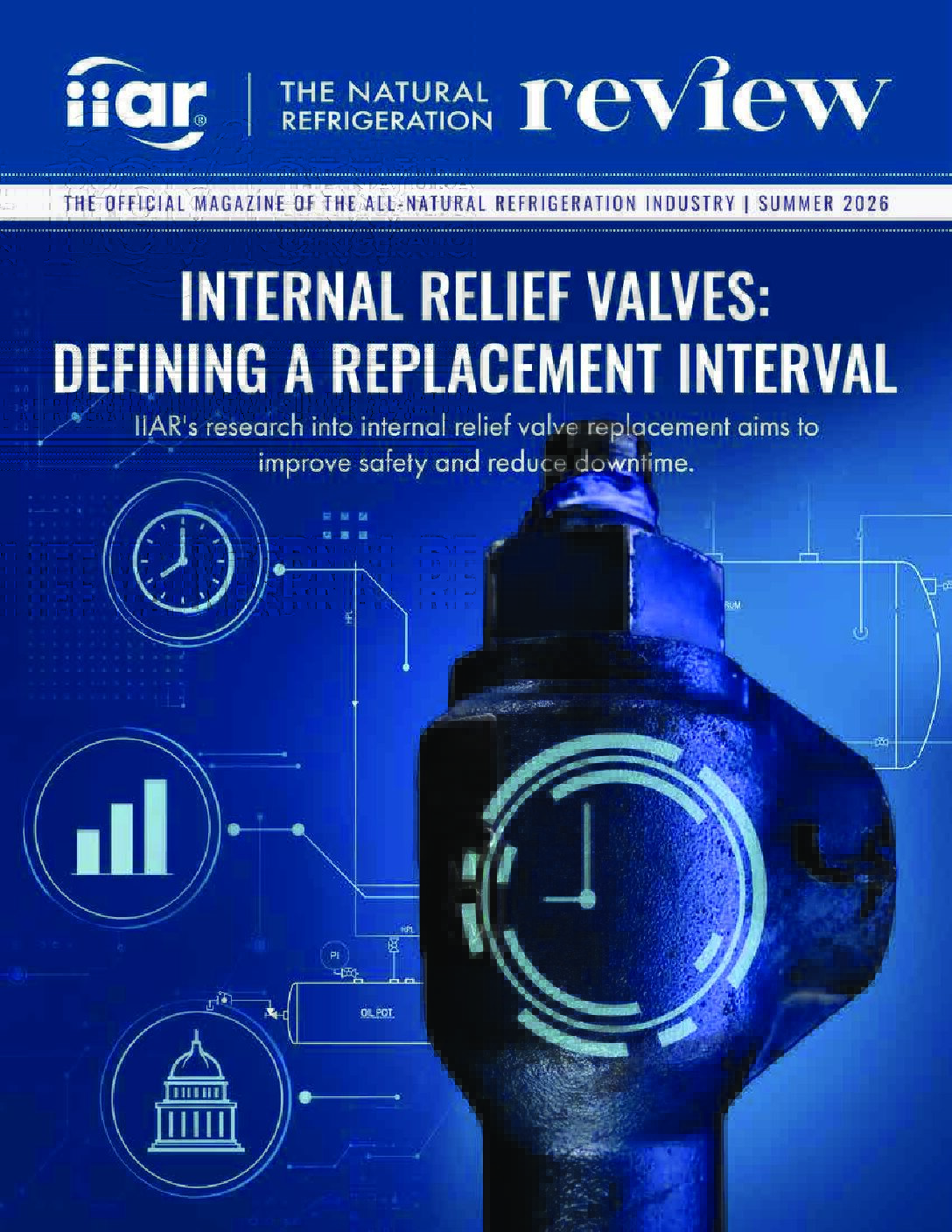
SUMMER 2026 THE NATURAL REFRIGERATION REVIEW
The Natural Refrigeration Review issues are available as PDF downloads for both lIAR members and non-members, or as individual article posts below. Click the button to view the full issue, or scroll through all the individual issue articles below.
Chairman’s Message by Walter Teeter
We're kicking off a new year and setting new agendas, and even though I’m well into my term as your IIAR Chairman, I’d like to take this opportunity to welcome everyone – new and renewing members alike.
Read MorePresident’s Message by Dave Rule
It’s the beginning of the summer and that means it’s time for one of IIAR’s most important activities – leading membership renewals. And while this may seem like a routine activity we all work hard to complete every year, I’d like to take the opportunity in my column this month to point out that, as an IIAR member, this is one of the most important contributions you can make to the success of our industry.
Read MoreThe Internet of REFRIGERATION
The Internet of Things — an increasingly massive network of electronically connected systems, devices and people that enables cross-platform data sharing — is creating a large, connected ecosystem across many industries, including refrigeration.
Read MorePackaged Components Promise Flexibility, Lower Install Costs
Package systems are providing turn-key solutions for those within the refrigeration industry, and some manufacturers are turning to packaged components within those systems, which can cut down on the number of parts in use and make maintenance easier.
Read More
Cleaner Coils Boost Cooling Capacity
When a large food distribution facility was faced with major issues resulting from evaporator and condenser coils coated with dust, dirt, and production debris, it turned to EcoClear in Georgia and its deepcleaning system. The facility was looking to improve air flow, increase dehumidification, improve energy savings and reduce maintenance cost through a deep cleaning of the coils.
Read MoreIIAR Members Honored with Awards from Accelerate America
Accelerate America magazine honored five IIAR member companies for their work in advancing natural refrigerant adoption in North America as part of its second annual awards program. The awards were presented in June during the ATMOsphere America conference in San Diego
Read MoreIIAR Remembers George Yoksas
George Yoksas was a long-time federal safety regulator, but he hated when red tape got in the way of solving issues. “He wanted to find> solutions. He would say, ‘How can we make this work and have a meaningful impact?’ ” said Doug Reindl, a professor in the University of Wisconsin departments of Engineering Professional Development and Mechanical Engineering, and a founding director of the Industrial Refrigeration Consortium. “He was willing to think differently than someone who might look at a standard or regulation and say ‘It says this.’ He thought about what made sense.”
Read More
Sealless Pumps Reap Energy Savings
Seal-less magnetic pumps, or mag-drive pumps, have become the preferred option for a variety of conditions in the ammonia refrigeration industry, mainly because they take the heat generated by the pump's electric motor out of the cooling proce
Read More
R-22: Five Things to Know
With production of HCFC refrigerants ending in less than three years, food and beverage manufacturers who currently rely on R-22 are faced with some difficult choices. Although facilities can continue to use recycled, reclaimed or stockpiled R-22 past Jan. 1, 2020, there will come a time when the shift to lower global-warming-potential synthetic refrigerants or natural refrigerants, such as ammonia, is unavoidable.
Read MoreARF to Create Industry Insulation Standards and Quality Control Guidelines
While insulation is a critical element currently is no industry standard for installation or quality control of the installation, a gap that the Ammonia Refrigeration Foundation plans to address with a new research project.
Read More
RETA, IIAR Develop CO2 Training Materials
As hydrofluorocarbons and hydrochlorofluorocarbons are being phased out, there is a growing emphasis on natural refrigerants. To help improve safety and educate those within the industry, IIAR and the Refrigerating Engineers and Technicians Association are working to create safety standards and develop educational materials
Read More
Trump Administration Advances Regulatory Reform
President Trump made regulatory reform a priority during the campaign and pledged to provide industry relief from overly burdensome regulations.Since President Trump took office, he has initiated a number of actions to advance regulatory reform that will impact the industrial refrigeration industry.
Read MorePARALLEL OPERATION OF SCREW COMPRESSOR PACKS
Ammonia screw compressor packs utilizing parallel operation of two or three smaller industrial NH3 screw compressors offer the optimum way to fulfill maximum part load efficiency, increased redundancy, and other highly desirable features in the industrial refrigeration industry.
Read MorePresident’s Message by Dave Rule
In this issue of the Condenser, we’re looking at the exit strategies that end users and manufacturers alike are using – to move away from hydrofluorocarbons and hydrochlorofluorocarbons. As former IIAR chairman Bob Port mentions in our cover story “There is a lot of internal pressure to get out of [HFC’s and HCFC’s] from a sustainability standpoint, but it has to come at a reasonable cost and be a good business decision.”
Read MoreMaking the Investment
As they move away from refrigerants with high global warming potential, commercial and industrial refrigeration users said they’re investing in new, natural refrigerant technology, including packaged ammonia systems and CO2 transcritical systems. The move to newer technologies is allowing them to ease some regulatory burdens, increase efficiency and improve safety.
Read MoreDid Amazon Just Invest in Natural Refrigerants?
In August, Amazon completed its $13.7 billion purchase of Whole Foods Market Inc., and the e-commerce giant now owns the upscale grocer Whole Foods, which is based in Austin, Texas, and has more than 460 stores in the United States, Canada and the United Kingdom.
Read MoreComparing Ammonia to 1234yf
Although ammonia has been the refrigerant of choice in industrial refrigeration systems for more than a century, it has faced competition from numerous synthetic refrigerants, most recently 1234yf and R32. Although the use of ammonia brings with it a greater regulatory burden, it remains the more logical choice of refrigerant in larger refrigeration systems, especially from a safety, efficiency and environmental standpoint.
Read More
Back to Basics: To Reduce the Energy Burden, Reduce the Load
New technologies have led to improvements in energy efficiency, but it will take a new and smarter approach to industrial refrigeration system design to harness the full potential of energy savings – systems that are environmentally sound and costeffective.
Read More
Situational Awareness Does Matter
I have often thought about situational awareness, but only on a cursory level. In my experience in dealing with emergencies, and seeing how people act in some situations most people seem oblivious to what is happening or can happen. Here is a recent experience I had that jarred me again into thinking about situational awareness.
Read More
Attention: End Users and Contractors working in Illinois
In May of 2015, IIAR was notified that inspectors with the Illinois State Fire Marshal were requesting that ammonia vessels as part of refrigeration systems be internally inspected.
Read More