




The Natural Refrigeration Review is a quarterly publication that contains technical articles, regulatory and code updates, industry news and information about IIAR activities and publications. It is distributed by email to all IIAR Members and IIAR Contact lists.
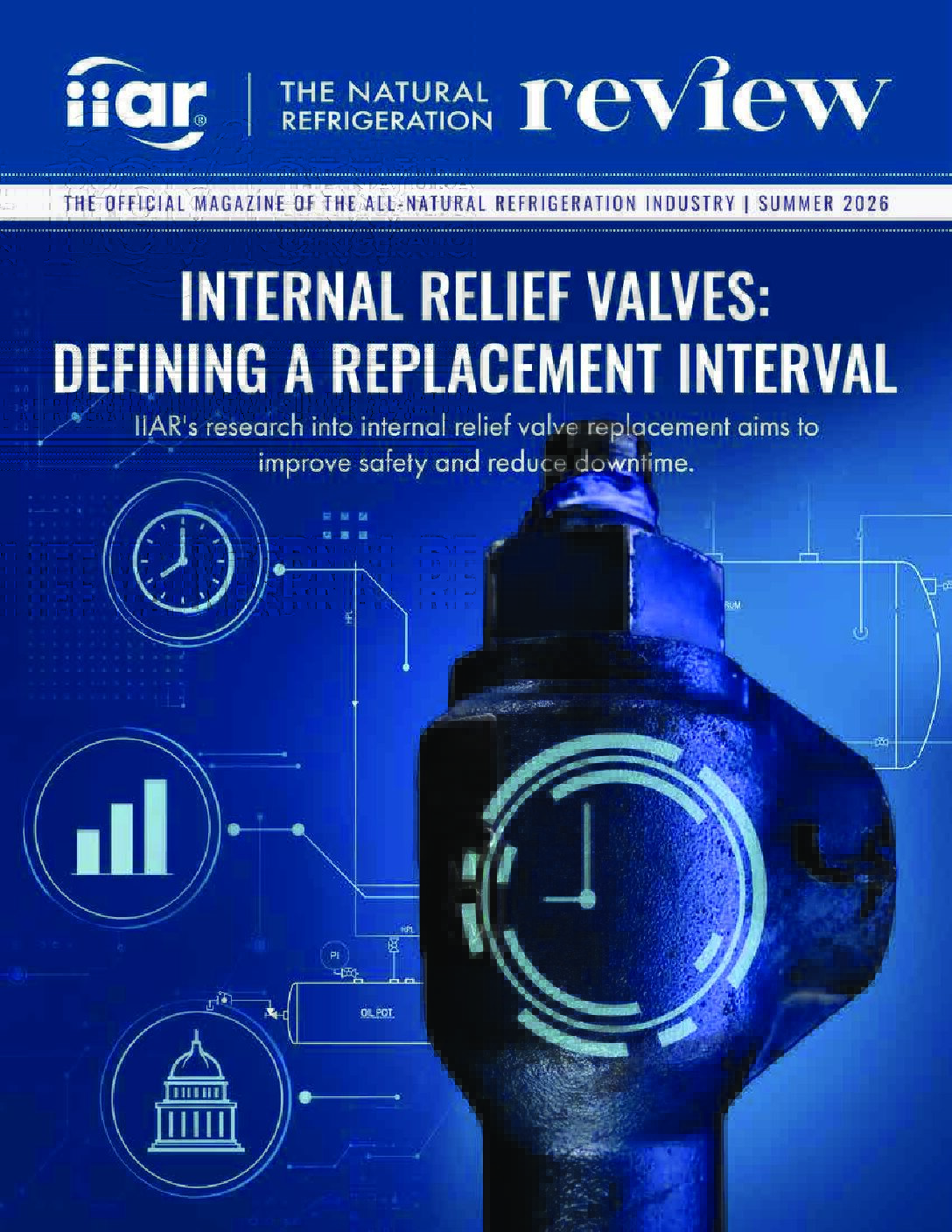
SUMMER 2026 THE NATURAL REFRIGERATION REVIEW
The Natural Refrigeration Review issues are available as PDF downloads for both lIAR members and non-members, or as individual article posts below. Click the button to view the full issue, or scroll through all the individual issue articles below.

The 2018 and 2021 Codes: Where We Are & Where We Are Headed (Part 2)
Part 1 of this article presented IIAR’s many successes in changing the 2018 editions of model mechanical, building, fire and electrical codes in working with FM Global to update their recommendations for facilities with ammonia refrigeration.
Read More
Understanding Compliance
I was talking recently to a professional acquaintance who told me that he is encountering more and more facility managers that ask him, “What is the minimum that we have to do to comply with 29 CFR 1910.119 and 40 CFR Part 68?”
Read MoreARF News
The end of the year offers a time of reflection and an opportunity to give back to the programs, organizations and people that have supported us throughout the year. I am excited to tell you about all your foundation has accomplished in 2018 . . . and issue a challenge to you to get involved by giving to the programs which create opportunities to sustain the future of our industry.
Read More
Year-End Tax Planning Strategies
If you are not engaging in year-end tax planning, you could be leaving money on the table. Consider the following strategies to identify potential opportunities to lower your 2018 (or 2019) tax bill. Be sure to consult with your a qualified tax professional before implementation.
Read More
Awareness
Are you “aware” in all, or at least most of LESSON the aspects of your life? Awareness implies that you have knowledge of something by maintaining a level of alertness in observing or in interpreting what you see, hear, feel, etc.
Read More
Supreme Court Declines to Hear HFC Case, EPA Proposes Removing HFC Leak Requirements
On October 9th, the Supreme Court of the United States declined to consider the case of whether the Environmental Protection Agency (EPA) has the authority to regulate hydrofluorocarbons (HFCs) under the Significant New Alternatives Policy (SNAP) program.
Read MoreEnergy and Function Analysis of Hot Gas Defrost in Ammonia Refrigeration Systems
Traditionally one of two methods for controlling drainage of the evaporator during hot gas defrost is used: pressure control, which keeps the pressure in the evaporator constant during defrost, or liquid drain control, which uses a float valve to drain condensed liquid from the evaporator. Each method’s energy consumption is quite different, as the pressure-control method bypasses a certain amount of hot gas during the defrost period.
Read MoreChairman’s Message by Walter Teeter
The Annual Conference and Heavy Equipment Show was a great success this year, and now that the flurry of committee meetings, networking events and technical discussions has ended and we’re all back at work, it’s time to set some new goals and carry the momentum of our recent meeting into the rest of the year.
Read MorePresident’s Message by Dave Rule
Now that we’ve all returned from San Antonio, it’s a new member year, and your staff is digging in to accomplish many of the new goals set out for 2017. First among them is planning the next successful conference. We’re looking forward to returning to the Broadmoor in Colorado Springs, and I hope to see you all there. Now is the time to take advantage of IIAR’s early membership renewal opportunities and get involved in the work of your committees.
Read MoreThe Green Transformation
Refrigeration manufacturers said they would make production plans and future product development decisions according to the expected worldwide HFC refrigerant phase down put forth by the Kigali Amendment. The amendment, last year’s Montreal Protocol add-on, will specify phase-out deadlines for HFC’s, adding those refrigerants with high global warming potential to the group of ozone depleting hydrochlorofluorocarbons that are already being outlawed under the international agreement.
Read MoreWhere Rules Regulate Refrigeration, Uncertainty Surrounds Trump Administration
A new presidential administration always brings changes, but the election of President Trump has also brought a new level of uncertainty for the natural refrigeration industry. “We’re in a very new world with the Trump administration,” said Lowell Randel, vice president, government and legal affairs for the International Institute of Ammonia Refrigeration. “We can get clues and signals but it is hard to know exactly what is going to happen at this early stage in the process.”
Read More
Who’s Ready?
The majority of am monia refrigeration systems are well built, - lesson well maintained, and operated by people who know what they’re doing. IIAR has several Standards established to help in design, construction, maintenance and inspection of ammonia refrigeration systems and all of these factors usually result in no more than incidental releases from systems. Although rare, a system can have a potentially large release, or an actually significant event.
Read MoreARF News
The son of John Adams, our more widely renowned second President, John Quincy Adams, and our nation’s sixth President, was an incredibly accomplished statesman and visionary. And he set a great example of devotion to a calling that many of IIAR’s past Chairs have followed. It’s an example of leadership that all can aspire to, and one that I hope to emulate as well.
Read More
Stick to the Design and Keep Coils Clean for Maximum Efficiency
Understanding and sticking to the design characteristics of a cold room along with keeping evaporator coils clean, is the key to maintaining a system’s maximum efficiency level. Deviating from a system’s specified operating design, or failing to check the cleanliness and condition of coils, will waste energy and reduce the desired results.
Read MoreIIAR Guideline to Address Low-Charge Ammonia Systems
IIAR said it is developing an informative guideline document designed to help facilities with low-charge ammonia refrigeration systems simplify compliance with the OSHA and EPA General Duty Clause requirements from the Occupational Safety and Health Administration and Environmental Protection Administration.
Read More
EPA Publishes Final Rule on Risk Management Program
The Environmental Protection Agency (EPA) completed it multi-year effort to revise the Risk Management Program (RMP) regulation with the publication of a Final Rule on Friday, January 13, 2017. The rulemaking was initiated as a part of President Obama’s Executive Order on Improving Chemical Facility Safety and Security, which came in response to the fertilizer plant explosion in West, Texas in 2013. IIAR played an active role engaging with EPA on its proposed revisions to RMP and led an industry coalition expressing concerns with several of EPA’s proposals along the way.
Read More
Compliance Doesn’t ETY Automatically Mean Safety
Your industrial ammonia refrigeration facility meets all the local, state and federal requirements regarding regulatory compliance, the Process Safety Management program or Risk Management program is up to date, the paperwork has been properly filed and you pass a government inspection.
Read More
Eight Things to Know About Your 5-Year Mechanical Integrity Inspection
Mechanical integrity inspections should be conducted on the entire refrigeration system every five years in order to determine that an ammonia refrigeration facility’s equipment is safe and working to premium capacity
Read More
Operating Procedures i n a r for Ammonia Refrigeration Systems
Tony Lundell, Director of Standards and Safety with the International Institute of Ammonia Refrigeration, hosted a webinar in January titled “Operating Procedures for Ammonia Refrigeration Systems” as part of IIAR’s program aimed at educating and advancing safety initiatives for its members.
Read MoreCauses of Surface Condensation on Insulated Piping
Pipe, tanks, ducts, vessels, and other mechanical equipment operating at below ambient temperatures are insulated for various reasons with a key one being to prevent condensation of water vapor from the ambient atmosphere on the exterior surface of the insulation system. Condensation can lead to numerous problems including:
Read More